

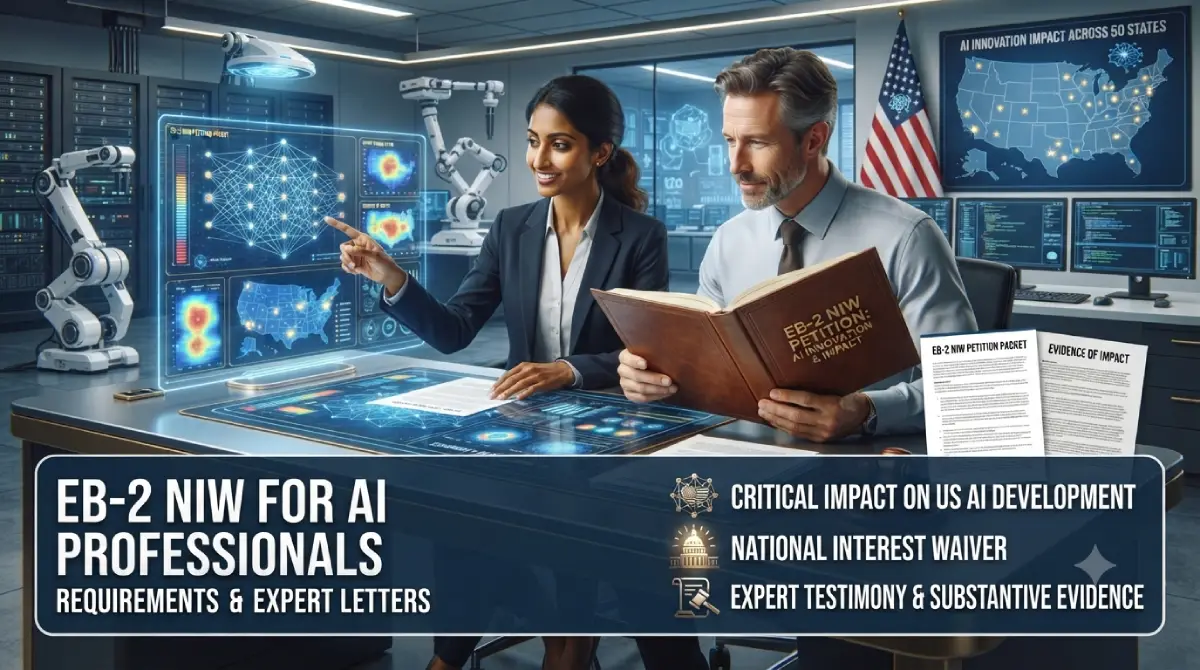
Artificial intelligence is transforming industries across the United States, from healthcare and financial services to cybersecurity, manufacturing, transportation, and scientific research. Professionals developing AI technologies, machine learning systems, and advanced data solutions may be able to use their expertise to support an EB-2 National Interest Waiver (NIW) petition.
However, working in artificial intelligence does not automatically qualify someone for an EB-2 NIW. Applicants must meet the underlying EB-2 eligibility requirements and demonstrate that their specific proposed endeavor satisfies the three-prong framework established in Matter of Dhanasar.
For AI professionals, this means explaining more than their programming skills, job title, or experience with machine learning. They must show what they intend to accomplish, why the proposed work matters, and how their education, technical achievements, and professional experience position them to advance it.
This guide explains EB-2 NIW requirements for AI professionals, examples of proposed endeavors, supporting evidence, and the role of independent expert opinion letters. It also explains how EEE of America supports applicants through professional evaluation and expert opinion letter services.
Can AI Professionals Apply for an EB-2 NIW?
Yes. Artificial intelligence professionals may apply for an EB-2 NIW if they meet the relevant immigration requirements.
Potential applicants include:
- Artificial intelligence engineers
- Machine learning engineers
- AI researchers and scientists
- Data scientists
- Deep learning specialists
- Natural language processing (NLP) engineers
- Computer vision specialists
- Robotics and autonomous systems engineers
- AI cybersecurity professionals
- AI product developers and technical entrepreneurs
Applicants may work in universities, research laboratories, technology companies, healthcare organizations, financial institutions, startups, or other industries.
The important distinction is that USCIS evaluates the applicant’s qualifications and proposed endeavor, not simply the popularity or commercial importance of artificial intelligence.
EB-2 NIW Eligibility Requirements for AI Professionals
Before requesting a National Interest Waiver, an applicant must first qualify under the underlying EB-2 immigrant classification.
There are two primary ways to establish this eligibility.
1. Advanced Degree Professional
An AI professional may qualify as an advanced degree professional by holding:
- A U.S. master’s degree or higher; or
- A foreign equivalent degree; or
- A U.S. bachelor’s degree or foreign equivalent followed by at least five years of progressive post-baccalaureate experience in the specialty.
For example, a machine learning engineer with a bachelor’s degree in computer science and five years of progressive professional experience may potentially qualify under the bachelor’s-plus-five-years pathway, depending on the documentation and applicable requirements.
Applicants with degrees earned outside the United States may need a professional foreign credential evaluation to establish the U.S. equivalency of their education.
EEE of America provides international education evaluation services for individuals who need their foreign academic qualifications assessed for U.S. purposes.
2. Individual of Exceptional Ability
AI professionals who do not qualify through the advanced degree pathway may be able to qualify through exceptional ability in the sciences, arts, or business.
The regulations identify six categories of evidence:
- An academic record relating to the area of exceptional ability.
- At least ten years of full-time experience in the occupation.
- A professional license or certification, where applicable.
- Evidence of a salary or other remuneration demonstrating exceptional ability.
- Membership in professional associations.
- Recognition for achievements and significant contributions by peers, government entities, or professional or business organizations.
Applicants generally need to satisfy at least three of these evidentiary categories or submit qualifying comparable evidence where permitted. USCIS then evaluates the evidence as a whole to determine whether the applicant meets the exceptional ability standard.
Meeting three categories alone does not automatically establish eligibility.
The Three EB-2 NIW Requirements for AI Professionals
After establishing eligibility for the EB-2 classification, applicants must satisfy the three requirements established in Matter of Dhanasar, 26 I&N Dec. 884 (AAO 2016).
These requirements are:
- The proposed endeavor has substantial merit and national importance.
- The applicant is well positioned to advance the proposed endeavor.
- On balance, it would benefit the United States to waive the job offer and labor certification requirements.
Each requirement needs a clear explanation supported by relevant evidence.
1. Demonstrating Substantial Merit and National Importance
The first requirement focuses on the applicant’s specific proposed endeavor.
AI is used in many important industries, but an applicant cannot establish national importance simply by stating that artificial intelligence is a growing technology or that their work involves machine learning.
The petition should identify the specific problem the applicant intends to address, the technology or research they plan to develop, and the potential impact of that work.
Examples of EB-2 NIW Proposed Endeavors for AI Professionals
The following examples illustrate possible areas of work. They are not automatically qualifying endeavors. Each applicant must establish the significance of their own proposed work.
AI in Healthcare and Medical Research
AI professionals may develop technologies that support medical research, healthcare operations, diagnostic assistance, and patient care.
Possible proposed endeavors include:
- Developing machine learning systems to assist with medical image analysis.
- Improving AI-based tools for early disease detection.
- Building predictive models that help healthcare providers identify patient risks.
- Developing technologies for analyzing large medical datasets.
- Improving clinical research through responsible AI applications.
Applicants should explain the intended application, the technical problem being addressed, and the potential benefits supported by their evidence.
AI and Cybersecurity
Cybersecurity is another area where AI professionals may pursue work with broader implications.
Potential endeavors include:
- Developing AI-based systems to identify cyber threats.
- Improving automated threat detection and incident response.
- Building machine learning models for identifying unusual network activity.
- Developing tools to protect sensitive information and digital infrastructure.
- Improving the detection of sophisticated cyberattacks.
Evidence may include technical research, deployed systems, security testing results, patents, and documentation of previous contributions.
AI for Critical Infrastructure
AI technologies can support the monitoring and management of infrastructure systems.
Possible endeavors include:
- Developing predictive maintenance systems for power infrastructure.
- Improving transportation monitoring and safety technologies.
- Creating AI tools for industrial equipment monitoring.
- Developing models for detecting infrastructure failures.
- Improving operational efficiency in essential public and industrial systems.
The applicant should explain how the specific system or technology could contribute to a broader infrastructure need.
AI in Manufacturing and Industrial Automation
AI professionals working in manufacturing may focus on improving production systems, quality control, and industrial efficiency.
Potential endeavors include:
- Developing machine learning models for predictive maintenance.
- Improving automated quality inspection.
- Creating intelligent robotics and production systems.
- Reducing manufacturing defects through computer vision.
- Improving industrial energy efficiency through data-driven optimization.
Useful evidence may include implementation reports, product performance data, project records, patents, and technical documentation.
Natural Language Processing and Generative AI
Professionals working in NLP and generative AI may develop technologies that improve how organizations process information, communicate, and use data.
Possible endeavors include:
- Developing specialized language models for technical or scientific applications.
- Improving information extraction from complex documents.
- Creating AI tools for multilingual communication.
- Developing systems for analyzing large research datasets.
- Improving the reliability and safety of AI-generated information.
Applicants should identify the actual technical contribution rather than relying on broad statements about the growth of generative AI.
AI for Scientific Research and Advanced Computing
AI researchers may also pursue work that supports scientific discovery and technical innovation.
Examples include:
- Developing machine learning methods for scientific simulations.
- Applying AI to materials discovery.
- Building models for climate and environmental research.
- Improving computational methods for drug discovery.
- Developing advanced algorithms for complex engineering problems.
Research publications, citations, collaborations, technical results, and evidence of potential applications may help establish the importance of the proposed work.
2. Demonstrating That You Are Well Positioned to Advance the Endeavor
The second Dhanasar requirement focuses on the applicant’s ability to carry out the proposed work.
AI professionals should demonstrate how their education, technical knowledge, previous achievements, and professional experience prepare them to advance the specific endeavor described in their petition.
A job title such as AI engineer or data scientist is not enough by itself. The petition should explain the applicant’s actual contributions and provide supporting documentation.
Academic Qualifications and Technical Training
Relevant academic evidence may include:
- Bachelor’s, master’s, and doctoral degrees.
- Academic transcripts.
- Computer science or engineering qualifications.
- Research degrees in artificial intelligence or data science.
- Relevant technical certifications.
- Foreign credential evaluation reports, where applicable.
Applicants should connect their education to the technical requirements of the proposed endeavor.
AI Research and Publications
AI professionals involved in academic or industrial research may use:
- Peer-reviewed journal articles.
- Conference papers.
- Research reports.
- Citation records.
- Technical publications.
- Research collaboration documentation.
Publications may demonstrate research activity and technical contributions. However, a publication list alone does not establish that the applicant is well positioned to advance the proposed endeavor.
The petition should explain the relevance of the research and the applicant’s individual contribution.
Patents and AI Innovations
Patents and documented innovations can help establish an applicant’s technical achievements.
Examples include:
- Granted AI-related patents.
- Published patent applications.
- Machine learning algorithms.
- Computer vision technologies.
- AI-powered software systems.
- Proprietary technical methods.
- Evidence of product implementation or commercialization.
A patent is not automatically proof of national importance. Its technical significance, practical applications, and relationship to the proposed endeavor should be explained.
Professional Experience and Project Contributions
AI professionals may have valuable experience even without academic publications or patents.
Relevant evidence can include:
- Machine learning model development.
- AI product development.
- Data science projects.
- Enterprise AI implementation.
- Technical leadership.
- Research and development responsibilities.
- AI system deployment and performance results.
Applicants should describe what they personally contributed, which technical challenges they addressed, and what results were achieved.
For example, stating that an applicant worked on an AI platform is less informative than explaining that they designed a particular model, developed its training methodology, improved its performance, or led its implementation.
Awards, Grants, and Professional Recognition
Recognition from professional organizations, research institutions, employers, or industry groups may help demonstrate an applicant’s achievements.
Examples include:
- AI research awards.
- Innovation competitions.
- Research grants.
- Technical conference recognition.
- Professional honors.
- Invitations to review research papers.
- Recognition from industry experts.
The petition should explain the importance and selection criteria of each award or recognition.
3. Explaining Why Waiving the Job Offer Requirement Would Benefit the United States
The third Dhanasar requirement asks whether, on balance, it would benefit the United States to waive the job offer and labor certification requirements.
AI professionals should explain why their specific qualifications and proposed work support granting the waiver.
For example, an AI researcher may plan to collaborate with multiple research institutions. An AI entrepreneur may intend to develop a specialized technology through a new business. An experienced machine learning professional may plan to work across several projects involving different organizations.
The petition should explain the actual nature of the proposed endeavor and why the applicant’s contributions may benefit the United States under the circumstances.
Supporting evidence may include:
- A detailed professional or research plan.
- Evidence of progress toward the proposed endeavor.
- Research collaborations.
- Letters of interest from relevant organizations.
- Potential customers, users, or investors.
- Documentation of technical partnerships.
- Evidence of the broader applications of the proposed technology.
Simply stating that AI is important to the U.S. economy or that the applicant wants to work independently does not establish this requirement.
What Evidence Can AI Professionals Submit for EB-2 NIW?
The evidence depends on the applicant’s background, qualifications, and proposed endeavor. The following documents may help build a well-supported petition.
| Evidence | What it may demonstrate |
|---|---|
| Academic degrees and transcripts | Educational qualifications |
| Credential evaluation | U.S. equivalency of foreign education |
| Employment verification letters | Professional experience and responsibilities |
| AI project reports | Technical contributions and project outcomes |
| Research publications | Research activity and technical expertise |
| Citation records | Influence of published research |
| Patents and invention records | Technical innovation |
| AI product documentation | Development and implementation |
| Awards and professional recognition | Recognition of achievements |
| Conference presentations | Research and professional participation |
| Business or research plan | Proposed activities and future objectives |
| Collaboration or interest letters | Potential external support |
| Independent expert opinion letter | Professional analysis of the applicant’s work |
The evidence should be consistent with the proposed endeavor. A large collection of unrelated certificates or general recommendation letters may not address the specific requirements.
How an Independent Expert Opinion Letter Can Help AI Professionals
AI projects often involve specialized technical concepts that may be difficult for a non-specialist to evaluate.
For example, an applicant may have developed a machine learning architecture, improved an AI-based diagnostic system, or created a cybersecurity model. The technical importance of these contributions may not be immediately clear from a resume or project description.
An independent expert opinion letter can help explain the applicant’s technical work and its relevance to the proposed endeavor.
At EEE of America, expert opinion letters are prepared for employment-based immigration matters, including EB-2 NIW petitions.
What Should an AI Expert Opinion Letter Explain?
Depending on the applicant’s evidence, an effective letter may address:
The Expert’s Qualifications
The letter should establish why the expert has the academic background, research experience, or professional expertise to evaluate the applicant’s work.
The Applicant’s Technical Contributions
The expert may discuss specific AI projects, research findings, algorithms, software systems, patents, or other technical achievements.
The Significance of the Proposed Endeavor
The letter can explain the technical problem being addressed and why the proposed work may have broader relevance.
The Applicant’s Ability to Advance the Work
The expert may assess the applicant’s education, previous achievements, technical knowledge, and experience in relation to the proposed endeavor.
The Broader Importance of the Work
Where supported by the evidence, the expert can explain how the applicant’s work relates to areas such as healthcare, cybersecurity, infrastructure, scientific research, or U.S. technological competitiveness.
An expert opinion letter should provide independent, evidence-based professional analysis. It should not simply repeat the applicant’s resume or guarantee an immigration outcome.
Learn more about EB-2 NIW expert opinion letters from EEE of America.
You can also read our detailed guide on what an EB-2 NIW expert opinion letter should include.
Why the Expert’s Field Matters
An expert evaluating an AI professional’s work should have qualifications relevant to the technical subject being discussed.
For example:
- A machine learning researcher may be evaluated by an expert with relevant AI research experience.
- A cybersecurity AI developer may need an expert familiar with cybersecurity and machine learning applications.
- A computer vision specialist may benefit from an assessment by someone with relevant computer vision or image-processing expertise.
- An AI healthcare researcher may require an expert familiar with medical technology, computational research, or healthcare applications.
The expert’s credentials and the substance of the analysis both matter. A generic letter from someone with no relevant technical background may provide limited value.
Common EB-2 NIW Mistakes AI Professionals Should Avoid
Even highly experienced AI professionals can face challenges when preparing an NIW petition.
1. Assuming That Working in AI Guarantees Eligibility
Artificial intelligence is an important technology area, but employment in AI does not automatically establish national importance.
The applicant must explain the significance of the specific proposed endeavor.
2. Describing a Job Instead of a Proposed Endeavor
“I plan to work as a machine learning engineer” describes an occupation.
A stronger proposed endeavor identifies the particular technology, problem, research, or system the applicant intends to develop and explains its potential impact.
3. Listing Technical Skills Without Demonstrating Results
Knowing Python, TensorFlow, PyTorch, or other AI tools does not establish that an applicant has made significant contributions.
Explain how those skills were applied, what the applicant developed, and what results can be documented.
4. Relying Only on Publications or Patents
Publications and patents can be useful, but they are not universal requirements for EB-2 NIW.
Applicants should present a complete record of relevant achievements, including professional projects, implementation results, research, leadership, and recognition where applicable.
5. Using Generic Expert Opinion Letters
An effective letter should address the applicant’s actual technical contributions and proposed endeavor.
Generic praise without specific examples or evidence may have limited persuasive value.
6. Failing to Explain the National Importance of the Work
A project may be technically impressive but still require a clearer explanation of its broader relevance.
Applicants should identify the problem, the intended beneficiaries, and the potential impact of the proposed work.
How EEE of America Supports EB-2 NIW Applicants in AI and Technology
EEE of America provides foreign credential evaluations, work experience evaluations, position evaluations, and expert opinion letters for employment-based immigration matters.
For AI professionals, documenting academic qualifications and explaining specialized technical contributions can be important parts of preparing an immigration petition.
EEE of America offers relevant services, including:
- EB-2 NIW expert opinion letters: Independent professional analysis of an applicant’s qualifications, technical contributions, and proposed endeavor.
- Education evaluations: Assessment of foreign academic credentials for U.S. equivalency.
- Work experience evaluations: Evaluation of professional experience where relevant to the immigration requirements.
- Position evaluations: Professional analysis of job duties and position requirements for applicable employment-based petitions.
- Certified translations: Translation of academic and other supporting documents.
You can review the expert opinion letter services and education evaluation services offered by EEE of America.
For service details and current fees, visit the EEE of America pricing page.
Additional Resources From AAE Evaluations
Applicants researching EB-2 NIW may also find these resources from AAE Evaluations useful:
- EB-2 NIW expert opinion letter requirements
- EB-2 NIW proposed endeavor examples
- EB-2 NIW expert opinion letter sample and format
- EB-2 NIW expert opinion letter for RFE
- EB-2 NIW expert opinion letter service
These resources provide additional information about NIW documentation, proposed endeavors, and independent professional evaluations.
Frequently Asked Questions About EB-2 NIW for AI Professionals
Can AI engineers qualify for an EB-2 NIW?
Yes. AI engineers may qualify if they meet the underlying EB-2 requirements and demonstrate that their proposed endeavor satisfies all three Dhanasar prongs. Their specific technical contributions, professional background, and future plans are important parts of the evaluation.
Do AI professionals need a PhD for EB-2 NIW?
No. A PhD is not a universal requirement. Applicants may qualify through a master’s degree, a bachelor’s degree followed by at least five years of progressive post-baccalaureate experience in the specialty, or the exceptional ability pathway, depending on their circumstances.
Can machine learning engineers apply for an EB-2 NIW?
Yes. Machine learning engineers may apply if they satisfy the applicable EB-2 and NIW requirements. Their proposed work could involve predictive analytics, cybersecurity, healthcare technology, industrial automation, or other relevant applications.
Can AI professionals apply without research publications?
Yes. Research publications are not a universal EB-2 NIW requirement. Applicants may submit other evidence, such as patents, software development achievements, professional project records, technical innovations, awards, and documented industry contributions.
Are expert opinion letters required for an EB-2 NIW petition?
No. An expert opinion letter is not a universal statutory requirement for every EB-2 NIW petition. However, an independent expert assessment may help explain specialized technical work and the significance of the applicant’s proposed endeavor.
Can an AI entrepreneur qualify for an EB-2 NIW?
Potentially. An AI entrepreneur may pursue an EB-2 NIW if they meet the underlying EB-2 classification requirements and establish that their specific proposed endeavor satisfies the three Dhanasar prongs. A business plan alone does not guarantee eligibility; evidence of progress, technical qualifications, market interest, and potential impact may also be relevant.
Does working in a critical AI technology field guarantee approval?
No. Work involving advanced or critical technologies may be relevant to the national importance analysis, but it does not automatically establish eligibility. USCIS evaluates the complete petition, including the proposed endeavor, the applicant’s qualifications, and the benefit of waiving the job offer requirement.
How can EEE of America help with an AI-related EB-2 NIW petition?
EEE of America offers expert opinion letters and evaluation services for employment-based immigration matters. Depending on the applicant’s needs, these services may help document academic qualifications, professional experience, and specialized technical contributions.
Prepare a Stronger EB-2 NIW Case as an AI Professional
Artificial intelligence professionals may have valuable experience in machine learning, deep learning, cybersecurity, healthcare technology, automation, and advanced research. However, a strong EB-2 NIW petition must explain how the applicant’s specific work may benefit the United States.
The petition should connect the proposed endeavor to a meaningful problem, demonstrate the applicant’s ability to advance that work, and explain why waiving the job offer and labor certification requirements would benefit the country.
Independent expert analysis can help clarify complex AI contributions and provide professional context for the evidence submitted with the petition.
If you are an AI engineer, researcher, machine learning specialist, or technology entrepreneur preparing an EB-2 NIW petition, explore EEE of America’s EB-2 NIW expert opinion letter services to learn more about professional evaluation support.
Disclaimer: This article is for general educational purposes and does not constitute legal advice. EB-2 NIW eligibility depends on the applicant’s individual qualifications, proposed endeavor, supporting evidence, and applicable immigration law. Consult a qualified U.S. immigration attorney for case-specific legal advice.