
Levels of Education in the USA: School System, Grades and Degrees Explained
The United States has one of the world’s largest and most diverse education systems. From preschool classrooms to research universities, students can follow different academic pathways depending on their age, interests, career goals, and educational background.
Unlike countries with a single national school curriculum, the U.S. education system is largely governed by states and local school districts. This means that grade arrangements, compulsory attendance ages, graduation requirements, and assessment methods can differ across the country.
Despite these variations, American education generally follows a recognizable progression: early childhood education, elementary school, middle school, high school, and postsecondary education.
According to the National Center for Education Statistics (NCES), approximately 49.4 million students were enrolled in U.S. public schools from prekindergarten through Grade 12 in fall 2024. This figure excludes students attending private schools and some other educational arrangements.
Understanding the levels of education in the USA is particularly useful for international students, parents, and professionals who need to compare American qualifications with those earned in other countries.
What Are the Five Levels of Education in the USA?
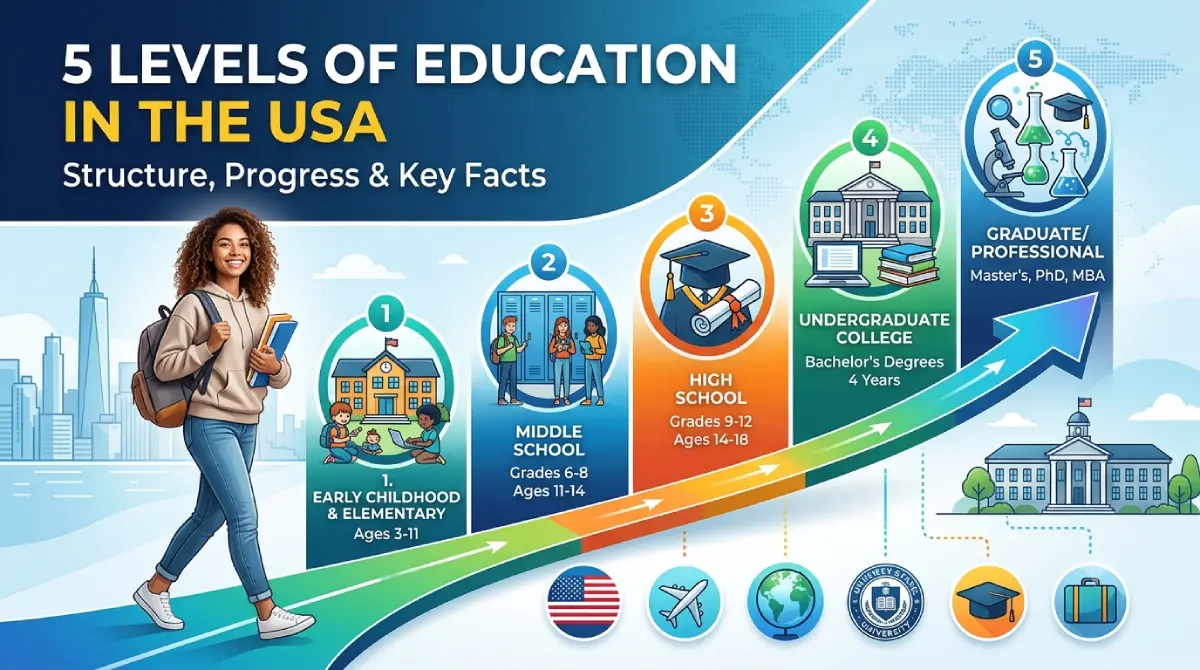
For a practical overview, the American education system can be divided into five broad stages.
| Education Level | Typical Grades or Programs | Approximate Age | Duration |
|---|---|---|---|
| Early childhood education | Preschool and kindergarten | 3–6 | Varies |
| Elementary education | Grades K–5 or K–6 | 5–12 | 6–7 years |
| Middle school education | Grades 6–8 or 7–8 | 11–14 | 2–3 years |
| High school education | Grades 9–12 | 14–18 | 4 years |
| Postsecondary education | Certificates, associate, bachelor’s, graduate and professional degrees | Usually 18+ | Varies |
These are descriptive categories rather than five nationally mandated levels. Some school districts use different arrangements, such as K–8 schools or junior high schools covering Grades 7–9.
The term K–12 education refers to kindergarten through twelfth grade, representing the main sequence of elementary and secondary schooling before college.
The United States does not have one nationwide rule requiring every student to complete precisely the same number of school years. States determine compulsory attendance requirements, and students may have access to alternative educational pathways.
Level 1: Early Childhood Education in the USA
Early childhood education introduces young children to structured learning before they enter the later elementary grades.
Programs typically serve children between ages three and five, although some early learning services begin earlier.
The objective is not simply to teach children to read or count. Early education also helps develop communication, emotional regulation, social interaction, physical coordination, and readiness for classroom learning.
Preschool and Prekindergarten
Preschool programs may be operated by public schools, private providers, nonprofit organizations, or community institutions.
Some states and school districts offer publicly funded prekindergarten programs, while others rely more heavily on private or income-based options.
A typical preschool learning environment includes:
- Early language and vocabulary development
- Recognition of numbers, shapes, and patterns
- Creative activities and storytelling
- Cooperative play and social interaction
- Physical coordination and motor skills
- Early problem-solving and independent routines
Preschool attendance is not universally compulsory across the United States.
According to the U.S. Census Bureau’s 2024 School Enrollment Supplement, 58.8% of children ages three to four were enrolled in school in 2024. This statistic reflects enrollment in early educational programs, not a national preschool attendance requirement.
Head Start and Early Head Start
Head Start is a federally funded program designed to support eligible young children and families.
It combines early learning with services related to children’s health, development, and family well-being.
Head Start generally serves preschool-age children, while Early Head Start supports eligible infants, toddlers, and pregnant women.
Eligibility and program availability depend on federal rules and local providers.
Kindergarten
Kindergarten is commonly the first year of the K–12 system, and children typically enter around age five.
Its legal status varies by state. Some states require kindergarten attendance, while others do not, even though public school systems widely offer it.
Kindergarten instruction generally introduces foundational literacy, early mathematics, classroom routines, social skills, and age-appropriate science and social studies concepts.
Children learn through a combination of direct instruction, guided activities, and play-based experiences.
Level 2: Elementary Education in the USA
Elementary school establishes the academic foundation students need for later schooling.
Most American children begin elementary education with kindergarten or Grade 1, depending on the school’s organizational structure.
Elementary schools commonly cover kindergarten through Grade 5 or Grade 6, although other arrangements exist.
Elementary School Grades and Ages
| Grade | Typical Age |
|---|---|
| Kindergarten | 5–6 |
| Grade 1 | 6–7 |
| Grade 2 | 7–8 |
| Grade 3 | 8–9 |
| Grade 4 | 9–10 |
| Grade 5 | 10–11 |
| Grade 6 | 11–12 |
These ages are approximate. A student’s exact age within a grade depends on school-entry cutoff dates and individual circumstances.
Core Subjects in Elementary School
Although individual states establish their own academic standards, elementary education commonly includes several core subjects.
English Language Arts
Students develop reading comprehension, vocabulary, writing, speaking, and listening skills. Instruction progresses from early phonics and word recognition to interpreting increasingly complex texts.
Mathematics
Elementary mathematics generally covers counting, arithmetic, fractions, measurement, geometry, and introductory data interpretation.
Instruction increasingly emphasizes explaining mathematical reasoning and applying concepts to practical situations.
Science
Students explore topics related to living organisms, physical science, Earth systems, and the natural environment.
Hands-on investigations may help students understand observation, evidence, and scientific reasoning.
Social Studies
Social studies introduces geography, communities, history, government, citizenship, and basic economic concepts.
Students gradually learn how individuals, institutions, and societies interact.
Arts, Physical Education, and Technology
Many schools also provide music, visual arts, physical education, health education, and technology-related learning.
Course availability and instructional time depend on state requirements and district resources.
Elementary School Assessment
Elementary schools use multiple approaches to evaluate learning.
These may include classroom assignments, quizzes, projects, teacher observations, reading assessments, and state-required standardized tests.
Under federal education law, states generally administer annual reading/language arts and mathematics assessments in Grades 3–8, with additional requirements for science testing at specified grade spans.
However, not every elementary school uses the same grading scale or report card format.
Some schools provide traditional letter grades, while others use standards-based reporting to describe how well students have mastered specific skills.
Social Development and Extracurricular Activities
Elementary education also supports children’s development outside academic subjects.
Students may participate in sports, music, art, school clubs, community activities, and collaborative projects.
These opportunities can strengthen communication, teamwork, confidence, and a sense of belonging.
The availability of extracurricular programs varies among public schools, private schools, and local districts.
Level 3: Middle School Education in the USA
Middle school provides the transition between elementary education and high school.
The most common structure covers Grades 6–8, serving students approximately 11–14 years old.
Some districts instead operate junior high schools covering Grades 7–8 or 7–9.
During this stage, students encounter more advanced academic expectations and begin taking greater responsibility for their education.
Middle School Curriculum
Unlike many elementary classrooms, where one teacher may teach several subjects, middle school students typically move between classes taught by subject specialists.
Common subjects include:
- English language arts and literature
- Mathematics, including pre-algebra or algebra where appropriate
- Life, physical, and Earth sciences
- U.S. and world history
- Geography and civics
- Physical education and health
- Arts, technology, and elective subjects
Students may also have opportunities to study world languages, computer science, robotics, or career exploration.
Academic Progression and Advanced Courses
Middle school helps students prepare for the academic requirements of high school.
Course placement may depend on previous achievement, teacher recommendations, assessments, and district policies.
For example, some students complete Algebra I during middle school, while others take it in high school.
Advanced coursework can affect future course sequencing, but middle school programs do not operate under a single nationwide model.
Student Development and School Activities
Middle school coincides with a period of significant personal and social development.
Schools often provide counseling, academic guidance, clubs, sports, and other activities that help students manage changing expectations.
Participation in these programs can help students explore interests and develop skills useful during high school.
Level 4: High School Education in the USA
High school is the final stage of the traditional K–12 education sequence.
Most American high schools cover Grades 9–12, with students generally attending between ages 14 and 18.
Unlike elementary and middle school, high school programs place greater emphasis on graduation credits, course selection, academic records, and preparation for college or employment.
High School Grades Explained
| Grade | Common Name | Typical Age |
|---|---|---|
| Grade 9 | Freshman | 14–15 |
| Grade 10 | Sophomore | 15–16 |
| Grade 11 | Junior | 16–17 |
| Grade 12 | Senior | 17–18 |
These terms are widely used in American schools and colleges.
High School Graduation Requirements
Students generally must earn a specified number of academic credits to receive a high school diploma.
Requirements vary by state and district and may include English, mathematics, science, social studies, physical education, health, and electives.
Some states or school systems also require particular assessments, projects, or other graduation conditions.
There is no single nationwide high school credit requirement that applies to every student.
Core High School Subjects
English: Literature, composition, communication, and analytical reading.
Mathematics: Algebra, geometry, advanced algebra, statistics, precalculus, or calculus, depending on course availability and student progression.
Science: Biology, chemistry, physics, environmental science, and other laboratory or general science courses.
Social Studies: U.S. history, world history, government, civics, geography, and economics.
Electives: World languages, computer science, business, arts, journalism, engineering, and other subjects.
Advanced Placement and International Baccalaureate
Some high schools offer academically advanced programs.
Advanced Placement (AP) courses allow students to study college-level material and take corresponding AP examinations.
Colleges may award credit or advanced placement based on examination results, but policies differ among institutions.
The International Baccalaureate (IB) Diploma Programme is another academically demanding option available at participating schools.
Students should verify how their intended universities recognize AP or IB qualifications.
Career and Technical Education
Career and Technical Education (CTE) provides opportunities to explore occupational fields while completing secondary education.
Programs may include information technology, healthcare, manufacturing, business, agriculture, and other career areas.
Depending on the program, students may gain practical experience, pursue industry-recognized credentials, or participate in work-based learning.
CTE can prepare students for employment, apprenticeships, community college, or four-year degree programs.
High School Diploma and GED
A traditional high school diploma is awarded after a student satisfies the graduation requirements of an authorized school.
The GED is a high school equivalency testing pathway used in participating jurisdictions.
Although both may support access to further education or employment, they are not identical credentials.
GED eligibility, testing requirements, and recognition depend on state rules and the receiving organization.
Level 5: Postsecondary Education in the USA
Postsecondary education includes educational programs pursued after high school.
It is broader than university education alone. Students may attend community colleges, four-year universities, technical institutions, trade schools, or other approved training providers.
The United States offers several types of academic degrees and nondegree credentials.
Community Colleges and Associate Degrees
Community colleges commonly provide two-year associate degree programs, certificate programs, workforce training, and pathways to four-year universities.
Two common associate degree categories are:
- Associate of Arts (AA), often associated with general education and transfer-oriented studies.
- Associate of Science (AS), often focused on science, mathematics, or related academic disciplines.
Associate of Applied Science (AAS) programs commonly emphasize occupational or technical preparation.
An associate degree often requires approximately 60 semester credits, although the exact requirement varies.
Many students begin at community colleges before transferring to a university to complete a bachelor’s degree.
Transfer credit acceptance is determined by the receiving institution.
Bachelor’s Degree
A bachelor’s degree is an undergraduate qualification typically completed after four years of full-time study.
Common degree titles include Bachelor of Arts (BA), Bachelor of Science (BS), and Bachelor of Business Administration (BBA).
Many programs require approximately 120 semester credits, but engineering, architecture, and other specialized programs may have different requirements.
Students usually complete a combination of general education courses, major requirements, and electives.
Master’s Degree
A master’s degree is a graduate-level qualification typically pursued after completing a bachelor’s degree.
Programs may focus on advanced professional knowledge, academic specialization, research, or a combination of these.
Common examples include:
- Master of Arts (MA)
- Master of Science (MS)
- Master of Business Administration (MBA)
- Master of Education (MEd)
Some master’s programs can be completed in approximately one year, while others take two years or longer.
Credit requirements depend on the institution, subject, and degree structure.
Doctoral and Professional Degrees
Doctoral education represents an advanced level of academic or professional study.
Research doctorates, such as the Doctor of Philosophy (PhD), generally involve advanced coursework, research, and a dissertation or equivalent scholarly work.
Professional degrees prepare graduates for particular occupations and may include qualifications such as the Doctor of Medicine (MD) or Juris Doctor (JD).
These programs have distinct admission requirements, durations, and licensing implications.
A professional doctorate should not automatically be treated as equivalent to a research PhD simply because both use doctoral-level titles.
Vocational and Technical Education
Trade and technical institutions provide specialized training for particular occupations.
Programs may lead to certificates, diplomas, apprenticeships, or associate degrees.
Training duration can range from a few months to several years, depending on the occupation and credential.
Students should examine institutional accreditation, program approval, licensing requirements, and employment outcomes before enrolling.
Understanding College Credits and Academic Degrees
The American higher education system commonly measures coursework using academic credits.
A semester credit represents a defined amount of academic work, although exact credit-hour policies and instructional formats vary.
A typical full-time undergraduate student may complete approximately 15 semester credits per term.
At that pace, a 120-credit bachelor’s program could be completed in eight semesters, assuming all required courses are available and successfully completed.
However, credit totals alone do not determine degree equivalency.
For example, a three-year bachelor’s degree earned abroad is not automatically equivalent—or automatically nonequivalent—to a four-year American bachelor’s degree.
A meaningful comparison may consider the awarding institution, entry requirements, academic level, program duration, curriculum, and recognition within the original education system.
International applicants who need their qualifications assessed can explore foreign credential evaluation to understand the general process of comparing qualifications across education systems.
How Much Does Education Cost in the USA?
The cost of education varies significantly by educational level, institution type, location, and residency status.
Public elementary and secondary schools generally provide tuition-free education to eligible students residing in their districts.
Private K–12 schools may charge tuition, while public preschool availability and costs differ across states.
At the postsecondary level, tuition and living expenses are major considerations.
Average U.S. College Tuition for 2025–26
According to the College Board’s Trends in College Pricing and Student Aid 2025 report, average published undergraduate tuition and fees for the 2025–26 academic year were:
| Institution Type | Average Annual Tuition and Fees |
|---|---|
| Public two-year, in-district | $4,150 |
| Public four-year, in-state | $11,950 |
| Public four-year, out-of-state | $31,880 |
| Private nonprofit four-year | $45,000 |
Source: College Board, Trends in College Pricing and Student Aid 2025. These are published tuition and fee averages, not total attendance costs.
The actual cost of attendance may also include housing, food, books, transportation, insurance, and personal expenses.
For 2025–26, the College Board estimated average annual student budgets of $30,990 for in-state students at public four-year institutions and $65,470 for students at private nonprofit four-year institutions.
Financial aid can reduce the amount students ultimately pay.
International students should be especially careful when comparing published tuition, nonresident tuition, and institution-specific scholarship offers.
Financial Aid and Scholarships for International Students
International students may have access to scholarships and other funding opportunities, but eligibility differs from that of U.S. citizens and eligible noncitizens.
Most students studying in the United States on F-1 or J-1 visas are not eligible for federal student aid.
However, other funding sources may be available.
Merit-Based Scholarships
These awards may consider academic achievement, examination results, leadership, artistic ability, athletic performance, or other accomplishments.
Selection requirements and award values depend on the institution or sponsoring organization.
Need-Based Institutional Aid
Some U.S. colleges and universities offer financial assistance to international applicants based on demonstrated financial need.
Institutions may require financial documents or applications such as the CSS Profile or their own international financial aid forms.
Not all universities offer need-based funding to international students.
Graduate Assistantships
Eligible graduate students may receive teaching or research assistantships that provide a stipend, tuition support, or other benefits.
Availability depends on the academic department, funding, and university policies.
External Scholarships and Education Loans
Students may also investigate scholarships from foundations, governments, and private organizations.
Education loans for international students may have additional eligibility requirements, including a qualified cosigner in some cases.
Applicants should compare funding terms carefully and avoid assuming that scholarships will cover all living expenses.
Academic Year and School Calendar in the USA
American school calendars differ between K–12 schools and colleges.
Elementary and Secondary School Calendar
Most K–12 schools begin their academic year in August or September and finish in May or June.
The exact schedule depends on the district and state.
Many schools operate for approximately 180 instructional days, although state requirements vary.
Common breaks include winter vacation, spring break, and summer vacation.
Some districts use year-round or modified calendars.
College and University Academic Calendar
U.S. colleges commonly use semester, quarter, or trimester systems.
| Calendar System | Typical Structure |
|---|---|
| Semester | Two principal terms, usually fall and spring |
| Quarter | Commonly fall, winter, spring, and an optional summer term |
| Trimester | Three academic terms during the year |
Semester-based institutions commonly begin their fall term in August or September and their spring term in January.
Universities may also offer summer sessions, accelerated courses, or alternative academic calendars.
Understanding these arrangements is important for international students because admission deadlines, academic transcripts, and credit systems may not align directly with those in their home countries.
Grading System in the USA
American schools and universities commonly use letter grades to report academic performance.
However, the United States does not have one mandatory grading scale for every educational institution.
A commonly used college GPA framework assigns the following grade points:
| Letter Grade | Typical Grade Points |
|---|---|
| A | 4.0 |
| B | 3.0 |
| C | 2.0 |
| D | 1.0 |
| F | 0.0 |
Schools may use plus and minus grades, alternative scales, pass/fail systems, or standards-based assessment.
Percentage cutoffs can also differ. An A at one institution may begin at 90%, while another may use a different threshold.
What Is GPA?
Grade Point Average (GPA) summarizes academic performance using grade points, often weighted by course credits.
For example, if a student earns an A in a three-credit course and a B in another three-credit course, the GPA for those two courses is:
(4.0 × 3 + 3.0 × 3) ÷ 6 = 3.5 GPA
Some high schools use weighted GPAs that award additional points for advanced courses.
Because grading policies vary, international transcripts should not be converted to a U.S. GPA using a universal percentage formula without examining the original grading system.
For more detailed information, read EEE of America’s guide to the American grading system.
How International Education Credentials Compare With U.S. Education Levels
Education systems around the world use different grade structures, degree durations, examination systems, and academic calendars.
A qualification’s title alone may not reveal how it compares with an American credential.
For example, a secondary school certificate from one country may represent 10 years of formal schooling, while another country’s upper-secondary qualification may follow 12 or 13 years of study.
Similarly, bachelor’s degrees may differ in program length, entry requirements, and academic content.
These differences can affect university admissions, employment applications, professional licensing, and other decisions involving foreign qualifications.
What Is an Education Credential Evaluation?
An education credential evaluation is a professional assessment of academic qualifications earned in another educational system.
Depending on the report type, it may describe the awarding institution, level of study, duration, qualification earned, and U.S. educational comparability.
EEE of America provides education evaluation services for individuals who need their international qualifications assessed for U.S.-related purposes.
Applicants should confirm the receiving organization’s requirements before selecting an evaluation service.
When Is a Course-by-Course Evaluation Needed?
A course-by-course evaluation provides a more detailed analysis of academic records.
It may include individual subjects, grades, credits, and a calculated U.S.-style GPA.
This type of report may be requested for university admission, transfer-credit review, or certain professional licensing applications.
Students who need detailed academic analysis can review EEE of America’s course-by-course evaluation services.
An evaluation can support the receiving institution’s review, but it does not guarantee admission, transfer-credit acceptance, licensing, or employment.
Frequently Asked Questions About Education Levels in the USA
1. What are the five main levels of education in the USA?
A useful five-stage classification is early childhood education, elementary school, middle school, high school, and postsecondary education. The United States does not legally require every institution to use these exact five categories.
2. What is K–12 education in the United States?
K–12 refers to kindergarten through Grade 12. It covers the main sequence of elementary and secondary schooling before postsecondary education.
3. At what age do children start school in the USA?
Children commonly begin kindergarten around age five and Grade 1 around age six. Entry requirements and cutoff dates vary by state and district.
4. How many years is high school in the USA?
High school typically lasts four years, covering Grades 9 through 12. Some districts organize secondary schooling differently.
5. Is education compulsory in the United States?
Yes, states have compulsory education laws, but the starting and ending ages vary. Not every state requires attendance through age 18, and lawful educational alternatives may be available.
6. What comes after high school in the USA?
Students may pursue certificates, vocational training, apprenticeships, associate degrees, bachelor’s degrees, or other educational pathways.
7. What is the difference between an associate degree and a bachelor’s degree?
An associate degree typically requires around two years of full-time study, while a bachelor’s degree generally requires around four years. Actual credit and program requirements vary.
8. What is the highest academic degree in the USA?
A research doctorate, such as a PhD, is generally regarded as the highest research-oriented academic degree. The U.S. also offers advanced professional doctorates with different educational purposes.
9. Is the American grading system the same everywhere?
No. Letter grades and the 4.0 GPA scale are common, but percentage thresholds, weighted grades, academic honors, and other grading policies vary by institution.
10. Can foreign qualifications be compared with U.S. degrees?
Yes. Academic credential evaluations can assess foreign educational records and provide a statement of their U.S. comparability. Acceptance of the evaluation remains subject to the receiving organization’s policies.
Conclusion
The levels of education in the USA provide multiple routes from early learning to advanced academic and professional qualifications.
Elementary and middle school establish essential academic foundations, while high school introduces greater specialization and preparation for postsecondary opportunities.
After high school, students can choose from community colleges, universities, vocational institutions, apprenticeships, and other forms of education or training.
Although the American education system has a recognizable structure, important details vary by state, school district, and institution. Understanding these differences is essential when planning education, interpreting academic records, or comparing qualifications internationally.
For students and professionals educated outside the United States, understanding the American system is also a useful first step toward determining whether a formal credential evaluation is required.
Accurate information about school levels, degrees, credits, and grading practices helps students make informed educational decisions and navigate opportunities across international education systems.