
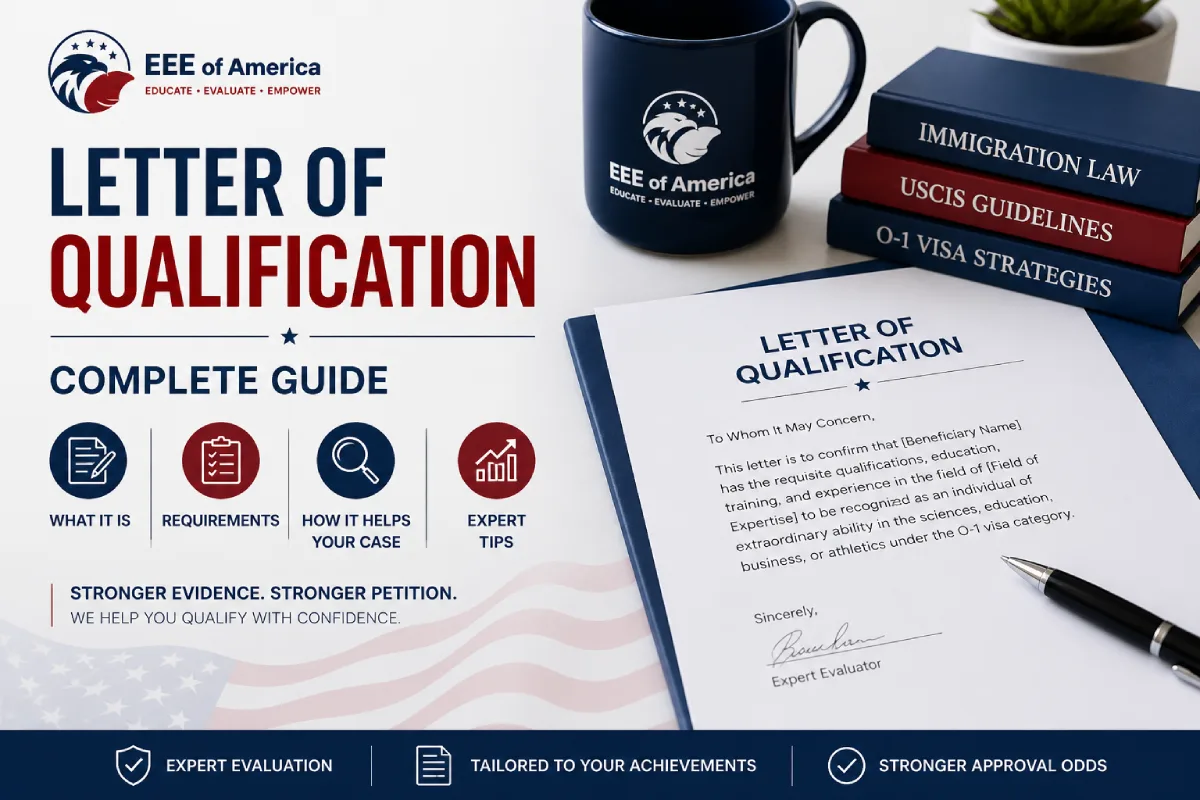
In a competitive job market, a resume alone rarely tells your full story. Employers reviewing dozens or hundreds of applications need more than a list of job titles and dates — they need to understand exactly how your qualifications map to the role they are trying to fill. That is the purpose of a letter of qualification.
A letter of qualification is a targeted, detailed document that demonstrates — point by point — how your education, skills, and professional experience align with every requirement of the position you are applying for. When written well, it does not just support your application. It makes the hiring committee’s decision significantly easier by giving them a clear, evidence-backed case for why you are the right choice.
This guide covers everything you need to know about letters of qualification — what they are, how they differ from cover letters, how to structure and write one effectively, and when credential documentation such as a foreign credential evaluation or work experience evaluation may be needed to substantiate your qualifications.
Contact EEE of America for credential support | View our services
What Is a Letter of Qualification?
A letter of qualification is a formal document submitted as part of a job application that provides a systematic account of how your background meets the stated requirements of the position. It goes well beyond a standard cover letter in both depth and purpose.
Where a cover letter introduces you and briefly expresses your interest in a role, a letter of qualification addresses every minimum and desired qualification listed in the job announcement — backed by specific examples from your education, training, and professional experience.
This document is particularly common in applications for government positions, civil service roles, regulated professions, and positions with defined eligibility criteria. In these contexts, hiring committees use the letter of qualification as a primary evaluation tool to determine whether a candidate is eligible to proceed to the interview stage.
A strong letter of qualification answers three questions the employer is asking about every applicant:
- Do you meet the minimum requirements for this role?
- Can you provide specific evidence of those qualifications?
- Does your background connect directly to the duties of this position?
Letter of Qualification vs. Cover Letter — Key Differences
Many applicants confuse the letter of qualification with a cover letter. While both are written documents submitted with a job application, they serve very different purposes and have different structures.
Scope
A cover letter is typically one page and provides a broad introduction to your candidacy. A letter of qualification is more detailed — often one to two pages — and systematically addresses every requirement listed in the job description.
Focus
A cover letter highlights your most relevant experiences and explains why you are interested in the role. A letter of qualification focuses exclusively on demonstrating that you meet each stated requirement, often structured as a point-by-point analysis of the job announcement.
Depth
A cover letter summarizes. A letter of qualification substantiates. Every claim you make should be backed by a specific example, a measurable result, or documented evidence of your background.
Purpose
The primary goal of a cover letter is to generate interest. The primary goal of a letter of qualification is to establish eligibility — to give the hiring committee the evidence they need to check off each requirement and confirm you qualify for consideration.
When Is a Letter of Qualification Required?
Letters of qualification are most commonly required or strongly recommended in the following situations:
Government and Civil Service Applications Federal, state, and local government job announcements frequently specify a statement of qualifications or letter of qualifications as a required component of the application package. In these cases, failure to submit one may result in automatic disqualification.
Regulated Professions Roles in healthcare, engineering, education, architecture, accounting, and law often have mandatory qualification criteria set by licensing boards or professional regulatory bodies. A letter of qualification demonstrates that your background meets those specific standards.
Positions with Detailed Eligibility Criteria Any job posting that lists highly specific minimum and desired qualifications — with distinct educational requirements, years of experience, or certification prerequisites — benefits from a letter of qualification that addresses each criterion individually.
International Applicants with Foreign Credentials If your academic credentials were earned outside the United States, a letter of qualification alone may not be sufficient. U.S. employers typically require a formal foreign credential evaluation that confirms the U.S. equivalency of your degree before they can verify that you meet the educational requirements of the role. EEE of America provides credential evaluations that are accepted by employers and licensing boards across the United States. See our education evaluations page for details.
Step 1 — Analyze the Job Description Thoroughly
Before writing a single word of your letter of qualification, spend time carefully analyzing the job posting. A superficial reading leads to a superficial letter. A thorough analysis allows you to build a document that speaks directly to what the employer needs.
When reviewing the job description, identify and list:
- Every stated minimum (required) qualification
- Every desired (preferred) qualification
- The primary duties and responsibilities of the role
- Any specific technical skills, certifications, or licenses mentioned
- Keywords and phrases that appear repeatedly in the posting
Once you have this list, cross-reference it against your own background. For each requirement, ask yourself: What specific evidence from my education, training, or professional history demonstrates that I meet this criterion?
Your letter of qualification should address every minimum qualification — not just the ones that are easiest to document. If you meet a desired qualification as well, include it. If there is a gap, you may be able to address it by citing related experience, transferable skills, or relevant training.
Note: Many employers use applicant tracking systems (ATS) to scan submitted documents before a human reviews them. Including the exact keywords and phrases from the job description in your letter of qualification improves the likelihood that your application passes this initial screening.
Step 2 — Research the Organization
A letter of qualification that demonstrates knowledge of the organization is significantly more compelling than one that focuses only on the job requirements. Take time to research the employer before you write.
Look into the organization’s mission, strategic priorities, values, and recent developments. Consider the following questions as you research:
- What are the organization’s current goals or challenges?
- What values guide their work?
- What kind of professional environment do they promote?
- Have they recently launched initiatives, programs, or projects that relate to the role you are applying for?
This information helps you frame your qualifications in terms of the employer’s actual needs — not just the requirements listed on paper. An applicant who understands the organization and can articulate how their background serves its specific goals stands apart from those who simply list their credentials.
Step 3 — Gather Your Qualifications and Supporting Evidence
With a clear picture of what the employer is looking for, compile the evidence you will use to substantiate each qualification. Be specific and concrete. Vague statements carry no weight in a letter of qualification.
Education and Academic Credentials List your degrees, fields of study, relevant coursework, and any certifications or licenses. If your degree was earned outside the United States, include documentation of its U.S. equivalency. A professional credential evaluation from EEE of America provides an official report confirming the U.S. equivalent of your foreign degree — a critical document when applying for roles that have specific educational requirements. See our course-by-course evaluation page if your application requires a detailed transcript analysis.
Professional Experience Document your relevant work history with specifics — not just job titles, but the duties you performed, the skills you applied, and the results you achieved. Wherever possible, quantify your contributions. Numbers, percentages, volumes, and measurable outcomes make your experience tangible and verifiable.
Skills and Technical Competencies Identify the technical and professional skills that are directly relevant to the role. For each skill, prepare a specific example from your experience that demonstrates your proficiency — not just a claim that you have the skill.
Certifications, Licenses, and Specialized Training Include any professional certifications, regulatory licenses, or specialized training programs that are relevant to the position. If these were obtained outside the United States, a position evaluation or work experience evaluation from EEE of America can help document their relevance and U.S. equivalency.
Step 4 — Structure Your Letter of Qualification
A well-structured letter of qualification makes it easy for the hiring committee to evaluate your candidacy. The goal is clarity — every reader should be able to follow your argument and check off each qualification against the evidence you provide.
Header and Salutation
Open with a professional business letter format. Include your name and contact information, the date, and the recipient’s name, title, and organization. Use a formal salutation such as “Dear Hiring Manager” or address the specific individual named in the posting if that information is available.
Opening Paragraph
The opening paragraph should accomplish three things: identify the position you are applying for, briefly state your professional background, and signal that the letter will demonstrate your qualifications for the role.
Keep this section concise. One strong paragraph is sufficient. Your goal at this stage is not to tell your full story — it is to orient the reader and set up the detailed analysis that follows.
Example:
“I am writing to apply for the [Position Title] with [Organization Name]. With [X] years of experience in [relevant field] and a [Degree] in [Field] from [Institution], I am confident that my background aligns directly with the requirements outlined in your job announcement. The following letter details how my qualifications meet each of the stated criteria.”
Body — Addressing Each Qualification
This is the most important section of your letter of qualification. You have two structural options:
Option A — Sectioned Format Create a separate section for each key qualification, labeled with the qualification as a subheading, followed by the evidence you provide. This format is particularly effective when the job announcement lists qualifications in a numbered or bulleted format.
Option B — Integrated Paragraphs Address multiple qualifications within flowing paragraphs, ensuring each requirement is clearly covered and supported with evidence. This format works well when qualifications naturally group together or when a more narrative style is appropriate for the industry.
Regardless of format, every body paragraph should:
- Identify the specific qualification being addressed
- Provide a concrete example or documented evidence of how you meet it
- Use active, specific language — not vague generalities
- Where possible, quantify your experience or outcomes
Closing Paragraph
Close with a brief, professional conclusion that thanks the reader, reaffirms your interest in the position, and includes a clear call to action. Express your availability for an interview and provide your contact details.
Step 5 — Write Compelling, Specific Content
The difference between a letter of qualification that generates interviews and one that does not usually comes down to specificity. Strong content is built on three principles:
Lead with evidence, not assertions
Do not simply claim to be detail-oriented, collaborative, or results-driven. Show it. Describe a specific project, situation, or outcome that demonstrates the quality or skill you are claiming. The hiring committee cannot verify an assertion — they can evaluate evidence.
Use strong action verbs
Begin your evidence statements with active, specific verbs that convey what you actually did: managed, developed, analyzed, implemented, coordinated, evaluated, resolved, designed, delivered, supervised. Avoid passive constructions and weak verbs that dilute the impact of your accomplishments.
Quantify wherever possible
Numbers and metrics give your experience credibility and scale. “Managed a team” is weak. “Managed a team of 12 analysts across three departments and reduced project delivery time by 22%” is compelling. Use percentages, volumes, timeframes, budgets, and other measurable data points to anchor your claims in reality.
Common Mistakes That Weaken a Letter of Qualification
Even well-intentioned applicants make errors that significantly undermine the impact of their letter of qualification.
The most common include:
Treating it like a cover letter A letter of qualification is not an introduction or an expression of interest. It is an evidence-based demonstration of eligibility. If your letter is structured like a cover letter — general, enthusiastic, and light on specifics — it will not serve its purpose.
Failing to address every minimum qualification Every stated minimum qualification must be addressed in your letter. Missing even one can result in your application being set aside before it reaches the interview stage.
Using vague, subjective language Phrases like “excellent communication skills,” “strong work ethic,” or “team player” are meaningless without specific examples. Every positive claim must be substantiated.
Submitting an unverified foreign credential If your educational qualification was earned outside the United States, stating your degree without a formal equivalency evaluation may not satisfy the employer’s requirements. A professional credential evaluation from EEE of America — including a document-by-document evaluation or course-by-course evaluation — provides the documentation employers need to verify your credentials. View our pricing page for evaluation costs.
Not tailoring the letter to the specific position A generic letter of qualification that is not written specifically for the job and organization you are applying to is easily recognized — and easily discarded. Every letter must be written from scratch for each application.
Credential Documentation for International Applicants
If you earned your academic degree or professional training outside the United States, your letter of qualification must be supported by documentation that verifies the U.S. equivalency of your credentials. Most U.S. employers — especially government agencies, regulated industries, and universities — require a formal credential evaluation before they can confirm that you meet the educational requirements of a role.
EEE of America provides a full range of credential evaluation and documentation services that support job applications and professional licensing requirements:
- Education Evaluations — Confirms the U.S. equivalent of your foreign degree or diploma
- Course-by-Course Evaluation — Required when specific coursework or GPA equivalency is needed
- Work Experience Evaluation — Documents the U.S. equivalency of professional work experience, particularly when it substitutes for formal education
- Position Evaluations — Analyzes whether a specific job role meets defined qualification standards
- Certified Document Translations — Required when academic documents are not in English
Including a formal credential evaluation alongside your letter of qualification gives employers the verified documentation they need to assess your eligibility with confidence.
Contact us to discuss your credential evaluation needs
Proofreading and Final Review
A single typo or grammatical error in a letter of qualification can signal a lack of care and attention to detail — qualities that may be central to the role you are applying for. Before submitting, apply the following review process:
Step back before proofreading
After completing your draft, set it aside for several hours or overnight before reviewing. Approaching the document with fresh eyes significantly improves your ability to catch errors.
Read aloud
Reading your letter aloud forces you to slow down and process every word. This technique is particularly effective for catching awkward phrasing, missing words, and run-on sentences that your eye might skip over when reading silently.
Check every factual detail
Verify the spelling of the organization’s name, the job title, the name of the contact person, and any dates, figures, or statistics you have included. Errors in these specifics undermine your credibility immediately.
Request a second review
Ask a trusted colleague, mentor, or career advisor to read your letter and provide honest feedback. Ask them specifically whether every qualification is clearly addressed, whether the evidence is convincing, and whether any sections are unclear or too long.
Review for ATS compatibility
Confirm that your letter includes the key terms and phrases from the job description. If the employer uses an applicant tracking system, keyword alignment is essential to ensure your letter reaches a human reviewer.
Frequently Asked Questions (FAQs)
What is the difference between a letter of qualification and a cover letter?
A cover letter provides a brief introduction to your candidacy and expresses your interest in the role. A letter of qualification is a more detailed document that systematically addresses every stated requirement of the position with specific evidence from your education, training, and professional experience. Many job postings — particularly in government and regulated industries — require a letter of qualification as a separate document in addition to a resume.
How long should a letter of qualification be?
A letter of qualification is typically one to two pages, depending on the number of qualifications listed in the job announcement and the depth of evidence required to address each one. Unlike a cover letter, it is acceptable for the document to exceed one page if necessary to fully address all stated requirements. Relevance and specificity matter more than brevity.
Do I need to address desired qualifications as well as required ones?
Yes, where possible. Addressing the minimum (required) qualifications establishes your eligibility. Addressing the desired (preferred) qualifications as well strengthens your candidacy relative to other applicants who may meet only the minimum criteria.
What if I have a foreign degree — do I need a credential evaluation?
Yes, in most cases. U.S. employers, government agencies, and licensing boards require verified documentation of the U.S. equivalency of foreign credentials before they can confirm you meet the educational requirements of a role. A professional credential evaluation from EEE of America provides that documentation. See our education evaluations page or contact us for guidance.
Can I use the same letter of qualification for multiple applications?
No. A letter of qualification must be tailored specifically to each job posting. Generic letters that do not directly address the stated requirements of the specific position are immediately recognizable and significantly less effective than targeted, position-specific letters.
What is a Statement of Qualifications (SOQ)?
A Statement of Qualifications (SOQ) is another term for a letter of qualification, used primarily in state and local government hiring — particularly in California and other states with formal civil service processes. The content and purpose are the same: a documented, evidence-based demonstration that you meet each stated requirement of the position.
Conclusion — Make Your Qualifications Impossible to Overlook
A well-crafted letter of qualification is one of the most effective tools available to a job applicant. It removes ambiguity, addresses every requirement on the employer’s list, and presents your background in the clearest, most compelling terms possible.
The keys to success are straightforward: analyze the job description carefully, address every qualification with specific evidence, use precise and active language, quantify your results wherever possible, and tailor every letter to the specific position and organization.
For international applicants, supporting your letter of qualification with professionally evaluated credential documentation — including a formal foreign credential evaluation or work experience evaluation — ensures that employers have everything they need to verify your eligibility with confidence.
EEE of America is here to support you with credential evaluation and documentation services that are accepted by employers, licensing boards, and institutions across the United States.
Call us: (727) 288-2848 Email: contact@eeeofamerica.com
Get your credentials evaluated | View our services | View our pricing
Related Services: Education Evaluations | Course-by-Course Evaluation | Work Experience Evaluation | Position Evaluations | Expert Opinion Letters | Document Translations