

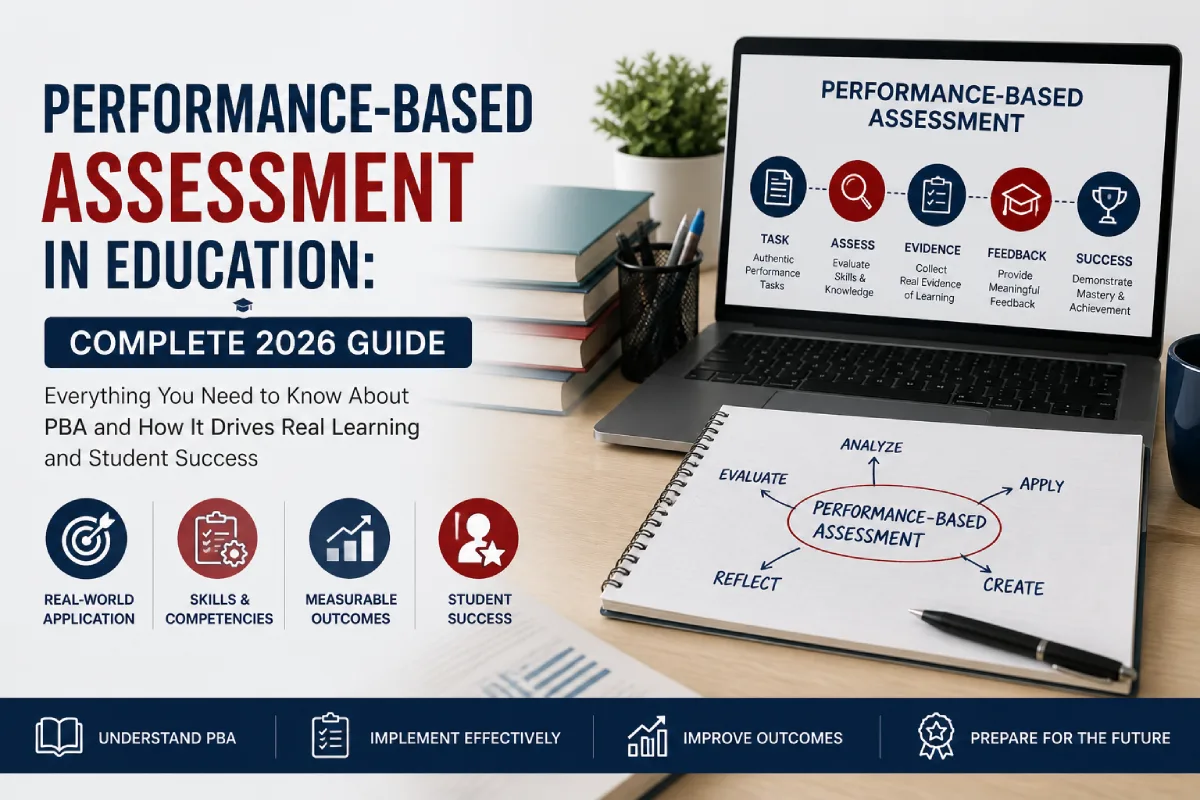
For decades, student learning has been measured through a familiar format: a standardized test, a multiple-choice exam, a timed quiz. These tools are efficient and easy to grade, but they measure only one thing well — a student’s ability to recall information under pressure.
Performance based assessment in education offers a fundamentally different approach. Instead of asking students what they know, it asks them to demonstrate what they can do. Instead of a bubble sheet, students produce a project, a presentation, a portfolio, or a solution to a real-world problem. The evidence of learning is authentic, observable, and directly tied to the skills that matter beyond the classroom.
This guide covers everything educators, curriculum designers, and educational institutions need to understand about performance based assessment — what it is, why it matters, the different types, how it compares to traditional testing, and how to implement it effectively.
What Is Performance Based Assessment in Education?
Performance based assessment (PBA) is a method of evaluating student learning by requiring students to complete tasks that demonstrate their knowledge and skills in applied, real-world contexts. Rather than selecting answers from a list, students must produce something — an argument, an experiment, a design, a performance, or a documented process — that shows their ability to think, analyze, create, and communicate.
The term “performance” in this context refers to any observable demonstration of competence. A student presenting a research project is performing. A student conducting a laboratory experiment is performing. A student writing a persuasive editorial, building a prototype, or delivering a speech is performing. What unites all of these tasks is that they require active engagement with knowledge — not passive retrieval of it.
Performance based assessment is grounded in the theory of authentic assessment, which holds that the most meaningful measure of learning is a student’s ability to apply that learning in contexts that resemble the real world. This theory, developed by educational researchers such as Grant Wiggins in the 1990s and reinforced by decades of subsequent research, argues that traditional tests often measure test-taking skill as much as subject knowledge, and that students who perform well on standardized exams do not always perform equally well when asked to apply the same knowledge in practice.
PBA addresses this gap by designing assessment tasks that are complex, meaningful, and connected to actual challenges students will encounter outside the classroom.
Performance Based Assessment vs. Traditional Assessment
Understanding what makes PBA distinct from traditional assessment helps educators and institutions decide when and how to use each approach effectively.
Traditional assessment — including multiple-choice tests, true/false questions, fill-in-the-blank exams, and standardized testing — has genuine value. It is efficient, easy to administer at scale, and highly consistent in scoring. It is also effective at measuring discrete factual knowledge and basic comprehension.
The limitations become apparent when the goal is to measure deeper learning. A student can correctly identify the steps of the scientific method on a multiple-choice test without being able to design or conduct an actual experiment. A student can define the elements of a persuasive essay without being able to write one convincingly. Traditional assessment captures what students know about a skill. PBA captures whether they can actually exercise it.
The following comparison illustrates the core differences:
| Dimension | Traditional Assessment | Performance Based Assessment |
|---|---|---|
| Primary focus | Recall and recognition of knowledge | Application and demonstration of knowledge |
| Task format | Standardized questions, fixed responses | Open-ended tasks, student-generated products |
| Skills measured | Memory, comprehension | Critical thinking, problem-solving, communication |
| Student role | Passive respondent | Active producer |
| Feedback | Score or grade | Detailed, criteria-based evaluation |
| Real-world relevance | Limited | High — tasks mirror authentic challenges |
| Scoring | Objective, machine-gradable | Requires rubric-based human judgment |
| Equity considerations | Can disadvantage diverse learners | Accommodates multiple ways of demonstrating learning |
Neither approach is universally superior. Many effective assessment systems combine both — using traditional tests to confirm foundational knowledge and performance based assessments to evaluate the application, synthesis, and communication of that knowledge.
Types of Performance Based Assessment
Performance based assessments can take many forms. The right format depends on the subject, grade level, learning objectives, and available resources. The most widely used types include:
Projects and Project-Based Learning
Projects are extended tasks in which students investigate a question, problem, or challenge over time and produce a tangible outcome — a report, a model, a plan, a product, or a presentation. Project-based learning (PBL) embeds assessment within the project process itself, evaluating not just the final product but the research, reasoning, and decision-making that led to it.
Projects are particularly effective for developing interdisciplinary skills. A student creating a business plan for a school enterprise, for example, is simultaneously applying mathematics (financial projections), English (written and oral communication), economics (market analysis), and organizational skills.
Presentations and Oral Demonstrations
Presentations require students to organize their knowledge, communicate it clearly, and respond to questions from an audience. They assess skills that written tests cannot capture — verbal clarity, organization of ideas, ability to explain complex concepts in accessible terms, and confidence under questioning.
Oral presentations are especially valuable in language arts, social studies, science, and any professional field where communication is a core competency.
Portfolios
A portfolio is a curated collection of a student’s work over a defined period. It demonstrates growth, depth, and breadth of learning more effectively than any single assessment. Students typically include samples of their best work, drafts and revisions that show their process, and reflections on what they have learned.
Portfolios are particularly powerful because they give students agency in their own assessment. Choosing what to include, writing reflective commentary, and presenting their collection to an audience are themselves high-order learning activities.
Laboratory Experiments and Scientific Investigations
In science education, performance based assessment often takes the form of a laboratory investigation. Students design an experiment, collect and analyze data, draw conclusions, and present their findings. This format assesses not just scientific knowledge but scientific reasoning — the ability to form hypotheses, identify variables, interpret evidence, and communicate results accurately.
Debates and Structured Academic Controversy
Debates require students to research a position, construct an argument, anticipate counterarguments, and respond under pressure. Structured academic controversy takes this further — students argue a position, then switch sides, then work toward a reasoned consensus. Both formats develop critical thinking, research skills, and civil discourse.
Simulations and Role-Playing
Simulations place students in realistic scenarios where they must apply their knowledge to make decisions and solve problems. A mock trial, a diplomatic negotiation simulation, a business case study, or a medical triage exercise all require students to draw on their learning in ways that are directly analogous to real professional situations.
Performance Tasks
A performance task is a focused, specific assignment that requires students to apply knowledge or skills to a defined challenge. Unlike extended projects, performance tasks are typically completed in a shorter time frame — a class period or a few days. They are widely used for formative assessment within a unit of study.
Examples include: writing a letter to a government official about a policy issue studied in class, redesigning a product to solve a specific engineering problem, or analyzing a primary source document and presenting an evidence-based interpretation.
Exhibitions and Public Demonstrations
Exhibitions require students to share their work with an authentic audience — parents, community members, other students, or subject-matter experts. The public nature of an exhibition raises the stakes and the authenticity of the task. Students must not only produce work of quality but also explain, defend, and discuss it with people outside their classroom.
Benefits of Performance Based Assessment in Education
The growing adoption of performance based assessment in education reflects a body of research demonstrating several meaningful advantages over purely traditional approaches.
Deeper and More Durable Learning
When students must apply knowledge to complete a task, they process that knowledge more deeply than when they simply memorize it for a test. Research in cognitive science consistently shows that active engagement with material — explaining, applying, creating — produces stronger and more lasting learning than passive review. PBA structures learning around this principle from the start.
Development of Critical Thinking and Problem-Solving
Traditional tests can be passed with surface-level memorization. Performance based assessments cannot. A student who cannot actually think through a problem cannot produce an authentic demonstration of having solved it. PBA therefore directly develops and measures the higher-order thinking skills — analysis, synthesis, evaluation, creation — that are the goals of rigorous education.
More Accurate and Comprehensive Measurement of Ability
A single multiple-choice test captures a snapshot of one type of performance on one day under one set of conditions. A well-designed performance based assessment captures a student’s sustained engagement with a problem, their ability to self-correct, the quality of their reasoning process, and the effectiveness of their communication. This is a richer and more valid picture of what a student actually knows and can do.
Support for Diverse Learners
Traditional standardized tests are administered identically to all students — same format, same timing, same question style. This uniformity can systematically disadvantage students with different learning styles, language backgrounds, or cognitive profiles.
Performance based assessment allows students to demonstrate understanding through multiple modalities. A student who struggles to express complex ideas in a timed written test may produce a sophisticated and insightful visual model, oral presentation, or design project. PBA creates space for diverse learners to show their genuine abilities.
Preparation for Real-World and Professional Contexts
The world beyond school rarely requires people to answer multiple-choice questions under a time limit. It does require them to solve problems, communicate clearly, collaborate with others, manage a project from start to finish, and adapt when circumstances change. Performance based assessment develops and evaluates exactly these capacities, making it a more direct preparation for academic, professional, and civic life.
Meaningful, Actionable Feedback
When students receive a numerical score on a standardized test, they learn that they got a certain percentage correct. When they receive feedback on a performance based task — evaluated against a rubric that identifies specific strengths and areas for development — they learn something genuinely useful about their thinking and their work. This kind of feedback drives improvement in ways that a score alone cannot.
Challenges of Performance Based Assessment
Performance based assessment is not without its difficulties. Educators and institutions considering its adoption should understand the genuine challenges involved.
Time and Resource Requirements
Designing high-quality performance tasks, administering them, and providing detailed rubric-based feedback takes significantly more time than grading a standardized test. For educators managing large classes with heavy workloads, this is a real constraint. Effective implementation typically requires institutional support, protected planning time, and in some cases additional staffing or resources.
Subjectivity and Scoring Consistency
Because performance based assessments evaluate open-ended products rather than fixed answers, scoring requires professional judgment. Two teachers evaluating the same student presentation may reach different conclusions. This subjectivity is managed — but not eliminated — through the use of well-designed rubrics, inter-rater reliability training, and calibration processes in which multiple evaluators discuss and align their judgments before scoring begins.
Difficulty Scaling to Large Groups
Large-scale standardized testing can process thousands of students simultaneously. Performance based assessment is inherently more individualized and more difficult to administer at scale. This is one reason that many education systems use PBA for formative and classroom-level assessment while retaining standardized testing for large-scale accountability purposes.
Equity in Task Design
While PBA can be more equitable than standardized testing in some respects, it can introduce its own equity challenges. Open-ended projects can disadvantage students who lack access to resources — internet, materials, quiet study space — at home. Oral presentations can disadvantage students who experience anxiety or whose cultural background does not emphasize public performance. Thoughtful task design should account for these factors.
Professional Development Requirements
Effective performance based assessment requires that educators understand how to design meaningful tasks, develop valid rubrics, provide constructive feedback, and use assessment data to adjust instruction. These skills do not develop automatically — they require deliberate professional development and ongoing collegial support.
How to Implement Performance Based Assessment Effectively
For educators and institutions moving toward performance based assessment in education, the following framework provides a practical starting point.
Define Clear Learning Objectives
Every performance task must be anchored to specific, measurable learning goals. Before designing a task, identify precisely what students should be able to know, understand, and do as a result of their learning — and ensure the task will actually require them to demonstrate those capabilities.
Design Authentic, Complex Tasks
The most effective performance tasks are genuinely challenging, require sustained thought, and connect to real-world contexts that students find meaningful. Avoid tasks that can be completed by following a template or copying an approach from a previous year. Authenticity and complexity are what make PBA genuinely diagnostic.
Develop a Clear, Detailed Rubric
A rubric defines the criteria by which student work will be evaluated and describes what performance at each level of quality looks like for each criterion. A strong rubric is specific enough to support consistent scoring and meaningful feedback, but flexible enough to accommodate the range of legitimate approaches students might take.
Share the rubric with students before they begin the task. Students perform better when they understand exactly what they are working toward and can self-assess their progress against clear criteria.
Build in Process Checkpoints
Rather than assessing only the final product, design assessments that evaluate the process as well — initial planning, research progress, draft stages, peer review, and revision. This approach reveals more about student learning and gives students the opportunity to improve before submitting their final work.
Provide Timely, Specific Feedback
Feedback on a performance task is most valuable when it is given while there is still time to act on it. During extended projects, provide feedback at key milestones. Focus feedback on specific aspects of the rubric criteria — what is working and why, and what needs development and how to address it.
Calibrate Scoring with Colleagues
Where multiple teachers are assessing student work against the same rubric, schedule regular calibration sessions. Review student samples together, discuss scores, and align on how rubric criteria apply to a range of responses. This process improves consistency and helps every evaluator apply the rubric more accurately.
Performance Based Assessment Across Subjects
Performance based assessment is not limited to any particular subject area. It can be adapted effectively across the full curriculum.
In mathematics, PBA might involve applying mathematical reasoning to solve a multi-step real-world problem — designing an optimal floor plan within a budget, analyzing statistical data to make a recommendation, or building a mathematical model to predict an outcome. The task assesses not just the correct answer but the reasoning process and the ability to communicate mathematical thinking.
In science, laboratory investigations are the classic form of PBA. Students design an experiment, collect data, analyze results, and draw evidence-based conclusions. Research presentations and science fair projects extend this further into the territory of genuine scientific inquiry.
In English language arts, portfolios of written work, formal debates, and oral presentations of literary analysis all represent strong PBA formats. These tasks assess writing craft, reading comprehension, argumentation, and communication simultaneously.
In social studies, students might research and present on a historical event, write a policy brief addressing a current issue, or participate in a simulation of a historical negotiation or legislative process. These formats assess content knowledge alongside research skills, civic reasoning, and the ability to construct and defend an evidence-based argument.
In career and technical education, PBA is especially natural — students complete tasks that directly mirror the work of the professions they are studying, from drafting architectural plans to completing a patient assessment to building a functional piece of software.
Performance Based Assessment and International Students
For international students and educators whose academic credentials were earned outside the United States, demonstrating the equivalency of their educational background is an important step in gaining admission to U.S. institutions or employment in U.S. schools.
EEE of America provides education evaluations and course-by-course evaluations that confirm the U.S. equivalent of foreign academic degrees and transcripts. International educators applying for teaching positions, curriculum roles, or graduate programs in education will often need a formal credential evaluation alongside their application materials.
We also provide certified document translations for academic records not in English, and work experience evaluations for professionals whose teaching or educational leadership experience was gained outside the United States.
Contact EEE of America to discuss credential evaluation needs for education professionals. View our pricing page for a full breakdown of our services.
Frequently Asked Questions (FAQs)
What is performance based assessment in education?
Performance based assessment in education is a method of evaluating student learning by requiring students to complete tasks that demonstrate their knowledge and skills in applied, real-world contexts — such as projects, presentations, experiments, portfolios, and simulations — rather than answering standardized test questions.
How does performance based assessment differ from traditional testing?
Traditional tests primarily measure a student’s ability to recall and recognize information. Performance based assessment measures a student’s ability to apply, analyze, synthesize, and communicate knowledge in meaningful tasks. PBA provides richer evidence of learning but requires more time and professional judgment to administer and score.
What are the most common types of performance based assessment?
The most widely used types include projects and project-based learning, oral presentations, portfolios, laboratory experiments, debates, simulations, performance tasks, and exhibitions. The appropriate format depends on the learning objectives, subject area, and grade level.
What is a rubric and why is it essential for PBA?
A rubric is a scoring guide that defines the criteria for evaluating student work and describes what performance at each quality level looks like. Rubrics are essential to performance based assessment because they make scoring criteria transparent to students, support consistent scoring across different evaluators, and provide the basis for specific, actionable feedback.
Can performance based assessment be used at all grade levels?
Yes. Performance based assessment can be adapted to all grade levels, from early childhood education through higher education. The complexity of tasks and the level of independence expected should be calibrated to the developmental stage of learners, but the core principle — demonstrating learning through application — is relevant and valuable at every level.
Is performance based assessment fair for all students?
When thoughtfully designed, performance based assessment can be more equitable than standardized testing because it allows students to demonstrate understanding through multiple modalities and accommodates diverse learning styles and backgrounds. However, task design must account for potential resource disparities, language barriers, and cultural factors that could affect performance. Clear rubrics, accessible task formats, and appropriate accommodations are essential to equitable implementation.
How is performance based assessment used outside the classroom?
Performance based assessment is widely used in professional credentialing, corporate training, and hiring. Bar exams, medical licensing exams, teaching certification assessments, and technical certification programs all incorporate performance-based elements. Employers increasingly use role-play simulations, case studies, and skills-based assessments in hiring because they provide a more valid prediction of job performance than interviews or written tests alone.
Conclusion — The Case for Performance Based Assessment
Performance based assessment in education is not a replacement for all other forms of evaluation — it is a powerful complement to them. When designed and implemented well, it gives educators a richer, more authentic picture of what students actually know and can do, provides students with feedback that drives genuine improvement, and develops the thinking, communication, and problem-solving skills that education is ultimately meant to cultivate.
The challenges — time, subjectivity, scale, and the professional development required — are real. But they are surmountable with institutional commitment, collegial collaboration, and a clear focus on what truly matters: preparing students not just to pass tests, but to apply their knowledge with skill and confidence in a complex world.
For international educators and students navigating the U.S. education system, EEE of America provides the credential evaluation and documentation services needed to have foreign academic qualifications recognized in the United States.
Call us: (727) 288-2848 Email: contact@eeeofamerica.com
Contact EEE of America | View our education evaluation services | View our pricing
Related Services: Education Evaluations | Course-by-Course Evaluation | Work Experience Evaluation | Certified Document Translations | Expert Opinion Letters