

Applying for an EB-1A green card requires more than demonstrating that you are experienced, highly educated, or successful in your profession. You must establish that you have extraordinary ability in your field and have achieved sustained national or international acclaim.
For many applicants, presenting this evidence can be challenging. Awards, research publications, patents, citations, leadership positions, media coverage, and professional achievements may demonstrate a strong career, but they do not always explain the broader significance of those accomplishments.
This is where an EB-1A expert opinion letter can provide valuable support.
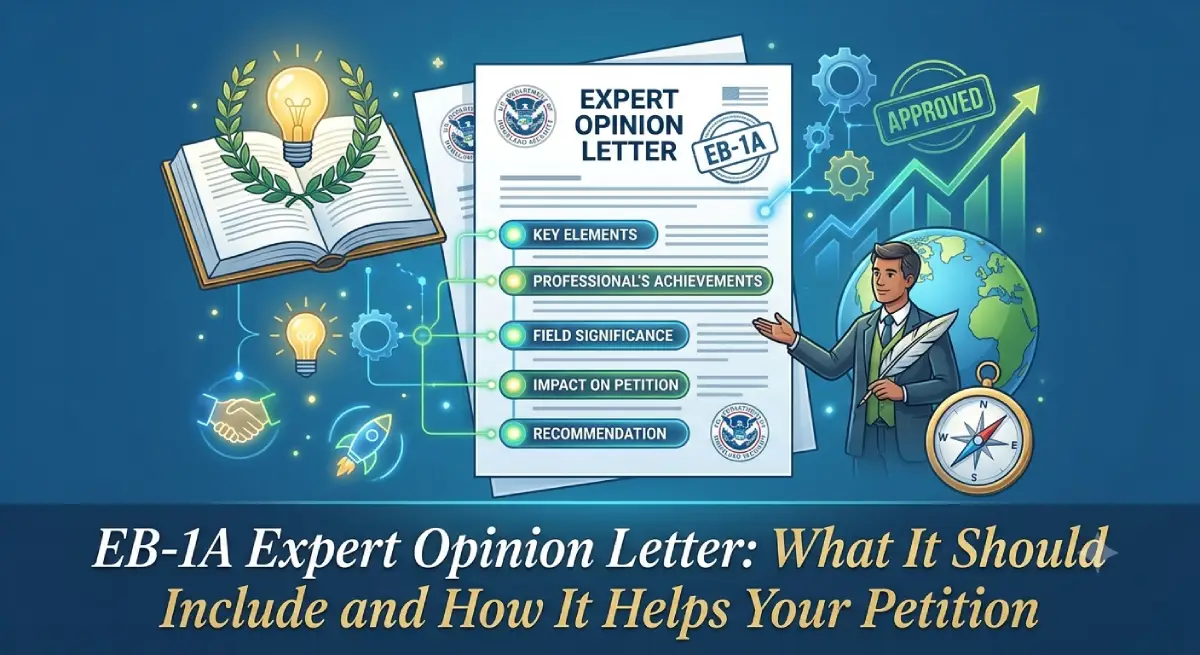
An expert opinion letter is a professionally prepared assessment written by a qualified individual who understands the applicant’s field. It explains the significance of specific achievements, evaluates their impact, and provides professional context that may help USCIS understand technical or specialized evidence.
However, an effective expert opinion letter should do more than praise an applicant. It should provide a reasoned, evidence-based analysis that connects the applicant’s accomplishments to the EB-1A extraordinary ability standard.
In this guide, we explain what an EB-1A expert opinion letter should include, who should write it, which achievements it can address, and how to obtain one for your petition.
If you are preparing an EB-1A petition and need professional documentation, EEE of America provides immigration expert opinion letter services for EB-1 and other employment-based immigration categories.
What Is an EB-1A Expert Opinion Letter?
An EB-1A expert opinion letter is a formal professional assessment prepared by a qualified expert in the applicant’s field.
The letter evaluates the applicant’s professional achievements, contributions, and recognition from the perspective of someone with relevant subject-matter expertise.
For example, a senior researcher may evaluate the significance of an applicant’s scientific discoveries, while an experienced technology executive may explain the industry impact of an applicant’s technical innovations.
The purpose is to explain why particular accomplishments matter within the relevant professional field.
An expert opinion letter may discuss:
- Original scientific or business contributions.
- The significance of research publications and citations.
- Professional awards and recognition.
- Leadership or critical roles in distinguished organizations.
- Industry influence and technological innovations.
- The importance of the applicant’s work to the broader field.
- Recognition from other professionals and institutions.
An expert opinion letter is supporting evidence. It does not replace the regulatory evidence required for an EB-1A petition, and it does not guarantee approval.
For more information about the service, visit EEE of America’s Expert Opinion Letter page.
Does USCIS Require an Expert Opinion Letter for EB-1A?
No. USCIS does not make an expert opinion letter a mandatory standalone requirement for every EB-1A petition.
Under 8 CFR 204.5(h), applicants generally must demonstrate either a qualifying one-time major internationally recognized award or evidence satisfying at least three of ten specified evidentiary criteria.
After considering the initial evidence, USCIS also evaluates the totality of the record to determine whether the applicant has sustained national or international acclaim and belongs to the small percentage who have risen to the top of their field.
An expert opinion letter can help explain the significance of particular achievements during this process.
For example, a researcher may have published several scientific papers, but the number of publications alone does not necessarily establish that the research has had a significant impact on the field.
An expert familiar with the research area may explain:
- What the applicant discovered.
- How the research differs from previous work.
- Whether other researchers have relied on the findings.
- How the contribution has influenced subsequent developments.
- Why the achievement matters to the broader scientific community.
USCIS guidance recognizes that detailed expert letters explaining the nature and significance of original contributions may provide valuable context, particularly when supported by corroborating evidence.
Therefore, the purpose of an expert opinion letter is not simply to claim that an applicant is extraordinary. It is to provide credible professional analysis that helps explain the evidence.
What Should an EB-1A Expert Opinion Letter Include?
A well-prepared EB-1A expert opinion letter should be specific, analytical, and supported by verifiable information.
Although the exact structure depends on the applicant’s profession and evidence, the following sections can help create a comprehensive assessment.
1. Expert’s Qualifications and Professional Background
The letter should establish why the author is qualified to evaluate the applicant’s achievements.
The expert’s professional background is important because USCIS needs to understand the basis for the opinions being presented.
This section may include:
- Academic qualifications.
- Professional degrees and certifications.
- Current professional position.
- University or institutional affiliation.
- Research experience.
- Publications and citations.
- Industry achievements.
- Professional awards and recognition.
- Relevant experience in the applicant’s area of expertise.
For example, if an applicant is a machine learning researcher, an expert with relevant academic research experience, publications, and knowledge of artificial intelligence may be better positioned to assess the significance of the applicant’s contributions than someone working in an unrelated discipline.
The expert’s qualifications should be verifiable and directly relevant to the subject being evaluated.
2. Introduction to the Applicant’s Field of Expertise
The letter should provide enough background to help the reader understand the applicant’s professional area.
Not every immigration adjudicator will have specialized knowledge of advanced engineering, artificial intelligence, biotechnology, medical research, or other technical disciplines.
The expert can explain:
- The current state of the industry or research field.
- Important developments and challenges.
- Relevant professional standards.
- The importance of the applicant’s area of specialization.
- How the applicant’s work relates to broader developments.
This context helps explain why a particular achievement may be significant.
For example, an innovation in cybersecurity may appear to be a technical improvement to someone outside the field. An expert can explain how it addresses a previously unresolved security problem, improves existing systems, or contributes to industry practices.
3. Analysis of Original Contributions of Major Significance
Original contributions of major significance are one of the ten EB-1A evidentiary criteria under 8 CFR 204.5(h)(3)(v).
This criterion requires evidence of original scientific, scholarly, artistic, athletic, or business-related contributions of major significance in the field.
An expert opinion letter can help explain both the originality and the significance of the applicant’s work.
The analysis should address questions such as:
- What exactly did the applicant contribute?
- How was the contribution different from existing approaches?
- What problem did it solve?
- Who has used, cited, adopted, or benefited from the work?
- What measurable impact has it produced?
- Why is the contribution important beyond the applicant’s immediate employer or organization?
Consider a software engineer who developed a new cybersecurity framework.
A weak letter might simply describe the framework as innovative and important.
A stronger letter would explain the technical problem, compare the applicant’s approach with established methods, identify its practical applications, and discuss documented evidence of its adoption or impact.
Supporting documents may include patents, technical publications, citations, implementation records, licensing agreements, independent research, or evidence of commercial use.
The expert’s analysis should accurately reflect the evidence rather than make unsupported claims about industry-wide recognition.
4. Evaluation of Awards and Professional Recognition
An expert may also explain the professional significance of awards received by the applicant.
Not every professional award automatically qualifies under the EB-1A awards criterion.
The relevant regulatory criterion concerns nationally or internationally recognized prizes or awards for excellence in the field of endeavor.
A useful assessment may explain:
- Who presents the award.
- The organization’s reputation.
- The selection process.
- The criteria used to select recipients.
- The number of recipients.
- The geographical reach of the award.
- Its recognition within the applicant’s profession.
For example, an industry award may be presented by a recognized professional organization after a competitive selection process.
An expert familiar with that industry can explain why the award is respected and how it reflects the applicant’s professional achievements.
The letter should not describe every certificate, participation award, or internal employee recognition as an internationally recognized achievement.
5. Assessment of Published Work and Research Impact
Research publications can be important evidence for applicants in science, engineering, medicine, education, and technology.
However, publication counts alone do not establish extraordinary ability.
An expert opinion letter may explain:
- The significance of the applicant’s research.
- The originality of the findings.
- The reputation and relevance of the journals or conferences.
- How other researchers have cited or applied the work.
- Whether the research influenced later developments.
- The applicant’s individual contribution to collaborative research.
For example, a biomedical researcher may have published a study that has influenced subsequent clinical or laboratory research.
A qualified expert can explain the research’s technical significance and the reasons other professionals have relied on it.
The analysis should distinguish between publication activity, the quality of the research, and evidence of its broader influence.
6. Evaluation of Leading or Critical Roles
Some EB-1A applicants have held senior positions in established companies, research institutions, universities, or professional organizations.
The leading or critical role criterion under 8 CFR 204.5(h)(3)(viii) focuses on the applicant’s role for organizations or establishments with distinguished reputations.
An expert opinion letter can explain:
- The organization’s reputation.
- The applicant’s responsibilities.
- Their decision-making authority.
- The importance of their work.
- Their influence on major projects.
- Their contribution to organizational outcomes.
For example, a senior engineering leader may have directed the development of a technology platform used by a major organization.
The letter should explain why the applicant’s role was important and what made it leading or critical, rather than relying solely on a prestigious job title.
Supporting evidence might include organizational charts, project documentation, performance records, company information, and statements from individuals with direct knowledge of the applicant’s responsibilities.
7. Explanation of the Applicant’s Industry Influence
An expert opinion letter can also provide context regarding the applicant’s broader professional influence.
Depending on the case, this may include:
- Adoption of the applicant’s work by other professionals.
- Invitations to speak at recognized industry events.
- Contributions to professional standards.
- Participation in influential technical committees.
- Independent references to the applicant’s research.
- Evidence of industry-wide applications or recognition.
The purpose is to explain how the applicant’s accomplishments extend beyond ordinary professional responsibilities.
The letter should distinguish between genuine professional influence and routine participation in industry activities.
8. Independent Professional Assessment and Conclusion
The letter should conclude with the expert’s reasoned assessment of the applicant’s achievements.
Rather than simply repeating the applicant’s resume, the expert should explain how the evidence supports the professional conclusions reached.
The conclusion may address:
- The applicant’s most significant achievements.
- Their importance within the relevant field.
- The expert’s assessment of the applicant’s professional standing.
- The relationship between the achievements and the applicable EB-1A criteria.
- The supporting documentation considered.
The expert should remain within their professional expertise and avoid presenting themselves as the immigration decision-maker.
USCIS retains responsibility for determining whether the applicant meets the legal requirements.
Which EB-1A Criteria Can an Expert Opinion Letter Support?
An expert opinion letter may provide useful analysis across several EB-1A evidentiary criteria, depending on the applicant’s circumstances.
The ten regulatory criteria are:
| EB-1A criterion | How expert analysis may help |
|---|---|
| Awards and prizes | Explain an award’s professional reputation and selection standards |
| Membership in associations | Explain selective membership requirements and professional significance |
| Published material about the applicant | Provide context about the publication or media outlet |
| Judging the work of others | Explain the professional importance of judging activities |
| Original contributions of major significance | Analyze originality, influence, and impact |
| Scholarly articles | Explain research quality and relevance |
| Artistic exhibitions or showcases | Explain the significance of qualifying exhibitions |
| Leading or critical roles | Explain the applicant’s responsibilities and organizational impact |
| High salary or remuneration | Provide relevant industry and compensation context |
| Commercial success in the performing arts | Explain the professional significance of documented commercial results |
An important distinction: an expert opinion letter does not automatically establish any of these criteria.
For example, a letter cannot replace documentary proof that an applicant actually received an award, published a paper, or performed a judging role.
Instead, it may help explain the significance of the underlying evidence.
Also, satisfying three criteria is not the end of the analysis. USCIS conducts a final merits determination based on the totality of the evidence.
Who Should Write an EB-1A Expert Opinion Letter?
The author should have relevant, verifiable expertise in the applicant’s professional field.
The appropriate expert depends on the applicant’s occupation and the achievements being evaluated.
Potential expert authors include:
University professors and academic researchers
These professionals may be suitable for evaluating scientific research, academic publications, citations, and scholarly contributions.
Senior industry professionals
Experienced executives, technical directors, and established professionals may be appropriate for assessing business innovations, engineering projects, and industry contributions.
Recognized subject-matter experts
Professionals with significant experience in a particular technical or specialized discipline may provide valuable assessments of achievements within that field.
Research institution leaders
Senior researchers and institutional leaders may be qualified to evaluate the importance of scientific discoveries, research projects, and technological developments.
Should the EB-1A Expert Be Independent?
Independence is an important consideration when selecting an expert.
An independent expert who has no close personal, financial, or supervisory relationship with the applicant may provide a different perspective from someone who has worked directly with the applicant.
However, independence alone does not make a letter persuasive.
The author’s qualifications, knowledge of the relevant field, understanding of the evidence, and ability to explain the significance of the applicant’s work are equally important.
A strong letter should clearly disclose the expert’s relationship with the applicant and provide a transparent basis for the opinions expressed.
In many cases, a combination of independent experts and professionals with direct knowledge of the applicant’s work can provide complementary perspectives.
Independent Expert Opinion Letter vs. Recommendation Letter for EB-1A
These terms are sometimes used interchangeably, but they serve different purposes.
A recommendation letter generally describes the applicant’s professional abilities, achievements, character, and experience from the perspective of someone familiar with their work.
An independent expert opinion letter focuses more specifically on professional analysis and the significance of particular achievements.
| Comparison | Recommendation letter | Expert opinion letter |
|---|---|---|
| Main purpose | Recommend and describe the applicant | Analyze professional achievements |
| Typical author | Supervisor, colleague, mentor, or expert | Qualified subject-matter expert |
| Focus | Experience and accomplishments | Significance, originality, and professional impact |
| Analytical depth | Varies | Should provide detailed field-specific analysis |
| Evidence discussion | May describe supporting facts | Should evaluate relevant supporting evidence |
| Independence | May be from someone familiar with applicant | Can be independent or otherwise transparently related |
Both types of letters may have a role in an EB-1A petition.
The important consideration is whether each letter contributes meaningful information rather than repeating the same praise.
For more information about selecting an expert, read our guide on EB-1A experts and how to choose one.
How Many Expert Opinion Letters Do You Need for EB-1A?
There is no universal USCIS requirement specifying a fixed number of expert opinion letters for every EB-1A petition.
The appropriate number depends on the applicant’s professional background, evidence, field, and the issues that need explanation.
Some applicants may benefit from one detailed expert assessment, while others may have several distinct achievements that require analysis from experts with different specializations.
When deciding how many letters to obtain, consider:
- How many achievements require technical explanation.
- Whether the applicant has contributions in multiple areas.
- Whether different experts can provide genuinely distinct perspectives.
- Whether the letters address different aspects of the evidence.
- Whether additional letters would repeat existing information.
The goal should be quality and relevance, not simply accumulating as many letters as possible.
A few detailed, well-supported expert assessments may be more useful than numerous generic letters that repeat the applicant’s accomplishments.
Your immigration attorney can help determine the appropriate evidence strategy.
Documents Needed to Prepare an EB-1A Expert Opinion Letter
A qualified expert needs sufficient information to understand the applicant’s background and assess the achievements being discussed.
The exact checklist depends on the applicant’s field and the purpose of the letter.
Commonly requested documents include:
Academic and professional background
- Updated resume or CV.
- Educational certificates and academic records.
- Professional licenses and certifications.
- Employment history.
Research and publication evidence
- Research papers and published articles.
- Citation records.
- Patent documentation.
- Research project descriptions.
- Evidence of independent use or reference to the applicant’s work.
Awards and recognition
- Award certificates.
- Selection criteria.
- Awarding organization’s information.
- Evidence of recognition within the industry.
Professional achievements
- Project descriptions.
- Evidence of leadership responsibilities.
- Organizational information.
- Records demonstrating the impact of the applicant’s work.
- Relevant media coverage.
Additional supporting documents
- Existing recommendation letters.
- Professional memberships.
- Judging invitations and records.
- Evidence of commercial impact.
- Immigration petition details, where relevant.
Providing organized and verifiable evidence helps the expert prepare an accurate assessment.
Common Mistakes to Avoid in an EB-1A Expert Opinion Letter
An expert opinion letter should strengthen the petition’s evidentiary presentation, not introduce unnecessary weaknesses.
Here are some common problems to avoid.
1. Using Generic Templates
A letter that simply substitutes the applicant’s name into a standard template may lack the technical detail needed to explain their achievements.
Each assessment should be prepared around the applicant’s actual background and supporting evidence.
2. Selecting an Expert Without Relevant Qualifications
A prestigious job title does not automatically make someone qualified to evaluate every professional discipline.
The expert should have demonstrable knowledge of the subject being assessed.
3. Making Unsupported Claims
Statements such as “the applicant is the best professional in the world” are not useful without a clear factual basis.
The letter should explain the evidence supporting its conclusions.
4. Repeating the Resume
An expert opinion letter should not merely list employment history, publications, or awards.
It should interpret the significance of relevant accomplishments.
5. Ignoring the Specific EB-1A Criteria
A letter that discusses achievements without explaining their relevance to the petition may provide limited value.
The expert should identify the particular professional questions being addressed.
6. Overlooking Corroborating Evidence
Expert opinions are more persuasive when they are consistent with supporting documents.
For example, an assertion that a research contribution has influenced the field should ideally be supported by citation records, adoption evidence, independent publications, or other relevant documentation.
7. Treating the Expert Opinion Letter as a Guarantee
No expert opinion letter can guarantee EB-1A approval.
USCIS evaluates the entire petition and makes the final eligibility determination.
How EEE of America Helps With EB-1A Expert Opinion Letters
Preparing a meaningful EB-1A expert opinion letter requires more than good writing. It requires an understanding of the applicant’s field, the relevant professional evidence, and the specific questions the expert is being asked to assess.
EEE of America provides expert opinion letter services for EB-1 and other employment-based immigration categories.
Its services are designed to help applicants and immigration attorneys obtain professional assessments tailored to their individual circumstances.
The process focuses on understanding the applicant’s qualifications, identifying the achievements that require expert analysis, reviewing supporting documentation, and preparing a case-specific opinion.
Depending on the applicant’s background, an EB-1 expert opinion letter may address:
- Original contributions and their significance.
- Research and scholarly achievements.
- Professional recognition and awards.
- Industry innovations.
- Leading or critical professional roles.
- Technical achievements and their wider applications.
EEE of America also provides expert opinion letter services for EB-2 NIW petitions, as well as education and work experience evaluations for other employment-based immigration matters.
If you are preparing an EB-1A petition, you can review the expert opinion letter service or contact EEE of America to discuss your documentation requirements.
Frequently Asked Questions About EB-1A Expert Opinion Letters
Is an expert opinion letter mandatory for EB-1A?
No. USCIS does not require every EB-1A applicant to submit an expert opinion letter. It is optional supporting evidence that may help explain the significance of professional achievements and specialized contributions.
Does an EB-1A expert opinion letter guarantee approval?
No. An expert opinion letter does not guarantee approval. USCIS evaluates the complete petition, including the applicant’s documentary evidence and whether the legal eligibility requirements have been satisfied.
What makes an EB-1A expert opinion letter strong?
A strong letter is written by a qualified expert, provides detailed field-specific analysis, discusses identifiable achievements, explains their significance, and is consistent with verifiable supporting evidence.
Can a professor write an EB-1A expert opinion letter?
Yes. A professor may write an expert opinion letter when their academic and professional expertise is relevant to the applicant’s field and the achievements being evaluated.
Can an employer write an EB-1A expert opinion letter?
An employer or supervisor may provide a letter describing the applicant’s responsibilities and achievements. However, the nature of the relationship should be disclosed, and the letter should provide specific, credible information rather than general praise. An independent expert may provide a complementary assessment.
Are independent expert opinion letters better for EB-1A?
Independent letters can provide valuable external perspectives because the author may have no direct personal or supervisory relationship with the applicant. However, the author’s qualifications, knowledge of the field, and quality of analysis matter more than independence alone.
Can an EB-1A expert opinion letter support original contributions of major significance?
Yes. A detailed expert assessment may explain the originality and importance of the applicant’s contributions. Supporting documentation, such as publications, citations, patents, adoption records, and evidence of industry impact, can strengthen the overall presentation.
How many expert opinion letters should I submit for EB-1A?
There is no fixed number required by USCIS. The appropriate number depends on the applicant’s achievements and the amount of additional expert analysis needed. Each letter should contribute meaningful, distinct information.
Can I use the same expert opinion letter for EB-1A and EB-2 NIW?
It is generally better to prepare separate, case-specific letters because EB-1A and EB-2 NIW have different legal standards.
An EB-1A letter should focus on extraordinary ability, professional recognition, and the significance of achievements. An EB-2 NIW letter should address the three-prong framework established in Matter of Dhanasar.
How long does it take to prepare an EB-1A expert opinion letter?
The time depends on document completeness, expert availability, the complexity of the applicant’s background, and the amount of analysis required. Contact the provider for its current processing estimate.
Can an expert opinion letter help with an EB-1A RFE?
It may help address specific issues raised in a Request for Evidence, particularly when USCIS needs additional explanation of technical achievements or the significance of contributions. However, the letter should respond to the actual concerns in the RFE and be supported by relevant documentation.
Get Professional Support for Your EB-1A Expert Opinion Letter
An EB-1A petition should present a clear, evidence-based explanation of why the applicant’s achievements demonstrate extraordinary ability.
A carefully prepared expert opinion letter can help explain complex professional accomplishments, provide independent or specialized analysis, and give context to supporting evidence.
The most effective letters are not generic recommendations. They are detailed professional assessments based on the applicant’s actual achievements and the expertise of the author.
If you need an expert opinion letter for an EB-1A petition, EEE of America can help you explore the appropriate service based on your professional background and documentation.
Explore EEE of America’s Expert Opinion Letter Services or contact the team to discuss your requirements.
Disclaimer: This article is for informational purposes only and does not constitute legal or immigration advice. An expert opinion letter is supporting evidence and does not guarantee approval of an EB-1A petition. Applicants should consult a qualified immigration attorney regarding their individual eligibility and evidence strategy.