
When preparing an EB-2 National Interest Waiver (NIW) petition, applicants often hear that they should obtain letters from independent experts. These letters are frequently discussed alongside recommendations from former supervisors, research collaborators, colleagues, clients, and other professionals who have directly worked with the applicant.
But what is the actual difference between an independent and a dependent expert opinion letter? Does an independent expert automatically make a petition stronger? Can a letter from someone who has worked with the applicant still provide valuable evidence?
Understanding these distinctions is important because the usefulness of an expert opinion letter depends on more than the writer’s professional title or relationship with the applicant. The expert’s qualifications, knowledge of the subject, supporting evidence, and ability to provide a reasoned assessment all matter.
For EB-2 NIW applicants, the objective should be to present credible professional perspectives that help explain the proposed endeavor, the applicant’s achievements, and the potential significance of the work in the United States.
This guide explains the differences between independent and dependent expert opinion letters, their respective advantages and limitations, and how to decide which type may be appropriate for your petition.
What Is an Independent Expert Opinion Letter for EB-2 NIW?
An independent expert opinion letter is a professional evaluation written by someone who can assess the applicant’s work without having a direct employment, supervisory, collaborative, or other close professional relationship with the applicant.
The expert may be familiar with the applicant’s research, technology, publications, professional contributions, or proposed endeavor through publicly available information, industry knowledge, academic work, or an independent review of supporting documents.
For example, imagine a researcher who has developed a new method for improving energy storage efficiency.
An established engineering professor at another university may review the researcher’s publications, technical results, patents, and proposed future work. If the professor has never worked directly with the applicant and has no relevant personal or financial connection, the professor may be able to provide an independent assessment.
The expert’s role is to explain the technical or professional significance of the work, identify relevant achievements, and assess the applicant’s proposed contributions from an informed perspective.
Common characteristics of an independent expert
An independent expert may:
- Work at a different university, research institution, company, or organization.
- Have no direct supervisory relationship with the applicant.
- Have no history of collaborating on the applicant’s projects.
- Be familiar with the applicant’s field through professional or academic experience.
- Evaluate the applicant’s work using publications, project records, patents, data, or other documentation.
- Provide an assessment based on specialized knowledge rather than personal loyalty or direct involvement.
However, independence should be disclosed accurately. A professional should not be described as independent merely because they work at another institution. Previous collaborations, financial relationships, personal connections, or other relevant associations should be disclosed when appropriate.
What Is a Dependent Expert Opinion Letter?
A dependent expert opinion letter is an evaluation or recommendation written by someone who has a direct professional or working relationship with the applicant.
The writer may have supervised the applicant, collaborated on research, managed a project, employed the applicant, worked as a colleague, or directly observed the applicant’s professional contributions.
For example, a research scientist’s former project supervisor may explain the scientist’s responsibilities in developing a new medical technology. Because the supervisor directly observed the work, the letter may provide detailed information about the applicant’s actual role and accomplishments.
A dependent expert may be particularly useful when the applicant needs to demonstrate what they personally contributed to a project.
Common characteristics of a dependent expert
A dependent expert may be:
- A current or former supervisor.
- A research advisor or academic mentor.
- A co-author or research collaborator.
- A former employer or senior colleague.
- A project director or technical manager.
- A client, business partner, or professional associate.
The relationship does not automatically make the letter weak. In fact, someone who directly observed the applicant’s work may be able to provide specific details that an independent reviewer cannot independently verify.
The important consideration is whether the writer can provide credible, relevant, and properly supported information.
Independent vs. Dependent Expert Opinion Letters: Key Differences
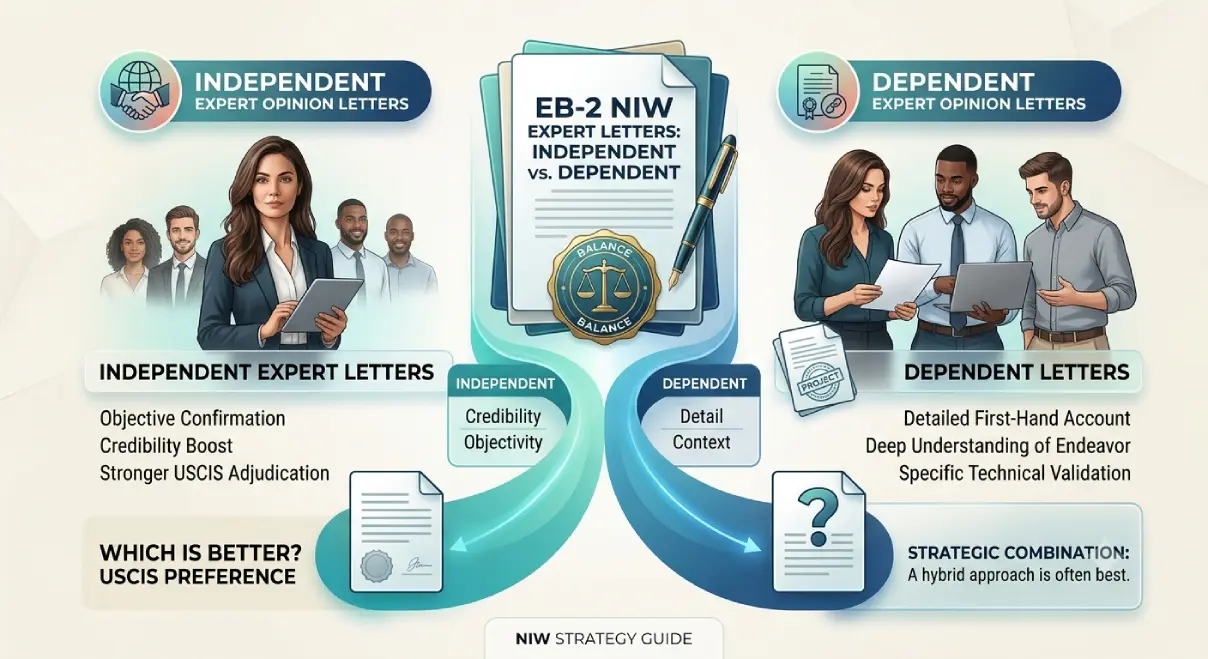
The main distinction is the nature of the expert’s relationship with the applicant and the type of information that relationship allows the expert to provide.
| Comparison factor | Independent expert | Dependent expert |
|---|---|---|
| Relationship with applicant | No direct working relationship, or no relevant close professional connection | Direct professional or working relationship |
| Basis of assessment | Independent review, field expertise, and available documentation | Direct observation and professional experience |
| Knowledge of applicant’s work | Often based on publications, records, and documented contributions | May include firsthand knowledge of specific projects |
| Potential advantage | Offers an outside professional perspective | Can explain the applicant’s actual role and contributions |
| Potential limitation | May have limited firsthand knowledge of the applicant’s work | May be perceived as having a personal or professional interest |
| Useful evidence | Technical significance, broader field context, professional assessment | Responsibilities, implementation, collaboration, and measurable results |
| Relationship disclosure | Should explain the basis of familiarity and any relevant connections | Should clearly identify the professional relationship |
Neither category is automatically superior in every case. The value of each letter depends on the specific facts, the expert’s qualifications, the evidence reviewed, and the relevance of the conclusions.
Are Independent Expert Opinion Letters Better for EB-2 NIW?
Independent letters can provide an important outside perspective, but it would be inaccurate to say that USCIS automatically gives every independent letter more weight than a dependent letter.
USCIS evaluates submitted evidence based on its relevance, probative value, and credibility, considering both individual documents and the complete record.
This means that a detailed letter from a former research supervisor may be more useful for establishing the applicant’s actual contribution to a project than a generic letter from an internationally recognized professor who has little knowledge of the work.
Similarly, an independent expert with relevant technical knowledge may provide a valuable assessment of why the applicant’s work matters beyond their immediate employer or research institution.
Consider the following two hypothetical examples.
Example A: Independent but general
A senior academic writes that an applicant is an outstanding researcher whose work could benefit the United States. However, the letter does not identify the research reviewed, explain the applicant’s contribution, or provide a reasoned assessment of the proposed endeavor.
Although the writer is independent and has impressive credentials, the letter offers limited case-specific analysis.
Example B: Dependent but evidence-based
A former research supervisor explains how the applicant designed a particular experimental method, solved a technical problem, and contributed to a project with documented results. The supervisor identifies the applicant’s specific responsibilities and provides supporting project details.
Although the writer has a direct professional relationship with the applicant, the letter may provide valuable firsthand evidence.
The lesson is straightforward: independence can strengthen the perspective offered by a letter, but it cannot replace substantive analysis and supporting evidence.
How Independent and Dependent Letters Can Support the Three Dhanasar Prongs
The EB-2 NIW framework established in Matter of Dhanasar, 26 I&N Dec. 884 (AAO 2016), requires applicants to satisfy three separate prongs.
An expert opinion letter may help explain relevant professional or technical facts associated with these requirements. However, the expert’s role is to provide a qualified professional assessment, not to replace the legal arguments or determine the petition’s eligibility.
1. Substantial Merit and National Importance
The first prong examines whether the proposed endeavor has substantial merit and national importance.
An independent expert may be able to explain how the applicant’s proposed work relates to broader developments, challenges, or opportunities in the relevant field.
For example, an expert in renewable energy may assess how a proposed energy-storage technology addresses technical limitations affecting grid reliability.
A dependent expert may contribute a different perspective by explaining how the applicant’s existing work has been implemented, tested, or used within a particular organization or project.
Together, these perspectives may help explain both the technical value of the work and the evidence supporting its broader significance.
2. The Applicant Is Well Positioned to Advance the Proposed Endeavor
The second prong focuses on the applicant’s ability and preparation to advance the proposed endeavor.
A dependent expert may be particularly useful here because they may have directly observed the applicant’s skills, research capabilities, technical responsibilities, or professional achievements.
An independent expert may provide an additional assessment of the applicant’s qualifications, documented accomplishments, and relevance to the field.
For example, a former project director could describe the applicant’s contribution to a successful engineering project, while an independent engineering specialist could evaluate the technical significance of the applicant’s work.
The two perspectives address different questions: what the applicant actually did and why those contributions matter.
3. Whether Waiving the Job Offer and Labor Certification Requirements Benefits the United States
The third prong examines whether, on balance, the United States would benefit from waiving the job offer and labor certification requirements.
An independent expert may explain the nature of the proposed endeavor, its professional or technical context, and why the applicant’s work may have significance beyond a single employer.
A dependent expert may explain the applicant’s existing role, project experience, or practical contributions that support the feasibility of continuing the work.
The expert’s conclusions should be grounded in the facts and relevant evidence. A letter should not simply declare that the applicant deserves a waiver without explaining the professional basis for that assessment.
Advantages of Independent Expert Opinion Letters
Independent expert letters can offer several benefits when prepared by appropriately qualified professionals.
1. An Outside Professional Perspective
An independent reviewer can evaluate the applicant’s work without relying on a direct supervisory or collaborative relationship.
This can be useful when the petition needs an assessment from someone outside the applicant’s immediate professional environment.
2. Broader Industry or Academic Context
An expert who understands the wider field may explain why a particular development, research result, or proposed initiative is relevant beyond one institution or company.
This perspective may help clarify the broader context of the proposed endeavor.
3. Assessment of Documented Contributions
An independent expert can review research papers, patents, project documentation, technical results, and other evidence to assess the significance of the applicant’s work.
The strongest evaluations explain which materials were reviewed and how they support the expert’s conclusions.
4. Reduced Reliance on Personal Endorsement
A letter from someone without a close professional relationship may offer a different form of support from a supervisor’s recommendation.
However, independence alone does not establish credibility. The expert must still possess relevant qualifications and provide a reasoned assessment.
Advantages of Dependent Expert Opinion Letters
Dependent expert letters also serve important purposes and should not be dismissed simply because the writer knows the applicant professionally.
1. Firsthand Knowledge of the Applicant’s Work
A former supervisor, research collaborator, or project manager may have directly observed the applicant’s contribution.
They can explain responsibilities, technical decisions, project challenges, and results that may not be obvious from a résumé or publication list.
2. Specific Examples of Professional Achievements
A dependent expert may provide detailed examples of how the applicant contributed to a project.
For example, a former manager could describe how the applicant developed a particular system, improved a process, or solved a complex technical problem.
Specific examples are generally more informative than broad statements about professional excellence.
3. Explanation of the Applicant’s Role
Large research or commercial projects often involve multiple contributors. A project supervisor or collaborator may help distinguish the applicant’s individual contribution from the overall team’s achievements.
This can be important when the supporting documentation does not clearly explain who was responsible for particular results.
4. Evidence of Practical Experience
A dependent expert may explain how the applicant’s work was tested, implemented, or used in a real professional environment.
Such information can help provide context for documented achievements and the applicant’s ability to continue the proposed work.
Can You Use Both Independent and Dependent Expert Opinion Letters?
Yes. Applicants may submit both types of letters when each provides useful and distinct information.
There is no universal USCIS requirement that an EB-2 NIW petition must contain a particular mix of independent and dependent letters.
The right combination depends on the applicant’s background, the proposed endeavor, the available supporting evidence, and the purpose of each letter.
For example, consider an applicant developing a new cybersecurity technology.
A balanced set of professional perspectives might include:
- A former research supervisor: Explains the applicant’s technical responsibilities and firsthand contributions to the original research.
- An independent cybersecurity expert: Evaluates the technical relevance of the applicant’s work and its potential applications.
- A former project manager: Describes the applicant’s role in implementing a security solution and documents measurable project outcomes.
These letters should not repeat the same general praise. Each should address a different evidentiary question and contribute information that is not already adequately established elsewhere.
The objective is not to collect as many signatures as possible. It is to build a coherent evidentiary record.
How to Choose the Right Independent Expert for an EB-2 NIW Petition
The expert’s professional background should be relevant to the subject being evaluated.
Before selecting an independent expert, consider the following factors.
Relevant Academic or Professional Qualifications
The expert should have education, experience, training, or professional knowledge appropriate to the subject.
A degree or senior job title alone is not enough to establish expertise in every technical area.
Experience in the Applicant’s Field
Look for professionals who understand the applicant’s research area, industry, technology, or proposed endeavor.
A close match between the expert’s background and the subject of the evaluation can make the analysis more useful.
Ability to Review and Explain Evidence
The expert should be able to examine the relevant documents and explain the significance of the findings.
A strong evaluation identifies the materials reviewed rather than relying entirely on the applicant’s own descriptions.
Transparency About Professional Relationships
The letter should accurately describe whether the expert has previously worked with, supervised, collaborated with, employed, or otherwise had a relevant relationship with the applicant.
An expert should never be presented as independent if that description would be misleading.
Willingness to Provide a Genuine Professional Opinion
The final letter should reflect the expert’s actual professional judgment.
The expert should be free to identify limitations, qualify conclusions, and distinguish documented facts from professional opinions.
Common Mistakes When Preparing Independent and Dependent Letters
Even when the expert has impressive credentials, a poorly prepared letter may provide limited value.
Avoid these common mistakes:
1. Assuming an independent letter is automatically stronger.
Independence is one consideration, not a substitute for expertise, detailed analysis, or supporting evidence.
2. Using experts with unrelated qualifications.
A well-known professional may not be the right person to evaluate a specialized technical endeavor.
3. Repeating the same information in every letter.
Multiple letters that make identical claims without adding new facts may contribute little to the overall petition.
4. Omitting the nature of the relationship.
The letter should clearly explain how the expert knows about the applicant’s work and whether any professional relationship exists.
5. Making unsupported claims about national importance.
Broad statements about the importance of an industry do not necessarily explain why the applicant’s specific endeavor has national importance.
6. Relying on praise instead of analysis.
Statements such as “the applicant is one of the best professionals in the industry” should be supported by concrete examples and a reasoned explanation.
7. Treating expert letters as substitutes for objective evidence.
Letters should be consistent with the petition’s supporting documents, including publications, project records, patents, implementation evidence, and other relevant materials.
What Should an Independent EB-2 NIW Expert Opinion Letter Include?
Although there is no single mandatory USCIS template for every expert opinion letter, a useful evaluation should generally identify the expert, explain the purpose of the assessment, and provide a clear basis for its conclusions.
Depending on the assignment, relevant components may include:
- Expert identification: Name, professional title, institution or organization, and contact information.
- Expert qualifications: Relevant education, professional experience, research, publications, or specialized knowledge.
- Relationship disclosure: An accurate explanation of whether the expert has any previous or current relationship with the applicant.
- Materials reviewed: Publications, patents, project records, technical documentation, CV, and proposed endeavor materials.
- Applicant’s professional background: Relevant achievements and qualifications.
- Technical or professional analysis: A detailed explanation of the applicant’s work and its significance.
- Connection to the proposed endeavor: An assessment of how the applicant’s background and contributions relate to future plans.
- Reasoned conclusions: Findings that follow logically from the materials reviewed and the expert’s professional knowledge.
For a more detailed breakdown, read our guide to the essential components of an EB-2 NIW expert opinion letter.
How Many Independent Expert Opinion Letters Do You Need?
There is no fixed number of independent or dependent expert opinion letters that every EB-2 NIW applicant must submit.
USCIS does not establish a universal requirement that applicants provide two, four, five, or any other specific number of expert letters for every petition.
The appropriate number depends on the evidence already available and the issues that need explanation.
For example, one detailed letter may provide meaningful technical analysis in a case where the applicant has extensive objective documentation. Another case may benefit from multiple distinct perspectives because the proposed endeavor involves several disciplines or requires explanation of different contributions.
Before requesting additional letters, consider:
- What specific issue will this letter address?
- Does the proposed expert have relevant knowledge?
- Will the letter provide information not already established?
- Can the expert support their assessment with identifiable evidence?
- Does the letter fit the overall petition strategy?
Your immigration attorney can help determine whether additional letters are appropriate for your circumstances.
How EEE of America Can Help With an EB-2 NIW Expert Opinion Letter
Choosing an appropriate expert and preparing a meaningful evaluation requires more than obtaining a signature from a senior professional.
EEE of America provides expert opinion letter services for employment-based immigration petitions, including EB-2 NIW.
An evaluation should be considered in the context of the applicant’s professional background, proposed endeavor, supporting documents, and the specific purpose of the letter.
Before proceeding, applicants should understand the scope of the evaluation, the expert’s relevant qualifications, the documents required, and the expected deliverable.
If you are considering an independent expert evaluation for your petition, explore the EEE of America EB-2 NIW expert opinion letter service.
You can also review our guide on where to obtain an expert opinion letter for U.S. immigration or contact EEE of America to discuss your requirements.
Frequently Asked Questions
1. What is an independent expert opinion letter for EB-2 NIW?
It is a professional evaluation prepared by a qualified expert who does not have a direct working or close professional relationship with the applicant. The expert reviews relevant information and provides an assessment based on their specialized knowledge.
2. What is the difference between an independent and dependent expert opinion letter?
An independent expert generally evaluates the applicant’s work from an outside perspective, often using publications, records, and other documentation. A dependent expert has a direct professional relationship with the applicant and may provide firsthand information about specific projects, responsibilities, and achievements.
3. Does USCIS prefer independent expert opinion letters?
USCIS does not establish a universal rule that independent letters must receive greater weight than dependent letters. Evidence is evaluated based on its relevance, probative value, credibility, and consistency with the complete record.
4. Are letters from former supervisors useful for EB-2 NIW?
They can be useful. Former supervisors may provide firsthand information about the applicant’s technical responsibilities, professional contributions, and project outcomes. The letter should clearly disclose the relationship and provide specific examples.
5. Can a professor who has never worked with me write an independent expert letter?
Potentially, yes. A professor or other qualified professional may provide an independent assessment if they have relevant expertise and a sufficient basis to evaluate the applicant’s work. Their opinion should be grounded in materials they have actually reviewed.
6. Can I submit both independent and dependent letters?
Yes. Both may be submitted when they provide relevant and complementary information. The goal is to establish different facts or professional perspectives rather than repeat the same general endorsement.
7. Do independent expert letters guarantee EB-2 NIW approval?
No. An independent expert opinion letter is supporting evidence, not a guarantee of approval. USCIS evaluates the entire petition under the applicable legal framework.
8. Should an independent expert discuss all three Dhanasar prongs?
The letter may address one or more issues relevant to the Dhanasar framework, depending on the expert’s knowledge and the purpose of the evaluation. It is not necessary or appropriate for every expert to make legal conclusions about all three prongs.
9. Can an independent expert opinion letter be used in an RFE response?
It may be useful when an RFE raises issues that require specialized professional or technical analysis. The expert should address the relevant issues and review the appropriate supporting documentation. The overall RFE response should be coordinated with the applicant’s immigration attorney.
10. Is an expert opinion letter the same as a recommendation letter?
Not necessarily. A recommendation letter generally endorses the applicant and describes their professional strengths or achievements. An expert opinion letter is intended to provide a reasoned professional assessment of particular facts, work, or specialized subject matter. The documents can overlap, but their purpose and analytical depth may differ.
Conclusion: Focus on the Quality of the Expert’s Assessment
Independent and dependent expert opinion letters can both contribute useful information to an EB-2 NIW petition.
An independent expert may provide an outside assessment of the applicant’s work and its significance. A dependent expert may offer firsthand details about the applicant’s contributions, responsibilities, and professional achievements.
Neither type is automatically better in every situation. The most useful letter is one written by a suitably qualified professional who can explain relevant facts, identify the evidence reviewed, and provide a clear, credible, and well-reasoned opinion.
Rather than focusing only on whether a writer is independent, applicants should consider what that person can genuinely establish and how the letter contributes to the overall petition.
Need an expert opinion letter for your EB-2 NIW petition? Visit EEE of America’s EB-2 NIW expert opinion letter service to learn more about the evaluation process.
Disclaimer: This article is for general informational purposes and does not constitute legal advice. Expert opinion letters are supporting evidence and do not guarantee approval of an EB-2 NIW petition. Consult a qualified U.S. immigration attorney for advice about your individual case.