

An H-1B visa petition involves more than demonstrating that a foreign professional has a bachelor’s degree and a U.S. employer is willing to hire them. The offered position must also qualify as a specialty occupation under U.S. immigration regulations.
For employers and foreign professionals, establishing this requirement can sometimes be challenging. A job title may sound highly technical, but USCIS needs evidence showing that the actual job duties require specialized knowledge and a bachelor’s degree or higher in a directly related specific specialty, or its equivalent.
This is particularly important for positions in software engineering, information technology, data science, business analytics, finance, engineering, and other fields where job responsibilities can vary significantly between employers.
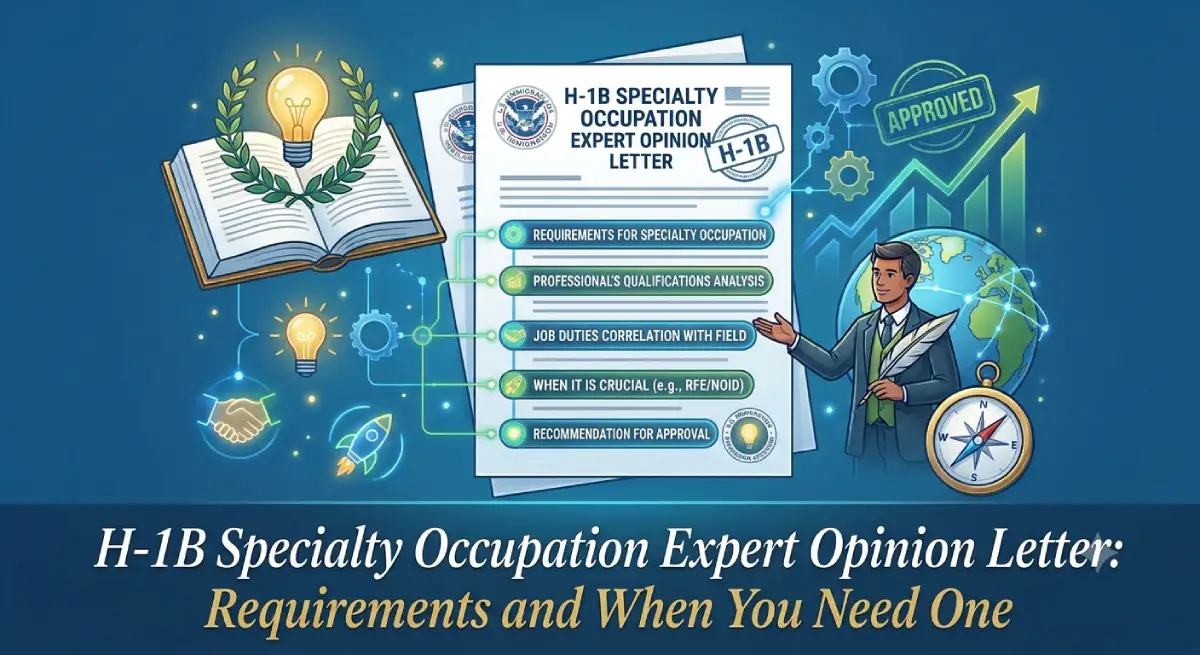
An H-1B specialty occupation expert opinion letter can help explain the technical nature of a position, the knowledge required to perform its duties, and the relationship between the position and the beneficiary’s academic qualifications.
Prepared by a qualified subject-matter expert, this letter provides an independent professional assessment that can support an initial H-1B petition or a response to a Request for Evidence (RFE).
In this guide, we explain when an H-1B specialty occupation expert opinion letter may be useful, what it should include, how experts evaluate job duties, and how EEE of America can help employers and applicants obtain professional evaluation services.
What Is an H-1B Specialty Occupation Expert Opinion Letter?
An H-1B specialty occupation expert opinion letter is a professional assessment prepared by a qualified expert in the relevant occupational or academic field.
Its purpose is to explain why a particular job requires specialized knowledge and how the position’s duties relate to the educational qualifications expected of someone performing that work.
For example, consider a software developer position involving cloud architecture, distributed computing, database engineering, and cybersecurity.
A general job description might list these responsibilities without explaining why they require specialized academic knowledge.
A qualified computer science expert can examine the actual duties, explain the technical concepts involved, identify the relevant academic disciplines, and assess how the required knowledge relates to the position.
An expert opinion letter may address:
- The technical nature of the offered position.
- The specialized knowledge required to perform its duties.
- The relationship between the job duties and a specific academic discipline.
- Industry educational requirements for comparable positions.
- The complexity of the position’s responsibilities.
- The relevance of the beneficiary’s degree and professional background.
- Whether the position’s educational requirements are consistent with applicable specialty occupation standards.
The letter is supporting evidence, not a substitute for the employer’s documentation or the legal requirements of the H-1B classification.
For professional assistance, explore EEE of America’s Expert Opinion Letter Services.
What Is a Specialty Occupation Under H-1B Regulations?
Under the Immigration and Nationality Act and 8 CFR 214.2(h)(4), an H-1B specialty occupation generally requires the theoretical and practical application of a body of highly specialized knowledge and a bachelor’s or higher degree in a directly related specific specialty, or its equivalent, as the minimum requirement for entry into the occupation in the United States.
The term directly related means there must be a logical connection between the required degree field and the duties of the position.
For example:
- A software engineering position may require a degree in computer science, software engineering, or another directly related discipline.
- A mechanical engineering position may require an appropriate engineering degree related to its technical responsibilities.
- A data science position may require specialized knowledge obtained through a directly related academic discipline such as data science, statistics, computer science, or applied mathematics, depending on the actual duties.
Importantly, a job title alone does not establish specialty occupation eligibility.
USCIS examines the actual position, its duties, the employer’s requirements, and the relationship between the required knowledge and academic qualifications.
The regulations were updated effective January 17, 2025, clarifying the specialty occupation definition and related requirements.
Under the updated framework, a position may accept degrees in more than one field when each accepted field is directly related to the duties of the position. Merely requiring a bachelor’s degree in any discipline is generally insufficient.
What Are the Four H-1B Specialty Occupation Criteria?
Under 8 CFR 214.2(h)(4)(iii)(A), a position generally needs to satisfy at least one of four alternative criteria to establish specialty occupation status.
An expert opinion letter can help explain how the position meets the applicable criterion, provided the analysis is supported by relevant evidence.
1. A Bachelor’s Degree Is Normally Required for the Occupation
The first criterion examines whether a bachelor’s or higher degree in a directly related specific specialty is normally the minimum requirement for entry into the particular occupation.
An expert may examine:
- The nature of the occupation.
- Typical professional responsibilities.
- Relevant academic disciplines.
- Educational expectations within the industry.
- Occupational and industry information.
For example, a position involving advanced software architecture, complex systems engineering, and specialized computational methods may require knowledge ordinarily obtained through a relevant bachelor’s degree or higher.
The expert should explain the relationship between the actual duties and the academic knowledge required.
2. The Degree Requirement Is Common in the Industry or the Position Is Complex and Unique
The second criterion considers whether a degree requirement is common for parallel positions among similar organizations in the employer’s industry.
Alternatively, the employer may establish that the particular position is so complex or unique that it can be performed only by an individual with a bachelor’s or higher degree in a directly related specific specialty.
For example, a data engineering role at a financial technology company may involve sophisticated data architecture, financial systems integration, and advanced computational responsibilities.
A qualified expert can explain the technical requirements of the position and compare them with relevant industry expectations.
The analysis should be supported by credible evidence rather than unsupported generalizations about the occupation.
3. The Employer Normally Requires a Relevant Degree for the Position
The third criterion examines whether the employer normally requires a bachelor’s or higher degree in a directly related specific specialty, or its equivalent, for the particular position.
Evidence may include:
- Previous job postings.
- Educational requirements for comparable positions.
- Recruitment records.
- Organizational hiring policies.
- Qualifications of employees performing similar duties.
- Documentation showing consistent degree requirements.
An expert can help explain whether the employer’s educational requirements are consistent with the specialized nature of the position.
However, simply stating that an employer prefers degree holders does not establish that the position qualifies as a specialty occupation.
4. The Specific Duties Are Specialized and Complex
The fourth criterion focuses on the actual duties of the position.
It examines whether the duties are so specialized and complex that the knowledge required to perform them is usually associated with obtaining a bachelor’s or higher degree in a directly related specific specialty.
This is particularly relevant for positions involving advanced technical responsibilities.
For example, a machine learning engineer may be responsible for:
- Designing predictive models.
- Developing machine learning algorithms.
- Evaluating statistical performance.
- Building data processing pipelines.
- Implementing production-level AI systems.
- Optimizing model performance and reliability.
A qualified expert can explain why these responsibilities require specialized knowledge in relevant academic disciplines.
This analysis can help USCIS understand the connection between the actual job duties and the required educational background.
When Do You Need an H-1B Specialty Occupation Expert Opinion Letter?
An expert opinion letter is not mandatory for every H-1B petition.
However, it may be particularly useful when the employer or applicant needs additional professional analysis to explain the position’s specialized nature or address questions raised by USCIS.
Here are some situations where an expert opinion letter may be considered.
1. When Filing an Initial H-1B Petition
Some positions have job duties that are highly specialized but are not immediately obvious from the job title.
For example, titles such as Business Analyst, Systems Analyst, Marketing Analyst, or Technology Consultant can involve very different responsibilities depending on the employer.
An expert can evaluate the actual duties and explain why they require specialized academic knowledge.
Including a well-supported expert assessment may help provide context in an initial petition, although it does not guarantee that USCIS will find the position eligible.
2. When USCIS Issues a Specialty Occupation RFE
A Request for Evidence may question whether the offered position qualifies as a specialty occupation.
USCIS may request additional documentation concerning:
- The actual job responsibilities.
- The relationship between the duties and a specific degree field.
- The employer’s educational requirements.
- Industry hiring practices.
- The complexity of the position.
- The beneficiary’s qualifications.
An expert opinion letter can provide a detailed technical assessment addressing the specific concerns raised in the RFE.
It should be prepared in response to the actual RFE rather than using a generic explanation of specialty occupations.
Read our guide to Expert Opinion Letters for H-1B RFE Responses.
3. When the Job Title Does Not Clearly Explain the Specialized Duties
Some professional positions have broad or unconventional job titles.
For example, a company may employ someone as a Technology Consultant while assigning responsibilities involving enterprise software architecture, cloud infrastructure, cybersecurity, and advanced database systems.
The title alone may not communicate the complexity of the position.
An expert can examine the detailed responsibilities and explain the specialized knowledge required to perform them.
4. When the Position Accepts Multiple Related Degree Fields
Some specialized positions may accept degrees in multiple academic disciplines.
For example, a data science position may reasonably accept degrees in computer science, statistics, applied mathematics, or data science when each discipline is directly related to the actual job duties.
An expert can explain why the accepted academic fields are relevant to the position and how the knowledge acquired through those disciplines supports its responsibilities.
5. When the Beneficiary Has a Foreign Degree
Applicants with foreign academic qualifications may need additional documentation explaining their educational background.
This is especially relevant when the degree title, program structure, or educational system differs from the U.S. system.
A credential evaluation can help explain the U.S. equivalency of the academic qualification.
Where appropriate, a separate expert assessment may also explain the relationship between the applicant’s academic background and the offered position.
Explore EEE of America’s Education Evaluation Services.
6. When the Applicant Relies on Education and Work Experience
In certain circumstances, specialized training and progressively responsible work experience may be considered as equivalent to a U.S. bachelor’s degree in a specific specialty.
This requires an appropriate analysis of the beneficiary’s education and professional experience.
An expert may assess the nature of the work performed, the specialized knowledge acquired, and the relationship between that experience and the relevant academic discipline.
EEE of America provides Work Experience Evaluation Services.
What Should an H-1B Specialty Occupation Expert Opinion Letter Include?
A strong expert opinion letter should be based on the actual position, employer documentation, and beneficiary qualifications.
It should provide a detailed professional assessment rather than simply repeat the employer’s job description.
The following sections are particularly important.
1. Expert’s Academic and Professional Qualifications
The letter should establish why its author is qualified to evaluate the position.
Relevant information may include:
- Academic degrees.
- Professional certifications.
- University appointments.
- Research experience.
- Industry experience.
- Professional publications.
- Specialized technical expertise.
- Relevant professional achievements.
For example, an expert evaluating a software engineering position should have relevant knowledge of software development, computer science, systems engineering, or another closely related discipline.
The expert’s qualifications should be verifiable and relevant to the subject being evaluated.
2. Description of the Offered Position
The letter should clearly identify the position being assessed.
This may include:
- Job title.
- Employer information.
- Department or business unit.
- Work location.
- Primary responsibilities.
- Required technical skills.
- Educational requirements.
- Reporting structure, where relevant.
The expert should understand the actual job rather than rely solely on a generic occupational description.
3. Detailed Analysis of Job Duties
This is one of the most important sections.
The expert should examine each major responsibility and explain the specialized knowledge required to perform it.
For example:
| Job responsibility | Specialized knowledge involved |
|---|---|
| Develop enterprise software systems | Software architecture and programming |
| Design database infrastructure | Database engineering and data modeling |
| Build machine learning models | Statistics and computational methods |
| Implement cybersecurity solutions | Network security and information assurance |
| Optimize cloud infrastructure | Distributed computing and cloud architecture |
The analysis should explain how the duties require theoretical and practical knowledge obtained through relevant academic training.
Simply listing technical skills is not enough. The letter should explain why those skills are necessary and how they connect to the position’s educational requirements.
4. Connection Between the Position and Academic Disciplines
An expert opinion letter should explain why a particular academic field, or multiple directly related fields, prepares an individual to perform the job.
For example, a data engineering position may require knowledge of:
- Database systems.
- Algorithms.
- Data structures.
- Statistical methods.
- Distributed computing.
- Software engineering.
The expert can explain how these subjects relate to the position’s responsibilities and why a relevant academic background is important.
The analysis should be specific to the position and should not assume that any bachelor’s degree is sufficient.
5. Industry Standards and Educational Requirements
The expert may examine relevant industry information to explain the educational expectations for comparable professional positions.
Supporting information may include:
- Occupational research.
- Industry hiring practices.
- Professional standards.
- Comparable job postings.
- Academic program descriptions.
- Employer documentation.
- Technical publications.
The purpose is to establish a factual basis for the expert’s conclusions.
6. Analysis of the Applicable Specialty Occupation Criterion
The letter should identify which specialty occupation criterion or criteria are relevant to the position.
For example, if the position is particularly complex, the expert may explain how the specialized and complex duties relate to the knowledge ordinarily associated with a relevant bachelor’s degree or higher.
If the employer relies on industry-wide degree requirements, the expert should explain the supporting industry evidence.
The letter should not merely repeat the regulatory language. It should apply the relevant standard to the actual position.
7. Conclusion and Professional Opinion
The conclusion should summarize the expert’s findings.
It may address:
- The specialized nature of the position.
- The knowledge required to perform the duties.
- The relevant academic disciplines.
- The relationship between the job responsibilities and educational requirements.
- The expert’s assessment of the position under the applicable specialty occupation standard.
The expert should clearly distinguish professional analysis from the legal determination that USCIS must make.
H-1B Specialty Occupation Expert Opinion Letter vs. Position Evaluation
These two documents are related, but they are not necessarily identical.
A position evaluation generally focuses on the duties, requirements, and complexity of a particular job.
An expert opinion letter may provide a broader professional analysis of the position, the relevant industry, and the educational knowledge required to perform the work.
| Comparison | Position evaluation | Expert opinion letter |
|---|---|---|
| Primary focus | Job duties and position requirements | Professional analysis of a specific immigration issue |
| Main purpose | Assess the nature and requirements of the role | Explain the specialized knowledge and relevant standards |
| Expert analysis | Position-focused | May cover position and beneficiary qualifications |
| Industry context | Depending on scope | May include detailed industry and academic analysis |
| H-1B use | Initial petitions and RFEs | Initial petitions and RFEs |
The appropriate document depends on the evidence required for the individual case.
If USCIS is questioning the nature of the position, a position evaluation may be relevant. If the case requires additional subject-matter analysis, an expert opinion letter may also be appropriate.
EEE of America offers both Position Evaluation Services and Expert Opinion Letter Services.
H-1B Specialty Occupation Expert Opinion Letter vs. Degree Evaluation
Another important distinction is between an expert opinion letter and an academic credential evaluation.
A degree evaluation examines foreign academic qualifications and explains their U.S. educational equivalency.
An expert opinion letter examines a specific professional question, such as whether the duties of an offered position require specialized knowledge associated with a directly related academic discipline.
| Comparison | Degree evaluation | Expert opinion letter |
|---|---|---|
| Main purpose | Assess foreign educational equivalency | Provide professional analysis |
| Focus | Academic credentials | Job duties and specialized knowledge |
| Typical evidence | Diplomas and transcripts | Job description, credentials, and industry information |
| H-1B application | Helps establish academic qualifications | Helps explain specialty occupation issues |
Some H-1B cases require both types of documentation.
For example, an applicant may have a foreign degree that needs U.S. equivalency assessment, while the employer also needs to demonstrate why the offered position qualifies as a specialty occupation.
Explore EEE of America’s Foreign Education Evaluation Services.
Which H-1B Positions May Benefit From an Expert Opinion Letter?
Expert opinion letters may be particularly useful for positions involving complex or specialized responsibilities.
Here are some examples.
Software Engineer and Software Developer
A software engineering position may involve advanced programming, software architecture, distributed systems, algorithm development, and application security.
An expert can explain how the position’s actual duties relate to computer science or software engineering education.
Data Scientist and Data Engineer
Data science and engineering positions may involve statistical modeling, machine learning, database architecture, data processing, and computational analysis.
An expert can explain the academic knowledge required for these responsibilities.
Business Analyst
Business analyst positions vary significantly across employers.
Some involve general administrative responsibilities, while others require advanced statistical analysis, financial modeling, enterprise systems, and specialized technical knowledge.
An expert can assess the actual responsibilities and explain whether the position requires a directly related academic background.
Financial Analyst
Certain financial analyst positions involve quantitative modeling, financial forecasting, risk assessment, and advanced statistical analysis.
An expert may explain the technical knowledge and educational preparation required for the specific role.
Mechanical and Electrical Engineers
Engineering positions often involve specialized technical responsibilities, including system design, simulation, testing, and advanced engineering analysis.
An expert can explain the relevant academic disciplines and how they relate to the position’s duties.
Cybersecurity Professionals
Cybersecurity roles may require specialized knowledge of network security, cryptography, threat analysis, information systems, and security architecture.
A qualified expert can explain why these responsibilities require a relevant academic foundation.
Importantly, no job title automatically qualifies for H-1B classification. Eligibility must be assessed using the actual duties and applicable regulatory requirements.
Documents Needed to Prepare an H-1B Expert Opinion Letter
The quality of an expert opinion letter depends partly on the information available for review.
EEE of America may request documents such as:
Employer and position documents
- Detailed job description.
- Employment offer letter.
- Employer information.
- Organizational details.
- Position requirements.
- Explanation of primary job duties.
- Relevant LCA and petition information, where applicable.
Beneficiary documents
- Updated resume or CV.
- Academic degree certificates.
- Official transcripts.
- Professional certifications.
- Previous employment records.
- Work experience letters.
- Existing credential evaluation reports, if available.
Additional documents for RFE responses
- Complete USCIS RFE notice.
- Copy of the original petition, where available.
- Previously submitted job descriptions.
- Supporting employer documentation.
- Any additional evidence requested by USCIS.
Non-English academic and employment documents may require certified English translations.
The exact checklist depends on the nature of the case and the questions the expert needs to address.
How EEE of America Helps With H-1B Specialty Occupation Expert Opinion Letters
Preparing an H-1B expert opinion letter requires a clear understanding of the offered position, the applicable educational requirements, and the specialized knowledge involved.
EEE of America provides expert opinion letters and professional evaluation services for H-1B and other employment-based immigration matters.
Its services may be useful for employers, foreign professionals, and immigration attorneys who need additional documentation to explain complex job duties or academic qualifications.
Depending on the case, EEE of America can assist with:
Specialty Occupation Expert Opinion Letters
Professional analysis of the position’s duties, specialized knowledge, and educational requirements.
Position Evaluations
Assessments of job responsibilities and the nature of the position for H-1B and other immigration-related matters.
Education Evaluations
Evaluation of foreign academic credentials to explain their U.S. educational equivalency.
Work Experience Evaluations
Assessment of professional experience when a combination of education and experience is relevant to the applicable qualification requirements.
Certified Document Translations
Translation of foreign academic and professional records into English.
By offering these services, EEE of America provides applicants and employers with an opportunity to coordinate several types of professional documentation through one provider.
To discuss your case, visit EEE of America’s Expert Opinion Letter Services or contact the team.
Frequently Asked Questions About H-1B Specialty Occupation Expert Opinion Letters
Is an expert opinion letter required for every H-1B petition?
No. USCIS does not require every H-1B petition to include an expert opinion letter. However, it may be useful when the petitioner needs additional professional analysis of the position’s specialized nature, degree requirements, or beneficiary qualifications.
Can an expert opinion letter help prove specialty occupation?
An expert opinion letter can help explain why a position requires specialized knowledge and how its duties relate to a directly related academic discipline. It should be supported by relevant employer documentation, job descriptions, and other evidence.
Can I submit an expert opinion letter with my initial H-1B petition?
Yes. An expert opinion letter may be included with an initial petition when the employer believes additional professional analysis would help explain the position and its educational requirements.
Can an expert opinion letter help with an H-1B RFE?
Yes. It may help address RFE concerns about specialty occupation status, job duties, degree relevance, or the beneficiary’s qualifications. The letter should respond directly to the issues raised in the RFE and be accompanied by relevant supporting evidence.
Who can write an H-1B specialty occupation expert opinion letter?
A qualified professor, researcher, or experienced industry professional with relevant expertise may prepare an expert opinion letter. The author’s qualifications should be verifiable and directly relevant to the position being evaluated.
Does a job title determine whether an H-1B position qualifies as a specialty occupation?
No. USCIS considers the actual duties and requirements of the position, not simply its job title. Two positions with identical titles may have substantially different responsibilities and educational requirements.
Can a position accept degrees in multiple fields?
Yes, provided that each accepted degree field is directly related to the duties of the position. The updated H-1B regulations clarify that multiple related fields may satisfy the specialty occupation definition.
Can work experience replace a bachelor’s degree for H-1B?
In certain circumstances, specialized training and progressively responsible work experience may be considered equivalent to a bachelor’s degree in a specific specialty. The equivalency must meet applicable requirements and be supported by appropriate documentation.
What is the difference between an H-1B expert opinion letter and a degree evaluation?
A degree evaluation assesses the U.S. equivalency of foreign academic credentials. An expert opinion letter provides professional analysis of a specific question, such as whether the job duties require specialized knowledge associated with a relevant academic discipline.
Can EEE of America prepare both position and work experience evaluations?
EEE of America offers position evaluation and work experience evaluation services, in addition to expert opinion letters and education evaluations. The appropriate combination depends on the requirements of the individual case.
How long does it take to prepare an H-1B expert opinion letter?
Processing time depends on document completeness, case complexity, and expert availability. Contact EEE of America for its current processing estimate, particularly if you are responding to an RFE with a filing deadline.
Does an expert opinion letter guarantee H-1B approval?
No. An expert opinion letter is supporting evidence. USCIS evaluates the entire petition, including the employer’s documentation, position requirements, beneficiary qualifications, and applicable immigration regulations. No expert opinion letter guarantees approval.
Get Professional Support for Your H-1B Specialty Occupation Case
Demonstrating that an H-1B position qualifies as a specialty occupation requires more than a technical job title or a general statement that a bachelor’s degree is preferred.
The employer must establish a clear relationship between the actual job duties, the specialized knowledge required, and the relevant academic qualifications.
A professionally prepared expert opinion letter can help explain these connections through detailed subject-matter analysis and supporting evidence.
Whether you are preparing an initial H-1B petition or responding to an RFE, EEE of America can help you explore the appropriate expert opinion letter, position evaluation, and credential evaluation services.
Need an H-1B specialty occupation expert opinion letter?
Visit EEE of America Expert Opinion Letter Services or contact our team to discuss your documentation requirements.
Disclaimer: This article is for general informational purposes only and does not constitute legal or immigration advice. Expert opinion letters are supporting evidence and do not guarantee H-1B petition approval. Eligibility depends on the facts of the case and applicable immigration regulations. Consult a qualified immigration attorney regarding your petition.