

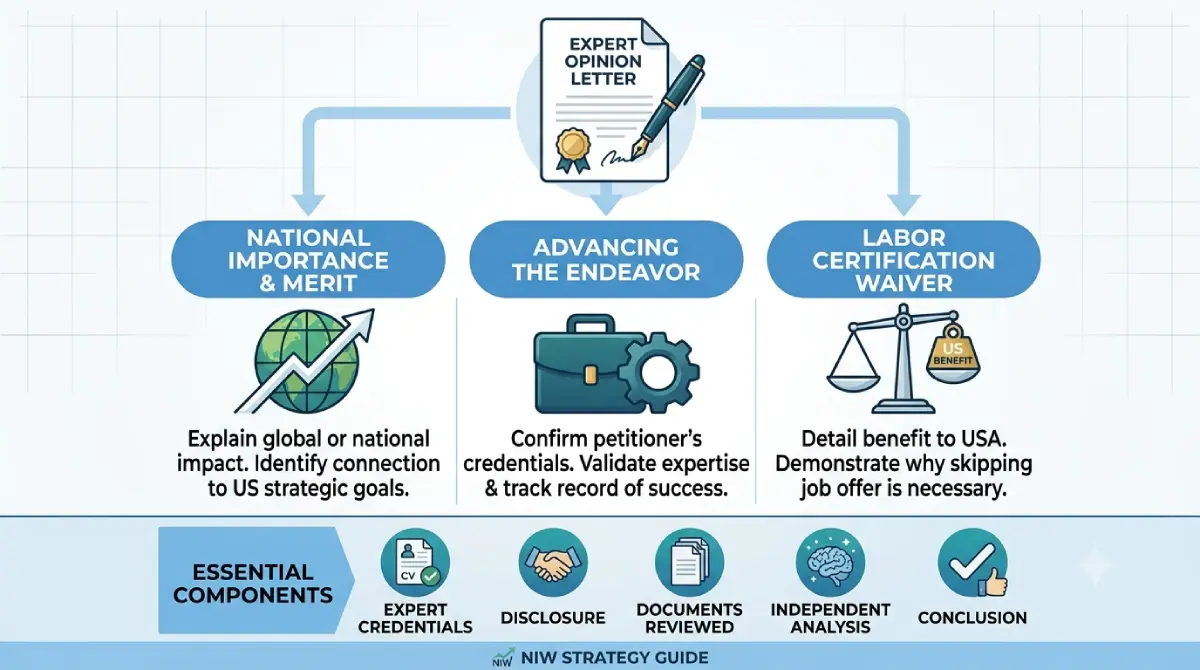
An EB-2 National Interest Waiver (NIW) petition involves demonstrating that an applicant’s proposed endeavor has substantial merit and national importance, that the applicant is well positioned to advance it, and that waiving the job offer and labor certification requirements would benefit the United States.
For professionals working in specialized fields, explaining the significance of their achievements and proposed work can be difficult. This is where an EB-2 NIW expert opinion letter may provide useful supporting evidence. A qualified expert can evaluate the applicant’s professional record, explain the technical or industry significance of their work, and provide an informed assessment based on the documents reviewed.
But what should an expert opinion letter actually look like? What information should it contain? Is there a standard USCIS format? And what separates a meaningful expert evaluation from a generic recommendation letter?
This guide explains the structure of an EB-2 NIW expert opinion letter, provides an illustrative sample, and highlights the elements that applicants should examine before including such a document in their immigration petition.
If you are looking for professional assistance, visit our EB-2 NIW expert opinion letter services to learn about expert evaluations offered by EEE of America.
Is There an Official USCIS Format for an EB-2 NIW Expert Opinion Letter?
No. USCIS does not prescribe one universal template or mandatory layout for an EB-2 NIW expert opinion letter.
The format can vary depending on the expert’s discipline, the applicant’s proposed endeavor, the evidence being evaluated, and the purpose of the letter. An evaluation concerning artificial intelligence research, for example, may require a different technical explanation from one addressing healthcare innovation, civil engineering, or entrepreneurship.
However, a well-organized letter should make several things clear:
- Who prepared the opinion and why the expert is qualified.
- What the expert was asked to evaluate.
- Which documents and information the expert reviewed.
- What the applicant’s proposed endeavor involves.
- How the applicant’s experience and achievements relate to that endeavor.
- What professional conclusions the expert reached and why.
The focus should be on the substance of the evaluation rather than copying a particular template. A document can have polished formatting and still provide little useful analysis if it contains unsupported praise or fails to explain the applicant’s actual work.
EB-2 NIW Expert Opinion Letter Sample: Recommended Structure
The following structure illustrates how an expert opinion letter may be organized. It is an educational example, not an official USCIS template or a letter intended for submission without customization.
1. Expert’s Letterhead and Contact Information
The document may begin with the expert’s institutional or professional letterhead, where appropriate.
It generally identifies:
- Expert’s full name.
- Academic or professional title.
- University, research institution, or organization.
- Relevant department or area of specialization.
- Professional contact information.
- Date of the letter.
The information should be accurate and verifiable. An expert should not use an institutional letterhead or imply institutional endorsement without authorization.
2. Subject and Purpose of the Letter
The opening should explain the purpose of the evaluation and identify the applicant.
For example:
Subject: Independent Expert Opinion Regarding the Professional Contributions and Proposed Endeavor of [Applicant Name]
The introductory paragraph should establish that the expert is providing a professional assessment of a defined subject. It should not suggest that the expert has authority to determine the applicant’s immigration eligibility or predict USCIS’s decision.
3. Expert’s Qualifications and Professional Background
This section explains why the expert is qualified to evaluate the applicant’s work.
Relevant information may include:
- Academic qualifications and specialized training.
- Current and previous professional positions.
- Research or industry specialization.
- Publications and research contributions.
- Relevant patents, technical work, or professional achievements.
- Experience evaluating work in the applicant’s field.
The expert’s credentials should be relevant to the opinion being provided. A long biography is not necessarily useful if it does not establish expertise in the subject under evaluation.
4. Relationship Between the Expert and the Applicant
The letter should explain how the expert became familiar with the applicant’s work.
For example, the expert may have:
- Worked directly with the applicant.
- Supervised the applicant’s research.
- Collaborated on a professional project.
- Reviewed the applicant’s published research.
- Encountered the applicant’s work through independent professional or academic channels.
- Evaluated the applicant’s professional record and supporting documents without a prior personal relationship.
Any existing relationship should be disclosed accurately. An expert should never describe themselves as independent if they have a direct relationship that makes such a description misleading.
5. Documents Reviewed
A credible opinion should identify the materials on which it is based.
Depending on the applicant’s field, these may include:
- Professional CV or resume.
- Academic qualifications.
- Research publications and citation records.
- Patent documents.
- Technical project reports.
- Employment records.
- Evidence of professional achievements.
- Proposed endeavor statement.
- Business plans or project documentation.
- Supporting letters or other relevant records.
The expert should not claim to have verified documents or facts that they have not actually examined.
6. Applicant’s Professional Background and Proposed Endeavor
This section connects the applicant’s professional experience to the work they intend to pursue in the United States.
A useful explanation should go beyond the applicant’s job title. It should describe the specific proposed endeavor, its objectives, the applicant’s role, and the relevant professional or technical context.
For example, a software engineer proposing to develop cybersecurity solutions should have the proposed work explained in terms of the security challenges being addressed, the intended applications, and the applicant’s relevant experience.
7. Expert’s Substantive Analysis
This is the central part of the letter.
The expert should explain the professional or technical significance of the applicant’s work, identify relevant supporting evidence, and provide a reasoned assessment.
Where relevant, the analysis may address the three requirements established in Matter of Dhanasar:
- Substantial merit and national importance of the proposed endeavor.
- Whether the applicant is well positioned to advance that endeavor.
- Whether, on balance, waiving the job offer and labor certification requirements would benefit the United States.
The letter should focus on issues the expert is competent to assess. An expert may provide technical or professional insight relevant to these requirements, while the overall legal argument should be developed with the applicant’s immigration attorney.
Illustrative EB-2 NIW Expert Opinion Letter Sample
The following is a shortened, fictional example showing how an expert might structure an evidence-based evaluation. The names, institutions, project descriptions, achievements, and figures are hypothetical. They must not be presented as real credentials, research findings, or USCIS-approved language.
Sample: Expert Opinion on a Proposed Cybersecurity Endeavor
[Expert’s Name]
[Professional Title]
[University or Organization]
[Department or Specialization]
[Professional Contact Information]
Date: [Month Day, Year]
Subject: Professional Evaluation of [Applicant Name]’s Cybersecurity Contributions and Proposed Endeavor
To Whom It May Concern:
Introduction and Purpose of Evaluation
I am writing to provide my professional assessment of [Applicant Name]’s background and proposed endeavor in the field of cybersecurity. I have prepared this evaluation after reviewing the professional information and supporting documentation identified in this letter.
My assessment focuses on the applicant’s technical experience, documented contributions, and proposed work involving the development of cybersecurity solutions for organizations operating in critical sectors.
Expert’s Professional Background
I am [Expert Name], a [professional title] specializing in [specific area of expertise]. My professional experience includes [relevant academic or industry experience], with particular focus on [relevant technical discipline].
My work has involved [relevant research, technical projects, publications, or professional responsibilities]. These experiences provide the professional foundation for my assessment of the technical matters discussed below.
Materials Reviewed
For this evaluation, I reviewed the following materials supplied for professional assessment:
- The applicant’s professional CV.
- Documentation describing previous cybersecurity projects.
- Technical reports outlining the applicant’s responsibilities and contributions.
- Relevant research publications and supporting materials.
- A description of the applicant’s proposed cybersecurity endeavor.
This opinion is limited to the materials reviewed and the areas within my professional competence.
Assessment of the Applicant’s Professional Contributions
The documentation describes the applicant’s experience in [specific cybersecurity specialization]. In particular, the project materials identify the applicant’s role in [describe a specific project or technical contribution].
The significance of this work should be assessed by examining the technical problem addressed, the applicant’s individual responsibilities, and the documented results.
For example, if a project involved improving the detection of security threats in enterprise networks, relevant evidence could include the system’s architecture, the applicant’s contribution to its development, testing results, and independently documented operational outcomes.
These details are more informative than simply describing the applicant as an accomplished cybersecurity professional.
Assessment of the Proposed Endeavor
The proposed endeavor involves [specific description of the applicant’s intended work in the United States].
From a professional perspective, the relevant questions include the nature of the cybersecurity problem being addressed, the intended applications of the proposed solution, and the potential implications for the organizations or sectors that may use it.
The assessment should distinguish between the general importance of cybersecurity and the specific potential contribution of the applicant’s proposed work.
Professional Opinion
Based on the materials reviewed, the applicant’s experience in [specific area] appears relevant to the proposed work involving [specific endeavor].
The applicant’s documented experience in [specific project, skill, or contribution] provides a basis for evaluating their technical preparation. Further assessment of the proposed endeavor should consider its objectives, implementation plan, supporting evidence, and the applicant’s demonstrated ability to carry it forward.
This is my professional opinion concerning the technical and professional matters addressed above. It is not a legal determination of immigration eligibility.
Sincerely,
[Expert’s Name]
[Professional Title]
[Institution or Organization]
[Signature, where applicable]
[Professional Contact Information]
Important: This sample is deliberately abbreviated to demonstrate structure and analytical style. A real evaluation should be substantially tailored to the expert’s actual qualifications, the applicant’s documented achievements, and the particular issues being examined. It should not include fictional credentials, invented statistics, unsupported claims, or conclusions that the expert cannot substantiate.
How Should an Expert Opinion Letter Address the Three Dhanasar Prongs?
The expert’s analysis should be relevant to the applicant’s actual NIW case. The following examples illustrate the distinction between a broad statement and a more useful professional explanation.
First Prong: Substantial Merit and National Importance
Weak approach:
“The applicant works in artificial intelligence, which is an important field in the United States.”
This statement discusses the importance of an entire industry without explaining the significance of the applicant’s particular proposed endeavor.
More useful approach:
“The applicant proposes to develop [specific AI application] to address [identified problem]. The technical approach involves [relevant method or innovation]. The potential implications should be evaluated through the proposed application’s intended use, supporting technical evidence, and its relevance to the affected sector.”
The expert should explain why the specific proposed work matters, rather than relying on general statements about the popularity or importance of the field.
Second Prong: Whether the Applicant Is Well Positioned to Advance the Endeavor
Weak approach:
“The applicant is highly qualified and has extensive professional experience.”
More useful approach:
“The applicant’s documented work on [specific project] involved [specific responsibility]. The project records indicate [documented outcome or contribution]. This experience is relevant to the proposed endeavor because it demonstrates familiarity with [specific technical or professional requirement].”
The distinction is that the second example connects an achievement to the applicant’s future proposed work.
Third Prong: Whether Waiving the Job Offer Requirement Would Benefit the United States
Weak approach:
“The United States will benefit greatly if the applicant receives a national interest waiver.”
More useful approach:
“The applicant’s proposed work involves [specific professional activity]. Its potential value should be assessed in the context of [relevant industry or public interest considerations], the applicant’s specialized experience, and the practical circumstances surrounding the proposed endeavor.”
The third prong involves a legal balancing assessment. An expert may explain relevant professional or technical considerations, but should not make unsupported legal conclusions or claim that a waiver is automatically justified.
What Makes an EB-2 NIW Expert Opinion Letter Persuasive?
The quality of an expert opinion letter is not determined by its length, number of pages, or the number of positive adjectives it contains.
Several factors are particularly important.
1. Relevant Expert Credentials
The expert should have qualifications that relate to the subject being evaluated. A professional with experience in a particular technical discipline may be more appropriate than a general industry commentator when the opinion requires specialized technical knowledge.
2. Clear Identification of Evidence
The letter should identify the documents reviewed and refer to specific evidence when discussing the applicant’s achievements.
Instead of stating that an applicant has made significant contributions, the expert should explain which contribution is being evaluated and what evidence demonstrates it.
3. Specific Technical or Professional Reasoning
The letter should explain why an achievement matters within the relevant field.
For example, an engineering expert might explain the technical challenge addressed by an applicant’s design, while a medical researcher might discuss the methodology and potential significance of a particular research contribution.
4. Connection to the Proposed Endeavor
Past achievements are relevant, but the expert should explain how they relate to the work the applicant intends to pursue.
A strong professional record does not automatically establish that the applicant is prepared to advance every proposed endeavor. The connection needs to be explained.
5. Consistency With the Petition
The expert’s statements should be consistent with the applicant’s CV, proposed endeavor statement, project records, recommendation letters, business plan, and other supporting materials.
Inconsistencies in job titles, dates, project outcomes, or descriptions of contributions can undermine the reliability of the evidence.
6. Balanced and Credible Conclusions
An expert should remain within their professional competence. They should distinguish between established facts, professional assessments, and future projections.
A letter that acknowledges the limits of the available evidence may be more credible than one making sweeping claims that cannot be supported.
Common Mistakes to Avoid in an EB-2 NIW Expert Opinion Letter
Applicants should review expert opinion letters carefully before including them in a petition.
Common weaknesses include:
- Generic praise: Describing the applicant as exceptional without explaining the achievements behind that assessment.
- Vague proposed endeavor: Discussing an occupation or industry rather than the applicant’s specific intended work.
- Unsupported national importance claims: Assuming that the importance of an industry automatically establishes the importance of the applicant’s endeavor.
- Insufficient expert credentials: Failing to explain why the author is qualified to assess the subject.
- Unclear methodology: Not identifying which documents the expert reviewed or how conclusions were reached.
- Overstated achievements: Including results or claims that are not supported by independent records.
- Repetitive language: Repeating the applicant’s CV or petition narrative without adding meaningful professional analysis.
- Incorrect independence claims: Misrepresenting the expert’s relationship with the applicant.
- Unrealistic projections: Presenting future economic, technical, or employment outcomes as established facts without a reasonable evidentiary basis.
- Inconsistency: Using descriptions or figures that conflict with other documents in the petition.
An expert opinion letter should complement the rest of the evidence, not create new factual claims that the applicant cannot substantiate.
Expert Opinion Letter vs. Recommendation Letter: What Is the Difference?
These terms are sometimes used interchangeably, but the purpose and substance of the documents can differ.
| Expert opinion letter | Recommendation letter |
|---|---|
| Provides a professional assessment of a defined subject. | Primarily expresses support for the applicant. |
| May evaluate technical work, professional contributions, or a proposed endeavor. | Often describes the applicant’s character, achievements, and professional abilities. |
| Should explain the expert’s methodology and evidence reviewed. | May be based on direct professional experience or collaboration. |
| Should contain specific reasoning supporting the opinion. | May focus on the recommender’s experience with the applicant. |
A recommendation letter can still contain substantive professional analysis, and an expert opinion letter can be prepared by someone familiar with the applicant’s work. The actual content, expertise, relationship, and purpose matter more than the document’s title.
EB-2 NIW Expert Opinion Letter Checklist
Before including an expert opinion letter in an NIW petition, consider whether it addresses the following questions:
- Is the expert clearly identified?
- Are the expert’s relevant qualifications explained?
- Is the expert’s relationship with the applicant accurately disclosed?
- Does the letter explain its purpose and scope?
- Does it identify the documents reviewed?
- Is the applicant’s proposed endeavor described specifically?
- Are relevant achievements supported by identifiable evidence?
- Does the analysis explain the significance of the applicant’s work?
- Does it connect relevant evidence to the proposed endeavor?
- Are conclusions within the expert’s professional competence?
- Is the letter consistent with the rest of the petition?
- Does it avoid guarantees or unsupported claims about immigration approval?
Not every letter must contain identical sections. The checklist is a practical quality-control tool, not a mandatory USCIS document requirement.
How EEE of America Can Help With an EB-2 NIW Expert Opinion Letter
Preparing a meaningful expert opinion letter requires more than filling in a standard template. The expert must understand the subject matter, review the relevant documentation, and provide a professional assessment appropriate to the purpose of the engagement.
EEE of America provides expert opinion letter services for employment-based immigration matters, including EB-2 NIW petitions. We work with university professors and industry professionals to provide evaluations relating to applicants’ specialized backgrounds, professional contributions, and proposed work.
Depending on the case and the scope of the evaluation, the process may involve reviewing:
- The applicant’s professional CV and educational background.
- The proposed endeavor and relevant professional objectives.
- Supporting documentation relating to research, projects, or technical achievements.
- The particular issues the expert is being asked to assess.
- Additional relevant materials supplied for the evaluation.
The goal is to provide a professional opinion grounded in the information reviewed and the expert’s relevant field of knowledge.
If you are preparing an initial EB-2 NIW petition or considering additional expert evidence, visit our EB-2 NIW expert opinion letter service page or contact EEE of America to discuss your requirements.
Frequently Asked Questions
What does an EB-2 NIW expert opinion letter sample look like?
A sample generally illustrates the expert’s credentials, the purpose of the evaluation, the applicant’s background, documents reviewed, professional analysis, and conclusions. The precise structure depends on the expert’s field and the purpose of the letter.
Is there a standard EB-2 NIW expert opinion letter template?
No mandatory USCIS template exists for this supporting document. A letter should be organized according to the subject being evaluated and the evidence available. A generic template should never replace a case-specific professional assessment.
How long should an EB-2 NIW expert opinion letter be?
There is no universal page-count requirement. The document should be long enough to explain the expert’s qualifications, the evidence reviewed, the relevant analysis, and the conclusions. Completeness and substance are more important than reaching an arbitrary page count.
Should an expert opinion letter address all three Dhanasar prongs?
Not necessarily. The appropriate scope depends on the purpose of the evaluation and the expert’s professional competence. Some experts may be best placed to address a particular technical contribution or part of the applicant’s proposed endeavor. The overall petition should address all applicable NIW requirements through the complete body of evidence.
Can I use the same expert opinion letter for every EB-2 NIW applicant?
No. A meaningful expert opinion should reflect the particular applicant’s background, proposed endeavor, supporting evidence, and the expert’s actual knowledge. Reusing generic language without individual analysis can weaken the document’s usefulness.
Is an independent expert opinion letter better than a dependent letter?
Independence may help establish that an assessment is not simply based on a direct supervisory or employment relationship. However, independence alone does not determine the evidentiary value of a letter. The expert’s relevant qualifications, knowledge of the subject, evidence reviewed, and reasoning remain important.
Can an expert opinion letter help if I have few research publications?
Potentially. Publications are only one possible form of professional evidence. Depending on the applicant’s field, other relevant materials may include documented projects, technical innovations, professional responsibilities, patents, business achievements, or measurable contributions. The expert should evaluate the evidence that actually exists rather than assume that every applicant must have the same academic profile.
Can I submit an expert opinion letter in response to an RFE?
An expert opinion letter may be submitted as additional supporting evidence when it is relevant to the issues raised in an RFE. Its purpose should be to provide substantive analysis addressing the specific concerns, rather than merely repeating the original petition’s statements. The response strategy should be developed with an immigration attorney.
Does an expert opinion letter guarantee NIW approval?
No. USCIS evaluates the complete petition, including eligibility for the underlying EB-2 classification and all applicable NIW requirements. An expert opinion letter is supporting evidence and does not guarantee approval.
Final Thoughts
An EB-2 NIW expert opinion letter should do more than describe an applicant as talented or highly accomplished. Its purpose is to provide a credible, professionally reasoned assessment of relevant evidence and explain the significance of the applicant’s work within the expert’s area of knowledge.
When reviewing an EB-2 NIW expert opinion letter sample, pay particular attention to the expert’s qualifications, the documents reviewed, the specificity of the analysis, and the connection between the applicant’s achievements and proposed endeavor.
The most useful document is not necessarily the longest or most impressive-looking one. It is the one that makes its purpose clear, supports its conclusions with evidence, and provides meaningful professional insight.
Need an EB-2 NIW expert opinion letter? Contact EEE of America to discuss an expert evaluation based on your professional background, proposed endeavor, and supporting documentation.
Disclaimer: This article is for general informational purposes only and does not constitute legal advice. An expert opinion letter is supporting evidence, not a guarantee of immigration approval or a substitute for legal representation. Applicants should consult a qualified U.S. immigration attorney regarding their individual circumstances.