
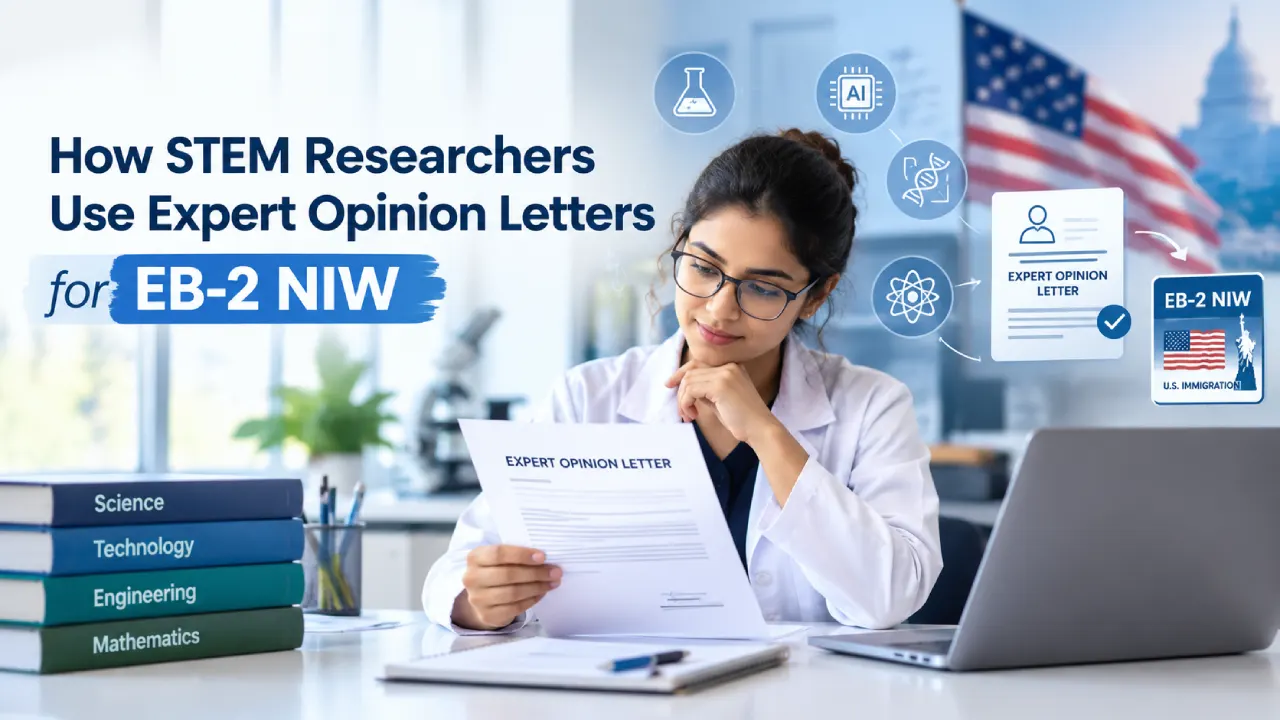
If you are a STEM researcher, scientist, or academic preparing an EB-2 National Interest Waiver petition, your expert opinion letters may be the single most important documents you submit. Not your CV. Not your publication list. The letters.
Here is why: USCIS adjudicators are generalists. They evaluate petitions across biomedical engineering, artificial intelligence, climate science, oncology, quantum computing, and dozens of other disciplines — all in the same week. Without a credible, expert voice explaining what your research actually does and why the United States needs it, even a genuinely impressive CV can fail to move the needle.
This guide explains exactly how STEM researchers and academics use expert opinion letters in EB-2 NIW petitions — what goes in them, who should write them, how USCIS evaluates them, and what separates letters that win approvals from letters that trigger RFEs.
What Is an EB-2 NIW Expert Opinion Letter for STEM Researchers and Academics?
An EB-2 NIW expert opinion letter is a formal, analytical document written by a credentialed, independent professional in your field — typically a senior researcher, university professor, or recognized subject-matter authority — who assesses your qualifications, your proposed research program, and the national significance of your work for a USCIS adjudicator.
It is not a reference letter. It is not a character endorsement. It is a structured legal-evidential argument, written by someone with the professional authority to make it.
For STEM researchers and academics specifically, the letter serves three interconnected functions:
- It translates technical work into plain language that a non-specialist USCIS officer can evaluate confidently.
- It connects your research to U.S. national priorities — NIH initiatives, NSF priorities, DOE clean energy goals, CDC public health programs — with specificity that a CV cannot convey.
- It gives USCIS an independent, third-party assessment of where your work stands relative to your field, why it matters, and why you are the right person to advance it in the United States.
A well-constructed expert opinion letter answers the question USCIS is really asking: Why does the United States need this specific researcher, doing this specific work, right now — badly enough to waive the standard labor market protections?
The Legal Standard: Matter of Dhanasar (2016)
Every EB-2 NIW petition — and every expert opinion letter supporting one — is evaluated against the three-prong framework established in Matter of Dhanasar, 26 I&N Dec. 884 (AAO 2016).
Issued by USCIS’s Administrative Appeals Office on December 27, 2016, Dhanasar replaced the prior NYSDOT standard and created the modern analytical test for National Interest Waivers. Understanding it is not optional if you want your expert letter to actually work.
The three prongs are:
Prong 1: Substantial Merit and National Importance
Your proposed endeavor must have genuine value to the United States — not just to your employer, your lab, or your academic department. USCIS looks for connection to national-level priorities: public health, energy infrastructure, technological competitiveness, economic development, or national security.
Importantly, Dhanasar moved away from requiring geographic breadth across the entire country. A regionally focused research program can satisfy Prong 1 if it addresses priorities of national concern or establishes a model that can be replicated elsewhere.
Prong 2: Well Positioned to Advance the Endeavor
This prong is about you specifically — not your field in general. USCIS wants evidence that this individual researcher, with their documented track record of publications, citations, grants, patents, or clinical outcomes, is specifically equipped to do what they say they will do.
This is the most commonly flawed prong in weak NIW letters. Many letters describe how important the field is without making a concrete case for the individual petitioner.
Prong 3: On Balance, Beneficial for the U.S. to Waive the Job Offer Requirement
This prong requires a balancing analysis. The expert must argue not just that the waiver could benefit the U.S., but that requiring PERM labor certification would concretely constrain the petitioner’s proposed work — and that what the U.S. gains from granting the waiver outweighs the labor market protection rationale.
For STEM researchers, this often centers on the freedom to work across institutions, publish openly, pursue federal grant funding without employer-tied constraints, and serve multiple academic or research communities simultaneously.
Every section of a strong EB-2 NIW expert opinion letter maps directly to one or more of these three prongs. Letters that do not build a clear, evidence-grounded argument for each prong fail — regardless of how impressive the expert or how strong the petitioner’s CV.
What Does an Expert Opinion Letter Say in EB-2 NIW?
A properly constructed EB-2 NIW expert opinion letter for a STEM researcher or academic follows a deliberate structure. Here is what each section must accomplish:
Expert Credentials and Basis of Authority (Opening Section)
The letter opens by establishing why this expert’s opinion matters. USCIS weighs the content of the letter in proportion to the author’s demonstrated authority to assess your specific field.
This section must go beyond a title and an institution. It should establish: degrees held and where, current institutional affiliation and role, publication record and citation impact, funded research grants, editorial board memberships, peer review service for major journals or federal funding agencies (NIH, NSF, DOE), and — critically — the expert’s specific basis for competence to evaluate your proposed endeavor.
“I am a professor at [University]” is not sufficient. “I am a Professor of Environmental Engineering at [University], have published 74 peer-reviewed articles with more than 3,100 citations, served as a principal investigator on four EPA-funded research programs, and peer-review grant applications for the National Science Foundation’s Environmental Engineering program” — that establishes authority.
Clear Description of the Proposed Endeavor
The expert must explain what you do and what you propose to accomplish — in plain language a non-specialist adjudicator can follow. Jargon-heavy descriptions are one of the most common and costly errors in letters from scientific fields.
This section should cover: what the research or professional work involves, the specific problem it addresses, the methods or approach being used, and the expected outcomes. Technically accurate. Clearly written. Accessible to a non-expert reader.
Substantial Merit and National Importance (Prong 1)
The expert must make a specific, evidence-anchored argument for the national importance of your proposed work. Not “this field is nationally important” — that is a field endorsement, not a Prong 1 argument. The expert must explain why your specific proposed endeavor matters at a national level, using concrete evidence.
For STEM researchers, strong Prong 1 arguments typically cite:
- Federal research priority documents (NIH strategic plans, NSF priority areas, DOE research roadmaps, CDC public health initiatives, White House technology or climate action plans)
- National-scale data on the problem being addressed (disease burden statistics, infrastructure gap data, economic productivity losses, national security assessments)
- Industry-wide adoption potential or replication value of the research outputs
- Policy alignment with existing federal programs or legislative mandates
The national importance connection must be explicit and cited. An expert asserting that “this research is of great importance to the United States” without citing supporting evidence is writing a letter that will fail.
Individual Positioning Assessment (Prong 2)
This is the section where most expert letters for STEM researchers fall short — and where the best ones stand apart.
The expert must assess this individual’s positioning to advance the proposed work, not the importance of the field. For academic and research petitioners, strong Prong 2 evidence includes:
- Publication record — not just a count, but the significance of where you publish, how often your work is cited, and whether peers in the field have built on it
- Citation metrics — h-index, total citations, citation trajectory, and how these compare to peers at your career stage
- Grants and funding — as PI or co-PI, amounts, funding agencies, and what the grants support
- Patents — with commercial application or licensing if applicable
- Peer recognition — editorial board positions, invited peer review, conference keynotes, awards from professional societies
- Prior measurable progress — has your proposed research already produced results? Clinical protocols adopted? Software deployed? Data sets used by other researchers? These specific outcomes are the strongest positioning evidence available.
- Institutional affiliations — affiliation with research universities, national labs, or federal programs adds credibility to the positioning argument
The expert should also explain what distinguishes this petitioner from other researchers in the field — not to denigrate peers, but to explain what is specifically valuable about this researcher’s track record and approach.
Waiver Justification (Prong 3)
The expert must make an affirmative case for why the waiver serves the national interest — not just why the petitioner would be harmed by PERM, but what the U.S. stands to gain.
For STEM researchers and academics, the Prong 3 argument typically addresses:
- Why tying this researcher to a single employer through labor certification would structurally constrain the proposed research program (multi-institutional data access, cross-university collaboration, independent publishing, federal grant eligibility as PI)
- Why the flexibility to work across research settings, institutions, or communities directly enables the national-level impact described in Prong 1
- What would be lost or delayed if PERM were required — specifically, not hypothetically
Clear, Unambiguous Professional Conclusion
The closing paragraph must state the expert’s conclusion directly and without hedging: this petitioner’s proposed work satisfies the Dhanasar standard and the NIW should be granted. This is a professional opinion from a credentialed authority. It should read like one.
Weak conclusions trail off into general praise. Strong conclusions are declarative.
How to Get an Expert Opinion Letter for EB-2 NIW
Option 1: Source Independent Experts Yourself
Some STEM researchers and academics identify their own expert letter writers — typically senior colleagues or respected figures in their field who are willing to write independently. This is viable but carries significant risk if the writer is unfamiliar with USCIS adjudication standards and the Dhanasar framework.
A letter from a Nobel laureate that focuses on praising your achievements without structuring the argument around all three Dhanasar prongs is weaker than a well-structured letter from a competent, independent senior researcher. The legal framework matters as much as the writer’s credentials.
If you go this route:
- Choose writers with no close supervisory or collaborative relationship with you (independent letters carry more evidentiary weight)
- Provide your proposed endeavor statement and full CV
- Brief the writer specifically on the Dhanasar framework and what each prong requires
- Review drafts against the checklist in the final section of this article
Option 2: Work with a Professional Evaluation Service
For STEM researchers who want letters written by credentialed, independent experts specifically matched to their field — structured around USCIS adjudication standards — professional services like AAE Evaluations handle the full process: expert matching, drafting, expert review and sign-off, and delivery on institutional letterhead.
This approach is particularly valuable for:
- Initial petitions where you need letters that preemptively address all three Dhanasar prongs
- RFE responses where you need entirely new, targeted letters addressing specific USCIS concerns
- Petitioners whose own network does not include suitable independent experts in their specific sub-field
AAE Evaluations has supported more than 1,500 EB-2 NIW and employment-based immigration cases since 2018, with expert networks covering STEM research, healthcare, technology, environmental science, and business disciplines.
Option 3: Hybrid Approach
Many strong NIW petition packages combine both: one or two letters from experts in the petitioner’s own professional network (affiliated letters, valuable for first-hand knowledge) plus one or two independent letters from credentialed professionals outside that network.
The January 2025 USCIS NIW policy guidance confirmed that both affiliated and independent letters serve distinct evidentiary roles in a complete NIW petition. Neither type alone is sufficient; the most compelling packages include both.
How Many Expert Opinion Letters Should You Include?
USCIS does not specify a required number. What matters is quality, independence, and relevance — not volume.
For most STEM researchers and academics:
For an initial petition: Two to three independent expert opinion letters, plus one to two affiliated letters from individuals who have direct, first-hand knowledge of your research contributions. This totals three to five letters and represents the most common profile of well-supported initial petitions.
For an RFE response: One to two entirely new, targeted expert opinion letters written specifically to address the concerns USCIS identified. Adding more volume rarely helps. Directly addressing the stated concerns, with specificity, is what matters.
The strategic question is not “how many” but “how well each letter covers the specific ground it needs to cover.” A petition with three surgically constructed letters from credentialed independent experts will consistently outperform a petition with eight generic endorsements.
Examples of Strong EB-2 NIW Expert Opinion Letters
The following illustrates the structural and analytical difference between a weak and a strong letter excerpt for a STEM researcher. Names and identifying details are hypothetical.
Weak Example (Prong 1 — National Importance)
Dr. [Petitioner] is a highly talented researcher in the field of antibiotic resistance. Her work is very important and has great potential national significance. I strongly believe that her research will benefit the United States.
Why this fails: No specific evidence. No connection to a named national priority or policy. No data supporting the claim. No explanation of what “national significance” actually means in this context. USCIS will not accept asserted importance — they require demonstrated, evidence-backed importance.
Strong Example (Prong 1 — National Importance)
Dr. [Petitioner]’s proposed research addresses antimicrobial resistance surveillance — a documented national public health priority. The CDC’s 2024 Antimicrobial Resistance Threats Report identifies antibiotic-resistant infections as responsible for approximately 35,000 deaths annually and more than $20 billion in excess healthcare costs in the United States. Dr. [Petitioner]’s proposed machine-learning surveillance system is specifically designed to address the detection gap the CDC identifies as the primary barrier to earlier clinical intervention. Her work aligns directly with Priority Action 1.2 of the White House National Action Plan for Combating Antibiotic-Resistant Bacteria: improving surveillance infrastructure at point-of-care settings.
Why this works: Specific data source cited. Named national priority document cited. Clear, explicit connection between the petitioner’s proposed work and the documented national-level challenge. No adjective-based assertions — evidence-based arguments.
Strong Example (Prong 2 — Individual Positioning)
Dr. [Petitioner] is specifically well-positioned to advance this endeavor. Her dissertation research produced a diagnostic algorithm that was subsequently validated in a clinical trial at [Hospital Name] and adopted for routine use by three regional health systems serving a combined patient population of approximately 1.2 million. Her h-index of 14 and 380 total citations place her work in the top 15% of researchers in this sub-field at her career stage, as measured against the Web of Science cohort data I reviewed. She was awarded a $340,000 NIH R21 grant as Principal Investigator in 2023 to develop the next phase of this work — evidence that federal peer reviewers with field expertise have already evaluated and endorsed her specific proposed research direction.
Why this works: Specific, measurable outcomes. Named comparison benchmark. Concrete prior progress. Federal grant recognition — which is third-party peer validation of the proposed work, directly relevant to Prong 2.
How Does USCIS Review Expert Opinion Letters?
USCIS adjudicators reviewing NIW petitions evaluate expert letters against several factors, though the process is not publicly documented as a formal scoring rubric. Based on adjudication practice and the Dhanasar framework, they assess:
Credibility of the expert: Does the author have documented authority to assess this field? Are credentials verifiable? Is there any sign of template language or generic endorsement that doesn’t reflect genuine field knowledge?
Independence: USCIS gives independent letters more evidentiary weight than letters from supervisors, collaborators, or close colleagues. A letter from someone who has no prior working relationship with the petitioner carries inherently greater perceived objectivity.
Specificity: Does the letter address this petitioner’s specific proposed endeavor, or does it describe the field in general? Generic descriptions of why a research area is important are not Prong 1 arguments — they are field endorsements.
Evidence vs. assertion: Does the letter support its claims with concrete, verifiable evidence — citations, data, policy references, measurable outcomes — or does it rely on subjective adjectives and generalizations?
Completeness: Does the letter address all three Dhanasar prongs? A letter that addresses Prong 1 and Prong 2 thoroughly but provides no Prong 3 waiver analysis leaves a gap USCIS will notice.
Consistency with the overall petition: Do the claims in the expert letter align with what the petitioner’s CV, publications, and other evidence demonstrate? Inconsistencies between the letter and the supporting documentation are red flags for adjudicators.
The January 2025 USCIS NIW policy guidance reinforced that USCIS more systematically flags letters that appear template-based or applicable to any professional in a given discipline. Letters that could have been written about any researcher in your field — without specific reference to your proposed endeavor, your documented achievements, or your individual positioning — are a significant risk.
Difference Between Weak and Strong NIW Expert Opinion Letters
| Element | Weak Letter | Strong Letter |
|---|---|---|
| Expert credentials | Title and institution only | Full credentials with publication record, grants, institutional authority |
| Basis of knowledge | Not stated | Explains how the expert is aware of petitioner’s work |
| National importance argument | Asserted (“very important nationally”) | Evidence-backed with named policy documents and data |
| Individual positioning | Describes the field’s importance | Assesses this specific petitioner’s track record with measurable evidence |
| Waiver argument | Absent or vague | Specific affirmative argument for what the U.S. gains from the waiver |
| Evidence quality | Adjectives and generalizations | Citations, statistics, named outcomes, policy references |
| Conclusion | Hedged or absent | Direct, unambiguous professional endorsement |
| Template indicators | Generic phrasing applicable to any petitioner | Petitioner-specific language throughout |
| Length | 1–2 pages | 3–5 pages with full argument for each prong |
Why Do Many NIW Expert Letters Fail USCIS Review?
The most common failure modes in EB-2 NIW expert letters for STEM researchers are consistent across adjudication patterns:
Adjectives instead of evidence. Phrases like “world-class researcher,” “brilliant scientist,” or “leading figure in the field” tell USCIS nothing verifiable. They are the single most recognized marker of a weak letter. Every claim must be supported by something concrete and documented.
Field endorsement instead of proposed endeavor analysis. Many letters explain why a research field is nationally important instead of why this petitioner’s specific proposed work is nationally important. These are fundamentally different arguments. A letter that describes the importance of AI research does not make a Prong 1 argument for a petitioner whose proposed endeavor is a specific AI system for medical imaging diagnostics.
Missing the national importance connection. The national importance argument must be explicit. The expert must name the specific national-level challenge, cite a policy or data source, and draw the direct line to the petitioner’s proposed work. Implicit connections do not satisfy Prong 1.
Only affiliated letters. A petition supported entirely by letters from your PhD advisor, your postdoc supervisor, and a close collaborator presents an evidentiary profile that USCIS treats with skepticism. These individuals have inherent motivation to support your petition. Independent letters are essential.
Reusing original letters for RFE responses. This is a critical error. USCIS has already read the original letters and found them insufficient. Submitting the same letters again — or only lightly revised versions — signals that you did not take the RFE seriously. An RFE response letter must be an entirely new document, addressing the specific concerns USCIS raised.
No Prong 3 analysis. Many expert letters for STEM researchers build strong Prong 1 and Prong 2 arguments and then provide no substantive Prong 3 waiver analysis. USCIS requires all three prongs. An otherwise excellent letter that omits the waiver argument leaves the petition incomplete.
Quick Reference: Six Mistakes That Ruin Expert Letters
- Adjectives instead of evidence — replace every subjective claim with a documented, specific, verifiable fact
- Describing the field instead of the proposed endeavor — the letter must be about what this petitioner proposes to do, not about the field generally
- No explicit national importance connection — the link between the proposed work and national-level priorities must be stated and cited, never implied
- All affiliated letters, no independent voices — USCIS weights independent assessment more heavily; your petition needs both types
- Reusing original letters in an RFE response — always write entirely new letters for RFE responses; USCIS has already evaluated the originals
- Missing Prong 3 — the waiver argument is not optional; it must be affirmative, specific, and grounded in the petitioner’s actual situation
EB-2 NIW Expert Opinion Letter Checklist Before Submission
Use this checklist before filing any expert opinion letter with your I-140 petition:
Expert qualifications
- [ ] PhD or equivalent in a field directly relevant to the proposed endeavor
- [ ] Publication record with citation impact documented
- [ ] Institutional affiliation on official letterhead
- [ ] No close supervisory or collaborative relationship with petitioner (for independent letters)
- [ ] Clear statement of how the expert became aware of the petitioner’s work
Proposed endeavor
- [ ] Clearly and specifically described — accessible to a non-specialist reader
- [ ] Focused on what the petitioner proposes to do in the U.S., not career history generally
Prong 1: Substantial Merit and National Importance
- [ ] Specific national-level challenge or priority identified
- [ ] Named policy document, federal program, or data source cited
- [ ] Explicit connection between proposed work and national-level concern
- [ ] Evidence-backed — not asserted
Prong 2: Individual Positioning
- [ ] Specific to this petitioner — not the field in general
- [ ] Publications with significance explained (not just listed)
- [ ] Citation metrics referenced and contextualized
- [ ] Prior measurable progress toward the proposed endeavor documented
- [ ] Distinguishing factors explained — what sets this researcher apart
Prong 3: Waiver Justification
- [ ] Specific argument for why PERM would constrain this proposed work
- [ ] Affirmative statement of what the U.S. gains from the waiver
- [ ] Petitioner’s situation specifically addressed — not a generic argument
Format and quality
- [ ] Written on official institutional or professional letterhead
- [ ] Signed by the expert
- [ ] 3–5 pages in length
- [ ] No template language — petitioner-specific throughout
- [ ] Clear, unambiguous professional conclusion in the closing paragraph
Frequently Asked Questions
Is an expert opinion letter required for EB-2 NIW?
USCIS does not mandate a specific document type. However, virtually every well-supported NIW petition includes independent expert opinion letters. USCIS adjudicators reviewing petitions across dozens of technical disciplines rely on credentialed, independent field experts to evaluate whether a proposed endeavor has the national importance and specialized significance required under Dhanasar. Petitions without expert support are significantly more vulnerable to RFEs and denials, particularly for STEM research fields where the technical complexity requires translation for non-specialist adjudicators.
Who should write an expert opinion letter for a STEM researcher’s EB-2 NIW?
University professors, senior research scientists, national lab researchers, and recognized authorities in your specific sub-field are the strongest writers. For STEM petitioners, a senior researcher at a research university or federal research institution who can speak with documented authority about your field, your proposed research area, and your individual track record is ideal. Independence from the petitioner is critical — experts who have not had a prior supervisory or close collaborative relationship with you carry the greatest evidentiary weight with USCIS.
How many expert opinion letters do STEM researchers need for EB-2 NIW?
Most well-supported initial NIW petitions from STEM researchers include three to five letters total — typically two to three from independent experts and one to two from affiliated sources with direct knowledge of your work. For RFE responses, one to two entirely new, targeted letters written specifically to address the USCIS concerns are more effective than submitting additional volume. Quality, specificity, and relevance matter more than letter count.
What is the difference between an expert opinion letter and a recommendation letter in EB-2 NIW?
An expert opinion letter is written by an independent expert with no prior working relationship with the petitioner and provides an objective, structured analysis of the proposed endeavor and petitioner’s positioning under the Dhanasar framework. A recommendation letter typically comes from a supervisor, collaborator, or colleague and provides first-hand attestation of the petitioner’s contributions and skills. Both serve distinct evidentiary roles. The January 2025 USCIS guidance confirmed that USCIS values both types in a complete petition package — neither alone is sufficient. For a complete comparison, see Expert Opinion Letters vs. EB-2 NIW Recommendation Letters.
Can an expert opinion letter help respond to an EB-2 NIW RFE?
Yes — a targeted, entirely new expert opinion letter written specifically in response to the RFE is one of the most effective RFE response tools available. It must directly address the specific concerns USCIS identified, introduce fresh evidence and arguments that were not in the original petition, and be structured as a new document — not a revision of the original. RFE response windows are typically 87 days from the notice date. Starting as early as possible matters.
What do STEM-specific expert opinion letters typically emphasize for Prong 1?
For STEM researchers, national importance arguments are most effectively anchored to federal research priority documents and national data. NIH strategic plans and funded research priority areas work well for biomedical and health research. NSF priority areas cover physical sciences, engineering, materials, and computer science. DOE research roadmaps cover clean energy, climate, and physical sciences. CDC public health priorities work for epidemiology and public health research. DOD research priorities cover defense-relevant STEM fields. Citing the specific federal document and explaining the direct connection between your proposed work and that documented national priority is stronger than a general statement about why the field matters.
Does the January 2025 USCIS NIW guidance change anything for STEM researchers?
Yes, in two important ways. First, it reinforced that USCIS more systematically identifies and discounts letters that appear template-based or applicable to any professional in a given discipline. Letters that don’t demonstrate specific knowledge of the petitioner’s proposed work are now more likely to be flagged. Second, it confirmed that both independent and affiliated letters serve distinct evidentiary roles — a shift from prior practice that often discouraged affiliated letters. STEM researchers should now include a mix of both rather than relying exclusively on independent experts.
Conclusion
For STEM researchers and academics, the EB-2 NIW expert opinion letter is not supporting documentation — it is the evidentiary core of the petition. It is the document that translates your technical contributions into a legal argument USCIS can evaluate, connects your proposed research to documented national priorities, and establishes your individual positioning in language that speaks to what adjudicators actually need to see.
A strong letter is evidence-anchored and petitioner-specific. It builds a real argument for each of the three Dhanasar prongs — not general field praise, not credential lists, not subjective endorsements. It is written by someone with genuine authority in your specific research area who has no prior professional relationship with you.
The difference between a petition that gets approved on initial filing and one that triggers an RFE often comes down to the quality of these letters — not the strength of the petitioner’s credentials.
If you are preparing an initial NIW petition or responding to an RFE, AAE Evaluations prepares USCIS-compliant EB-2 NIW expert opinion letters from credentialed, independent field experts — custom-built around your proposed endeavor, your evidence, and all three Dhanasar prongs.
Additional EB-2 NIW Resources for STEM Researchers, Scientists & Academic Professionals
- EB-2 NIW Expert Opinion Letters — Service Overview
- EB-2 NIW Recommendation Letters
- Expert Opinion Letters vs. EB-2 NIW Recommendation Letters — Full Comparison
- How to Respond to an EB-2 NIW RFE with an Expert Opinion Letter
- How to Get a Strong Expert Opinion Letter for an EB-2 NIW RFE
- Expert Opinion Letter for USCIS — Full Guide
- Academic Credential Evaluation for USCIS
- Work Experience Evaluation for Exceptional Ability
- EB-2 NIW Business Plan
- AAE Evaluations Pricing