
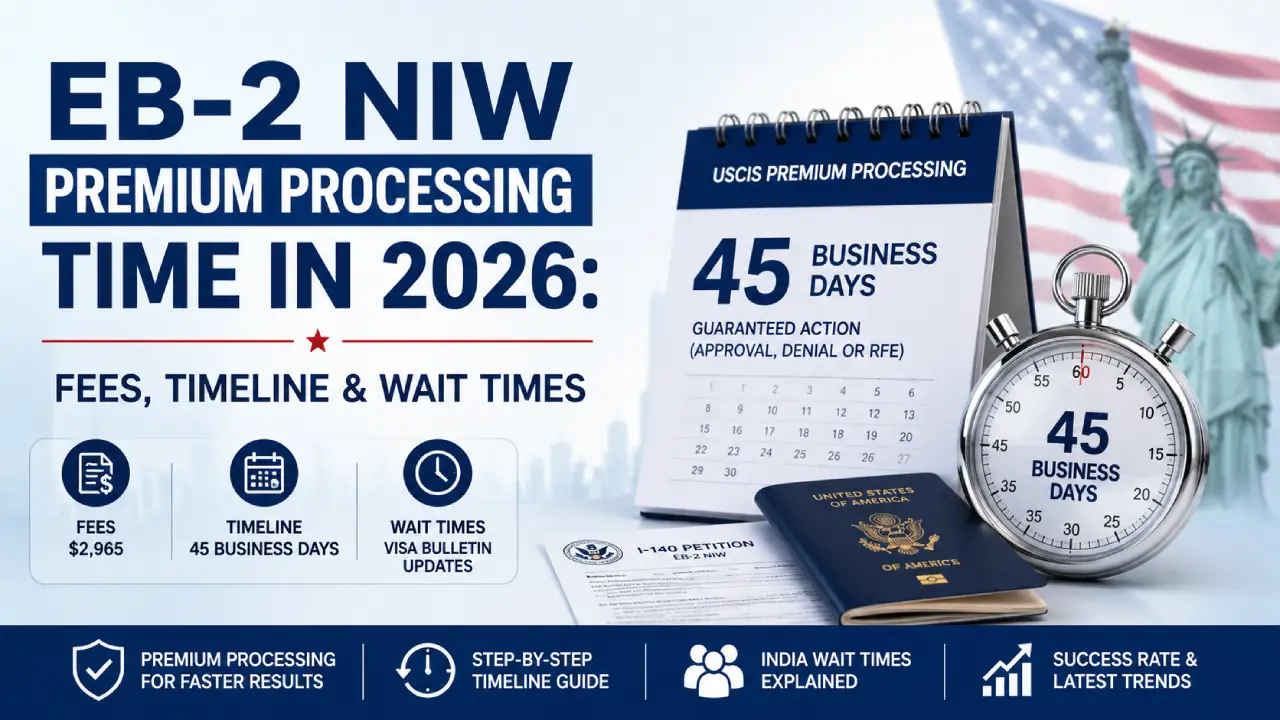
Quick Answer: EB2 NIW premium processing time is 45 business days (roughly 9 calendar weeks), guaranteed by USCIS from receipt of your I-140 petition and Form I-907. The current fee is $2,965. Without premium processing, standard I-140 adjudication for EB-2 NIW is running 20–26.5 months in 2026. Premium processing only covers the I-140 stage — it does not accelerate visa availability, adjustment of status, or the Visa Bulletin wait, which for Indian nationals can stretch beyond a decade.
Key Takeaways:
- Premium processing guarantees a USCIS action (approval, denial, or RFE) on your I-140 within 45 business days — not a guaranteed approval.
- Standard EB-2 NIW I-140 processing now runs 20–26.5 months in 2026, making premium processing a significant time-saver.
- The EB2 NIW premium processing fee is $2,965, filed via Form I-907 alongside or separately from your I-140.
- For Indian nationals, I-140 approval is just the start: the EB-2 Visa Bulletin backlog currently sits at roughly 12–13 years.
- The overall EB2 NIW success rate recovered to 48.1% in Q2 FY2026, up from a historic low of 35.7% in Q4 2025 — strong, well-documented petitions still get approved.
If you’re applying for a U.S. green card through the EB-2 National Interest Waiver, you’ve probably hit the wall every serious applicant eventually hits: the waiting. The USCIS processing times page says one thing, attorney forums say another, and Reddit threads from 2023 are now dangerously outdated. The situation in 2026 looks meaningfully different from even 18 months ago.
This guide cuts through the noise with current data. We’ll walk through exactly how long each stage takes, what premium processing actually buys you (and what it doesn’t), why the timeline is especially complex for EB-2 NIW applicants from India, and how to decide whether the $2,965 fee is worth it for your specific situation. If you need supporting documentation — from credential evaluations for EB-2 NIW to expert opinion letters that address the Dhanasar prongs — having that package in order before you file is what determines whether premium processing leads to an approval or an RFE.
What Is EB2 NIW Premium Processing? A Plain-Language Overview
The EB-2 National Interest Waiver is an employment-based green card category that lets highly skilled professionals self-petition — no employer sponsor, no PERM labor certification. It’s governed by the Matter of Dhanasar three-prong test: your proposed endeavor must have substantial merit and national importance, you must be well-positioned to advance it, and the U.S. must benefit from waiving the normal job-offer requirement.
Premium processing for EB-2 NIW became available in January 2023, when USCIS expanded the program to include all pending and initial Form I-140 petitions classified as E21 (the NIW subcategory). Before 2023, NIW applicants had no choice but to wait in the standard queue.
Here’s what premium processing is, precisely: you pay $2,965 for USCIS to commit to taking action on your I-140 within 45 business days. “Action” means one of three things — an approval, a denial, or a Request for Evidence (RFE). It does not mean an approval in 45 days. If USCIS issues an RFE, the 45-day clock pauses. Once you respond, USCIS typically has another 45 days to issue a final decision.
Most applicants using premium processing do see faster results than the 45-day guarantee. A mid-2025 analysis found that the median EB2 NIW premium processing time was approximately 21 days — less than half the guaranteed window.
EB2 vs EB2 NIW: Are They the Same Thing?
This trips up a lot of people. Here’s the distinction:
EB-2 is the parent category — second preference employment-based green cards for professionals with advanced degrees or exceptional ability. There are two main pathways within EB-2:
- EB-2 with PERM: Employer-sponsored. Requires a labor market test (PERM), a job offer, and an employer to file the I-140 on your behalf.
- EB-2 NIW: Self-petitioned. You waive the job offer and PERM requirement by demonstrating your work serves the national interest.
Both pathways share the same EB-2 Visa Bulletin queue. That’s a critical point we’ll come back to when discussing wait times for Indian nationals.
EB2 NIW Processing Time: A Stage-by-Stage Breakdown
The EB2 NIW green card processing time isn’t a single number — it’s the sum of three distinct stages, each with its own timeline and variables.
Stage 1: I-140 Petition Adjudication
This is the only stage premium processing can accelerate.
| Processing Type | Current Timeline (2026) |
|---|---|
| Standard processing | 20–26.5 months |
| Premium processing | 45 business days (~9 calendar weeks) |
| Premium — typical real-world | ~21 days (median, mid-2025 data) |
| Premium fee | $2,965 (effective March 1, 2026) |
Standard processing times have climbed sharply. As recently as 2022, standard I-140 processing for NIW ran 6–12 months. By late 2025, backlogs at both the Texas and Nebraska service centers pushed those timelines to 19.5 months. As of 2026, the benchmark sits at 20–26.5 months depending on the service center.
Why the spike? USCIS received 66,276 EB-2 NIW petitions in FY2025 — a 4.3% increase over FY2024 — while the pending inventory ballooned to an estimated 60,000–80,000 cases. More filings, tighter scrutiny, and the same adjudicator capacity is a recipe for slower standard timelines.
What this means for you: If your priority date is current (or approaching current), waiting 20+ months for a standard I-140 decision isn’t a passive inconvenience — it’s actively costly. Premium processing collapses that window to roughly 6–9 weeks.
💡 Ready to file? Before you upgrade to premium, make sure your petition package is truly ready. Expert opinion letters for EB-2 NIW that clearly address all three Dhanasar prongs are the single biggest factor in whether premium processing ends in an approval or triggers an RFE. Getting your documentation right before filing is worth more than any expedited timeline.
Stage 2: Visa Bulletin Wait (Priority Date Becoming Current)
This stage is where the EB2 NIW green card processing time gets complicated — especially for Indian nationals.
Premium processing cannot touch this stage. Once your I-140 is approved, you receive a priority date (the date USCIS received your I-140). You cannot move to the green card stage until that priority date becomes “current” on the monthly Visa Bulletin published by the Department of State.
Current Visa Bulletin picture (2026):
| Country of Birth | EB-2 Final Action Date (approx. 2026) | Estimated Wait for New Filers |
|---|---|---|
| Rest of World | October 2024 (close to current) | 1–3 years total |
| China | September 2021 | 4–6 years |
| India | September 2013 | 12–15+ years |
For Indian nationals, this is the hard reality of the eb2 niw wait time: the I-140 approval is just the starting gun, not the finish line. India’s EB-2 backlog exists because of the 7% per-country cap on employment-based visas — even though Indian nationals file a disproportionately high share of petitions. No amount of premium processing, attorney skill, or strong documentation changes this.
There is one strategic response available to Indian professionals: file as early as possible to lock in the earliest priority date. Premium processing on the I-140 can help here — it gets your petition decided quickly, confirming (or establishing) your place in the queue without the multi-year standard processing wait.
For details on how your foreign degree affects EB-2 eligibility, including the tricky three-year bachelor’s degree question, see our guide on education evaluation for green card.
Stage 3: Adjustment of Status or Consular Processing
Once your priority date is current, you move to the final stage.
- Adjustment of Status (I-485) — for applicants inside the U.S.: 10–28.5 months.
- Consular Processing — for applicants abroad: 4–12 months, plus scheduling time at the U.S. consulate.
Neither of these stages can be expedited through premium processing. Premium processing applies exclusively to Form I-140.
Total timeline summary:
| Country | Realistic Total EB2 NIW Processing Time |
|---|---|
| Rest of World | 2–4 years (from petition prep to green card) |
| China | 6–10+ years |
| India | 15–20+ years (from today’s filing date) |
How to Use Premium Processing for EB-2 NIW: Step-by-Step
Using premium processing isn’t complicated, but there are a few mechanics worth understanding before you file.
Step 1: Confirm Your Petition Is Truly Ready
Premium processing doesn’t protect a weak petition — it just gets you a faster denial or RFE. The EB2 NIW success rate dropped to a historic low of 35.7% in Q4 FY2025 (the first quarter where USCIS denied more petitions than it approved). While the rate has since recovered to 48.1% in Q2 FY2026, that’s still nearly a coin flip for an unprepared filing.
Before requesting premium processing, make sure you have:
- A credential evaluation confirming your advanced degree equivalency
- Expert opinion letters addressing all three Dhanasar prongs (from credentialed, independent experts in your field)
- Evidence of your proposed endeavor, positioning, and national benefit
- A coherent petition narrative that connects every exhibit to a specific Dhanasar prong
Step 2: File Form I-907 With or After Your I-140
You can request premium processing in two ways:
- Concurrently: File Form I-907 alongside your I-140 in the same package.
- Separately: Upgrade a pending standard I-140 to premium processing at any point by filing Form I-907 separately.
The second option is particularly useful if you filed standard and your situation has changed — your priority date is approaching current, you need to file I-485 soon, or you’ve been waiting over a year and simply want a decision.
Step 3: Pay the Premium Processing Fee
The current fee is $2,965, which must be paid with a separate check or money order made payable to “U.S. Department of Homeland Security.” Don’t combine it with the I-140 filing fee on the same instrument. As of March 1, 2026, this amount is confirmed by USCIS.
Step 4: Monitor Your Case
After USCIS receives your I-907, you’ll get a premium processing receipt notice. From that date, the 45 business day clock starts. Monitor your case at USCIS Case Status Online and set up text or email alerts.
When Is EB2 NIW Premium Processing Worth the $2,965?
This is the question most applicants get wrong. Premium processing isn’t always the right call — and it’s not always optional.
Premium processing makes strong sense if:
- Your priority date is current or within 6–12 months of becoming current, and you need I-140 approval to file I-485.
- You’re on a nonimmigrant visa (H-1B, L-1, O-1) with a status deadline approaching and need confirmed approval for job portability or AC21 protection.
- You’ve filed an exceptionally strong petition and want a decision quickly to remove uncertainty from your immigration plan.
- You need to apply for concurrent I-485 filing while a visa number is available — a window that can close quickly.
Premium processing is a lower priority if:
- Your priority date is years away from becoming current (particularly for Indian nationals), and the I-140 decision doesn’t change your near-term situation.
- Your petition has open evidentiary gaps that would likely result in an RFE — in that case, premium processing gets you an RFE faster, but you still have to address it.
- You’re in no rush and the standard $715 I-140 fee is the smarter budget allocation for your situation.
One common mistake: Indian-born applicants sometimes pay $2,965 for premium processing, get their I-140 approved in 45 days, and then discover they’re looking at a 12+ year Visa Bulletin wait regardless. The fast I-140 approval still has value — it locks in your priority date and enables AC21 portability — but it doesn’t accelerate the green card itself. Understanding the eb2 niw wait time in full, across all three stages, before deciding on premium processing is essential.
Not sure if your documentation is ready for premium? A weak petition going into a 45-day premium review still produces an RFE or denial — just faster. Our expert opinion letters for EB-2 NIW are written by PhD-level specialists in your field and are built specifically to address each Dhanasar prong with the precision USCIS now demands.
EB2 NIW Success Rate and What It Means for Your Timeline
The eb2 niw success rate has been one of the most volatile data points in immigration in recent years, and understanding it matters for premium processing decisions.
Here’s the trajectory:
| Period | EB-2 NIW Approval Rate |
|---|---|
| FY2022 | 95.7% |
| FY2023 | 79.9% |
| FY2024 | 43.3% |
| Q4 FY2025 (historic low) | 35.7% |
| Q2 FY2026 (most recent) | 48.1% |
The decline from 95.7% to 35.7% in roughly three years is dramatic. Several forces drove it: surging application volume (the NIW backlog grew over 7,300% between FY2022 and FY2025), stricter USCIS scrutiny of the Dhanasar prongs, and a policy environment emphasizing evidence-based adjudication over general claims of national importance.
What does this mean practically? The published approval rate is a blended average that includes unprepared self-petitions, incomplete documentation, and petitions with weak Dhanasar arguments. Well-documented cases from applicants with strong positioning evidence continue to get approved at higher rates. For EB-2 NIW applicants from India specifically, properly documented cases showed a 74% approval rate in FY2025 data.
The critical implication for premium processing: the faster USCIS reviews your petition, the faster a weak one gets denied. This makes documentation quality and premium processing inseparable — you shouldn’t use one without optimizing the other.
EB2 NIW for Indians: The Honest Timeline Picture
The eb2 niw for Indians situation deserves its own section, because the timeline math is genuinely different from any other nationality.
India filed 9,196 EB-2 NIW petitions in FY2025, making it the second-largest source of NIW filings globally. Yet USCIS approved only 1,930 of those — a reflection of both approval rate dynamics and the sheer volume of Indian applicants across the EB-2 category.
The structural problem is the 7% per-country cap on employment-based visas. Despite India representing a massive share of EB-2 demand, the annual number of green cards available to Indian nationals is capped at roughly the same level as any other country. The result: a Visa Bulletin backlog currently sitting at around September 2013 for India’s EB-2 Final Action Date. Applicants filing in 2026 are looking at an estimated 12–15 year wait before their priority date becomes current.
What Indian applicants can actually do about this:
- File your I-140 immediately to lock in the earliest possible priority date. Every month you wait is a month further back in the queue. Premium processing is a reasonable tool here — get your I-140 decided quickly, confirm your priority date, and start the clock.
- Use your approved I-140 for AC21 job portability. Once your I-140 has been pending for 180+ days, you can change employers or job roles with more flexibility, as long as the new role is in a same or similar occupational classification.
- Evaluate an EB-1A concurrent filing strategy. Indian nationals in EB-1A currently face roughly a 3-year wait — significantly shorter than EB-2’s 12-15 years. For applicants who may qualify under extraordinary ability criteria, pursuing both EB-1A and EB-2 NIW in parallel (with the same priority date porting from the earlier filing) is a well-established strategy.
- Maintain valid nonimmigrant status throughout. While your EB-2 NIW petition works through the queue, keeping H-1B, L-1, or O-1 status active and in good standing protects your ability to remain in the U.S.
How to Get EB-2 Visa Approval: What USCIS Is Actually Looking For in 2026
The EB-2 process changed meaningfully after the Dhanasar framework replaced the older National Interest Waiver standard. But USCIS updated its NIW guidance again in 2025, placing even more emphasis on an “evidence-first” approach to each prong. Here’s what that means in practice.
Prong 1: Substantial Merit and National Importance
Your proposed endeavor must have real significance to the United States — not just to your employer, your industry, or even your field broadly. USCIS now expects specific, concrete evidence of national importance: documented policy implications, measurable economic impact, critical infrastructure relevance, or public health significance. Generic statements like “advances the field of AI” or “contributes to medical research” no longer clear this bar without supporting evidence.
Prong 2: Well-Positioned to Advance the Endeavor
This prong is where RFEs most commonly originate in 2026. USCIS wants to see that you — specifically, not just someone with your credentials — are the right person to advance this endeavor. Evidence of past work with measurable outcomes, citations of your research, adoption of your methods, patents, high salary compared to peers, and independent recognition from others in your field all strengthen this prong. This is also where work experience evaluations and expert opinion letters do their heaviest lifting.
Prong 3: National Benefit of the Waiver
You have to make the affirmative case that the U.S. benefits more from waiving the job offer and PERM requirement than from enforcing it. This often involves showing urgency, scarcity of your expertise, or that requiring employer sponsorship would create unnecessary barriers to nationally important work. This prong is frequently underdeveloped in petitions that run into RFEs.
Avoid the most common documentation mistake. Many EB-2 NIW denials in 2025–2026 came from petitions where the expert opinion letters were generic, unspecific, or failed to connect the applicant’s work to the national interest. Before filing with premium processing, consider an expert opinion letter for EB-2 NIW written by a credentialed specialist who can speak to all three prongs with specificity.
EB2 NIW Approvals: Common Mistakes That Delay or Derail Your Case
Even with premium processing, certain errors add months to your timeline or produce outright denials.
1. Filing without a current credential evaluation. If you hold a three-year bachelor’s degree — common among Indian applicants — USCIS will issue an RFE unless your advanced degree or a proper combination of credentials is evaluated and documented by an accredited evaluator. An education evaluation for EB-2 NIW is not optional; it’s the foundation of eligibility.
2. Using recommendation letters instead of expert opinion letters. These serve different evidentiary roles. Recommendation letters come from people who know you directly. Expert opinion letters come from credentialed, independent authorities who assess your work against the Dhanasar framework. USCIS expects both, and conflating them produces RFEs. See the distinction explained in detail here.
3. Filing premium without a complete documentation package. An incomplete filing with premium processing means a faster RFE, not a faster approval. Premium processing doesn’t give USCIS less to evaluate — it just gives them fewer days to do it.
4. Treating premium processing as a substitute for visa current status. Premium processing speeds up the I-140 decision. It doesn’t move the Visa Bulletin or change your position in the EB-2 queue. Applicants who pay for premium and then discover their priority date won’t be current for years are understandably frustrated — but that’s a planning failure, not a USCIS failure.
5. Misunderstanding the RFE clock. If USCIS issues an RFE within the 45-day window, the clock pauses. You typically have 84 days to respond. Once your response is submitted, USCIS has another 45 days to issue a final decision. Factor this into your timeline if you’re racing toward a visa availability window or a visa expiration date.
Frequently Asked Questions About EB2 NIW Premium Processing
What is the current EB2 NIW premium processing time in 2026?
USCIS guarantees action on your I-140 petition within 45 business days of receiving Form I-907. In practice, many applicants are seeing decisions in roughly 21 days. Standard processing, without premium, currently takes 20–26.5 months.
Does premium processing guarantee approval?
No. Premium processing guarantees a timely action — approval, denial, or RFE — within 45 business days. A well-documented, decision-ready petition is still required. The EB-2 NIW approval rate in Q2 FY2026 was 48.1%; premium processing doesn’t change those odds.
Can I add premium processing to a pending I-140?
Yes. You can file Form I-907 at any time to upgrade a pending standard I-140 to premium processing. USCIS will transfer the case to premium processing upon receipt of the fee and form.
What happens if USCIS doesn’t act within 45 business days?
USCIS will refund the premium processing fee and continue adjudicating the case. They’re required by law to do this if the 45-day window lapses without action.
Does EB2 NIW premium processing speed up adjustment of status (I-485)?
No. Premium processing applies only to Form I-140. The I-485 adjustment of status process cannot be expedited through premium processing. It currently takes 10–28.5 months.
Is EB2 NIW premium processing worth it for Indian nationals?
It depends on your goals. If you need a quick I-140 approval to establish priority date, enable AC21 portability, or file I-485 while a visa number is available, yes — it’s worth it. If your priority date is more than a decade away and you’re in no risk of losing status, the calculus is less clear.
What is the EB2 NIW success rate right now?
The most recent USCIS data shows a 48.1% approval rate for Q2 FY2026 (January–March 2026), up from a historic low of 35.7% in Q4 FY2025. Well-prepared petitions with strong Dhanasar evidence historically outperform the blended average.
Does the EB2 NIW category have a separate visa queue from standard EB-2?
No. EB-2 NIW and EB-2 with PERM share the same Visa Bulletin queue. NIW eliminates the PERM step (which typically adds 12–24 months before even filing the I-140), but once the I-140 is filed, both pathways wait in the same country-specific line.
Conclusion: What Premium Processing Actually Buys You — and What It Doesn’t
The EB2 NIW premium processing time of 45 business days is genuinely valuable in 2026, when the standard alternative stretches past 20 months. For applicants whose priority date is current, approaching current, or whose status requires a confirmed I-140 approval, the $2,965 is often money well spent.
But premium processing is only as useful as the petition it accelerates. The scrutiny on EB-2 NIW petitions has increased dramatically — approval rates dropped from 95.7% in 2022 to a record low of 35.7% in late 2025 before partially recovering. The applicants who continue to get approvals are the ones with complete documentation, specific Dhanasar evidence, and expert opinion letters that make USCIS’s job easy.
If you’re preparing an EB-2 NIW petition — whether you’re filing premium or standard — the foundation is your supporting documents. EEE of America and AAE Evaluations provide the credential evaluations, expert opinion letters, and work experience evaluations that EB-2 NIW petitions depend on. Both organizations work with individual self-petitioners and immigration attorneys, and both understand what USCIS adjudicators are looking for in 2026. Don’t file with a rushed documentation package — use premium processing for speed, and use the right evaluation partners to make that speed count.