
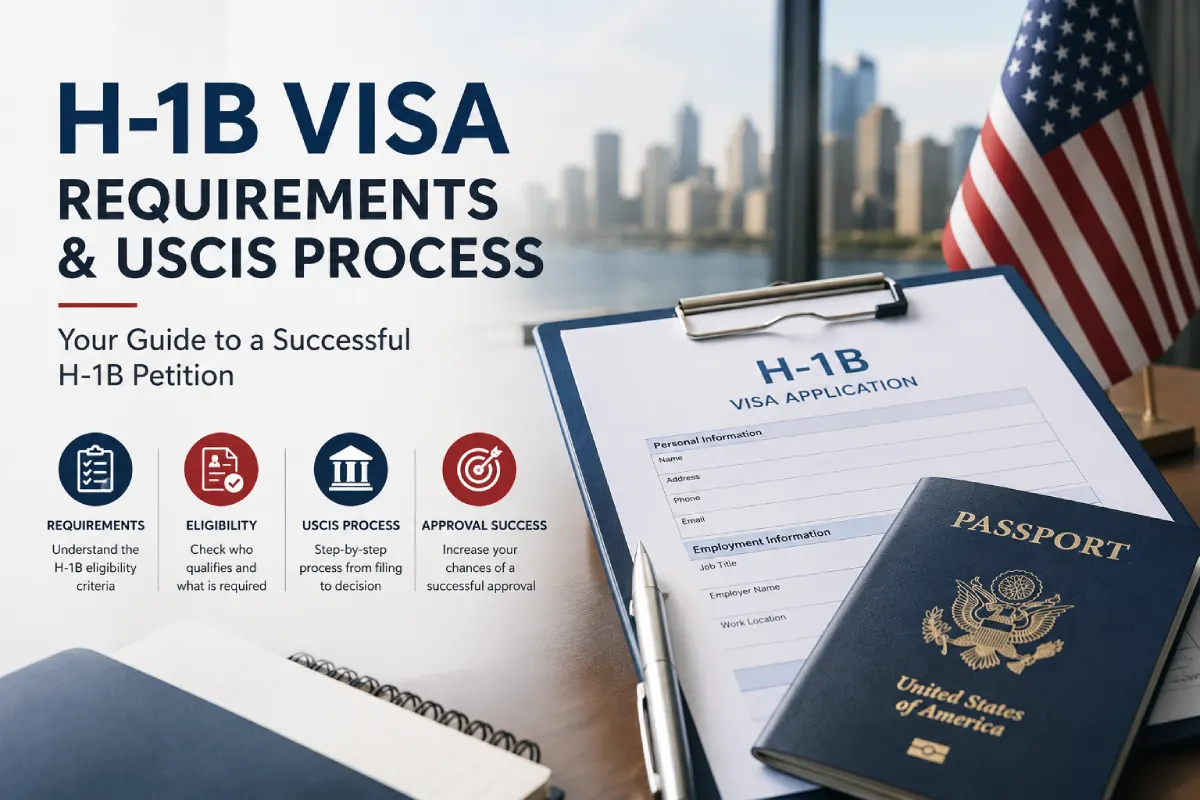
The H-1B visa is an employer-sponsored, non-immigrant work visa for foreign professionals in “specialty occupations” that normally require a U.S. bachelor’s degree or its equivalent. As of 2026, selection runs through a wage-weighted lottery, the process involves seven distinct USCIS stages, and a new $100,000 fee applies to certain applicants filing from outside the U.S. Getting approved now depends heavily on strong specialty-occupation evidence, accurate wage-level filing, and a properly documented foreign credential.
If you’re researching the H-1B visa in 2026, you’ve probably noticed the goalposts have moved. The lottery isn’t random anymore. There’s a six-figure fee that didn’t exist two years ago. Two new petition fees just took effect. And RFE rates for specialty occupation and wage-level issues are climbing.
This guide walks through everything that matters right now: who qualifies, what USCIS actually checks, how the current wage-weighted selection system works, what documents you need, and how to avoid the mistakes that turn a strong case into a denial.
What Is the H-1B Visa?
The H-1B visa is a non-immigrant, employer-sponsored classification that lets U.S. companies hire foreign nationals for specialty occupations — jobs that require theoretical and practical application of specialized knowledge and normally require at least a U.S. bachelor’s degree (or its foreign equivalent) in a directly related field.
Three things define it:
- It’s employer-driven. You cannot self-petition for a standard H-1B. A U.S. employer must file Form I-129 on your behalf.
- It’s occupation-specific, not person-specific. USCIS evaluates whether the job qualifies as a specialty occupation, not just whether you’re qualified.
- It allows dual intent. Unlike most non-immigrant visas, the H-1B doesn’t require you to prove you’ll return home afterward. You can pursue a green card while working on H-1B status without jeopardizing your visa.
Common H-1B occupations include software engineers, data scientists, financial analysts, mechanical and civil engineers, physicians, university faculty, and market research analysts — roles where the connection between a specific degree field and the daily job duties is direct and demonstrable.
H-1B Visa Benefits: Why It’s Still the Most-Used Work Visa
| Benefit | What it means in practice |
|---|---|
| Legal work authorization | Up to 6 years total (3-year initial period, plus a 3-year extension) |
| Dual intent | You can pursue a green card while on H-1B status without abandoning your visa |
| Employer mobility | You can transfer to a new H-1B employer without re-entering the lottery |
| Family accompaniment | Spouse and unmarried children under 21 may join you on H-4 status |
| Spousal work authorization | H-4 holders may qualify for an H-4 EAD if the H-1B spouse has an approved I-140 |
| Extension beyond 6 years | Available if a PERM or I-140 has been pending 365+ days, or an I-140 is approved but a visa number isn’t yet available |
Who Qualifies for an H-1B Visa? Eligibility Requirements
Eligibility has two sides: the job has to qualify, and you have to qualify for the job. USCIS scrutinizes both.
1. The Job Must Be a “Specialty Occupation”
USCIS looks for three things when deciding whether a position genuinely requires specialized knowledge:
| Requirement | What USCIS is checking |
|---|---|
| Specialized knowledge | The role can’t be learned through brief on-the-job training alone |
| Bachelor’s degree as the normal minimum | The job must require a degree, not merely prefer one |
| Degree-to-duty match | The specific degree field must align with the actual day-to-day work |
A generic job title isn’t enough. USCIS compares the position against industry norms, the employer’s own hiring history for similar roles, and the complexity of the actual duties listed in the petition.
2. Your Educational Background
You need to establish your qualification for the specialty occupation through one of three paths:
- A U.S. bachelor’s degree or higher in the relevant field.
- A foreign degree equivalent to a U.S. bachelor’s — this requires a formal credential evaluation that maps your foreign coursework and credit hours to the U.S. system. USCIS does not independently research foreign universities; the evaluation has to make the equivalency explicit.
- A combination of education and work experience, using the USCIS 3-for-1 formula: three years of progressive, directly-related work experience can substitute for one year of missing college education. This substitution isn’t automatic — it requires a documented work experience evaluation that analyzes your job duties against academic coursework equivalents.
If your degree is from outside the U.S., skipping the credential evaluation is one of the most common (and most avoidable) reasons petitions get an RFE.
3. The Employer-Employee Relationship
USCIS wants to confirm the petitioning employer genuinely controls your employment — meaning they can hire, pay, supervise, and terminate you. This is scrutinized most heavily for consultants and IT staffing placements at third-party client sites, where petitions need to show exactly who directs your daily work.
Required Documents for an H-1B Petition
Missing paperwork is consistently one of the top causes of processing delays and RFEs.
From the Employer
- Certified Labor Condition Application (LCA) from the Department of Labor
- Company registration documents (EIN, business license, proof of active operations)
- Employer support letter explaining the business need for the role
- A detailed, duty-specific job description
- Evidence of ongoing business operations (leases, tax filings, contracts, payroll records)
From the Employee
- Valid passport and proof of current address
- Resume/CV tailored to the specific job duties
- Degree certificates for every post-secondary credential
- Official academic transcripts
- Employment verification letters on company letterhead with dates, titles, and duties
- A credential evaluation, if your degree was earned outside the U.S.
- A work experience evaluation, if experience is substituting for part of your education
The petitions that move fastest are the ones filed complete the first time — no promises to “send it later.”
The 2026-2027 H-1B Cap and the Wage-Weighted Lottery
This is the area that has changed the most, and it’s worth understanding in detail because it directly affects your odds of selection.
Annual Cap Numbers
| Cap category | Visas available |
|---|---|
| Regular cap | 65,000 |
| U.S. master’s degree exemption | 20,000 |
| Total | 85,000 |
Demand consistently exceeds supply, which is why USCIS runs a selection process rather than approving registrations on a first-come, first-served basis.
From Random Lottery to Wage-Weighted Selection
For years, every registration had an equal, random chance of selection regardless of salary. That changed under a DHS final rule that took effect February 27, 2026, applying to the FY 2027 cap season. Instead of one entry per registration, USCIS now weights entries by the Department of Labor’s four-tier Occupational Employment and Wage Statistics (OEWS) wage levels:
| DOL wage level | Description | Lottery entries |
|---|---|---|
| Level I | Entry-level, basic duties | 1 entry |
| Level II | Qualified, some independent judgment | 2 entries |
| Level III | Experienced, exercises significant judgment | 3 entries |
| Level IV | Fully competent, highest complexity | 4 entries |
Employers register each beneficiary with the OEWS wage level their offered salary supports for the relevant occupation code and location. Higher-wage, higher-complexity roles now receive proportionally better odds — a direct incentive for employers to file accurate, higher wage levels rather than defaulting to Level I to save money. If a beneficiary has multiple registrations at different wage levels, USCIS assigns the lowest level among them for weighting purposes, which closes a loophole that previously let employers game the odds by inflating wage claims.
For the FY 2027 cap season, registration ran from March 4 through March 19, 2026, with a $215 per-beneficiary registration fee. Selected registrants then had a 90-day window to file the full Form I-129 petition. If you missed this cycle, the next registration window opens in March 2027 for the FY 2028 cap.
Cap-Exempt Employers
Some employers bypass the lottery entirely and can file at any time of year:
- Universities and affiliated nonprofit entities
- Nonprofit research organizations
- Governmental research organizations
New and Pending Fee Changes to Know
The cost of filing an H-1B petition has shifted substantially over the past year:
- The $100,000 fee. A presidential proclamation imposes a $100,000 fee on certain H-1B petitions filed on behalf of beneficiaries who are outside the United States or whose case requires consular processing. It generally does not apply if the beneficiary is already lawfully in the U.S. and the petition requests a change of status rather than consular notification — which is why many attorneys now advise H-1B holders and prospective beneficiaries to avoid unnecessary international travel while a petition is pending.
- Visa Integrity Fee and Asylum Program Fee. For petitions filed on or after May 29, 2026, a new $250 Visa Integrity Fee per beneficiary and a $102 Annual Asylum Program Fee per petition apply, in addition to standard USCIS filing fees.
- Proposed wage floor increase. A Department of Labor proposal would raise the Level I prevailing wage floor from roughly the 17th percentile to the 34th percentile of OEWS data — potentially a 20–30% salary increase requirement for entry-level positions in many metro areas. This rule is not yet finalized as of mid-2026.
Key takeaway: Filing accuracy at the wage-level and registration stage now has direct financial and legal consequences. A wage level chosen to minimize cost can reduce your lottery odds and increase RFE risk; a wage level that doesn’t match the actual seniority of the role can trigger denial.
Step-by-Step: How the USCIS H-1B Process Works
- Registration. The employer creates a USCIS online account and submits basic beneficiary information — name, passport number, country of birth, and the offered OEWS wage level.
- Wage-weighted lottery. USCIS runs the selection based on weighted entries, notifying employers of results.
- Labor Condition Application (LCA). Once selected, the employer files an LCA with the Department of Labor confirming prevailing wage, work location, and working conditions. This typically takes about seven days when the filing is clean.
- Form I-129 petition. The employer files the full petition, including every supporting document, within 90 days of selection.
- USCIS adjudication. Standard processing runs roughly 2-6 months; Premium Processing (Form I-907, currently $2,805) guarantees a 15-calendar-day response, though the clock resets if an RFE is issued.
- Visa stamping or change of status. Beneficiaries abroad attend a consular interview for the visa stamp; beneficiaries already in valid U.S. status typically transition automatically.
- Employment start date. New fiscal-year H-1B employment cannot begin before October 1, regardless of when the petition was approved.
H-1B RFEs: Triggers, Deadlines, and How to Respond
An RFE (Request for Evidence) is not a denial — it’s USCIS asking for more proof before deciding. But how you handle it determines whether the case survives.
Most Common RFE Triggers
| Reason | What USCIS is really asking |
|---|---|
| Specialty occupation not established | Does this job actually require a bachelor’s degree? |
| Wage-level mismatch | Why is a senior-level role filed at an entry-level wage? |
| Educational equivalency gaps | Is the foreign degree actually equivalent to a U.S. bachelor’s? |
| Vague job description | Could these duties apply to any generic job? |
| Employer-employee relationship | Who actually supervises this person day to day? |
| Biometrics/address verification | Confirming identity and current location |
Deadlines You Cannot Miss
- You generally have 84 days from the RFE issue date to respond (87 if mailing, to account for delivery).
- USCIS does not grant extensions for H-1B RFE deadlines.
- Your response must arrive by the deadline — postmark dates don’t count.
How to Strengthen an RFE Response
- A detailed expert opinion letter from an independent subject-matter expert explaining why the job requires specialized knowledge and why your background fits it
- A rewritten, duty-specific job description
- Organizational charts showing your supervisory structure
- Client contracts and statements of work for third-party placements
- A credential evaluation, if the RFE questions your foreign degree
- A work experience evaluation, if you’re relying on the 3-for-1 formula
Treat the 84-day window as a 60-day window in practice. Build in time for signatures, revisions, and courier delays — a strong response filed one day late is still a denial.
After Approval: Extensions, Transfers, and the 60-Day Grace Period
Extension Rules
| Stage | Details |
|---|---|
| Initial grant | 3 years |
| First extension | Additional 3 years (6 years total) |
| Beyond 6 years | Possible if a PERM/I-140 has been pending 365+ days, or an I-140 is approved but no visa number is available yet |
Time spent physically outside the U.S. during your H-1B validity can often be “recaptured” and added back toward your 6-year limit — keep detailed travel records.
Changing Employers (H-1B Transfer)
You don’t need to re-enter the lottery to switch jobs. Your new employer files Form I-129, and once USCIS issues a receipt notice, you can generally start working for the new employer immediately — provided your H-1B status has remained continuous and your prior employment ended lawfully. Don’t resign your current job before the transfer petition is filed; a gap in status complicates everything that follows.
The 60-Day Grace Period
If your employment ends before your H-1B validity expires, you get a one-time 60-day grace period per validity period. During this window you can find a new sponsor and file a transfer, apply to change to another status, or prepare to depart the U.S. You cannot work during the grace period unless a new filing has already been submitted.
Common H-1B Mistakes That Trigger RFEs or Denials
Vague job descriptions. “Software developer needed to write code” reads like an entry-level posting, not a specialty occupation. Duties need to name specific tools, methodologies, and the degree knowledge they require.
Wage-level mismatch. Filing a senior role at Level I wages tells USCIS the job isn’t as specialized as claimed — and under the new weighted lottery, it also costs you lottery entries.
No credential evaluation for a foreign degree. USCIS officers are not admissions committees; an unevaluated foreign degree carries no independent weight in the petition.
No work experience evaluation when experience is substituting for missing education. The 3-for-1 formula requires documented mapping, not a resume summary.
Late RFE responses. USCIS does not accept postal delays as an excuse. Treat every deadline as earlier than it actually is.
Ignoring third-party worksite documentation. Staffing and consulting placements need the full chain of evidence: staffing agreement, client’s job description, and clear supervisory structure.
No expert opinion letter for degree-job mismatches. When a degree is related but not identical to the job field (a physics degree for a data science role, for example), an independent expert opinion letter explaining the connection can be the difference between an RFE and an approval.
What If You’re Not Selected in the Lottery?
With demand still well above the 85,000 annual cap, a large share of registrants don’t get picked — and under the wage-weighted system, Level I registrations statistically face the longest odds. If you’re not selected, you have a few realistic options rather than simply waiting for next March:
- Register again the following cycle. There’s no penalty for re-registering, and a stronger wage level or a cap-exempt job offer can improve your odds the second time around.
- Look at cap-exempt employers. Universities, affiliated nonprofits, and nonprofit or government research organizations can file H-1B petitions year-round, outside the lottery entirely.
- Consider alternative visa categories. Depending on your background, an O-1 extraordinary ability visa, an L-1 intracompany transfer, or a TN visa (for Canadian and Mexican citizens in qualifying professions) may fit without a lottery at all.
- F-1 students on OPT/STEM OPT can often extend authorized work status while waiting for a future H-1B cycle, buying time without a gap in status.
- EB-1 or EB-2 NIW routes may be worth evaluating in parallel if you have a strong research, leadership, or extraordinary-ability profile — these don’t require H-1B status as a prerequisite for a green card.
None of these alternatives are automatic substitutes for the H-1B, and each has its own eligibility bar. But treating the lottery as the only path often means losing a full year unnecessarily.
How Credential Evaluations and Expert Opinion Letters Strengthen an H-1B Case
A qualified candidate with a legitimate job offer can still get an RFE or denial purely because of documentation gaps. The most common gaps map directly onto three types of evidence:
| Document | What it establishes |
|---|---|
| Education Evaluation for H-1B | Confirms a foreign degree is equivalent to a U.S. bachelor’s, with an explicit equivalency statement USCIS can rely on |
| Work Experience Evaluation | Converts professional experience into academic credit using the USCIS 3-for-1 formula, with detailed duty analysis |
| H-1B Expert Opinion Letter | An independent expert confirms the position is a genuine specialty occupation and that your background matches its requirements — critical for degree-job mismatches and RFE responses |
These aren’t generic add-ons. They’re the specific evidence types USCIS references by name in RFE notices for specialty occupation and educational equivalency issues. Building them into the initial petition — rather than scrambling to produce them after an RFE — is consistently the difference between a fast approval and a multi-month delay.
Why Work With AAE Evaluations
AAE Evaluations coordinates education evaluations, work experience evaluations, and expert opinion letters as a single engagement rather than scattered across separate vendors — which matters because H-1B petitions with degree-job mismatches or education substitutions often need more than one document type working together.
- One team producing consistent, cross-referenced documentation for your attorney
- USCIS-compliant formatting and methodology
- Direct coordination with immigration attorneys as well as individual applicants
- Experience with RFE response letters addressing the specific concerns USCIS raised
If you’re preparing an initial H-1B filing, responding to an RFE, or building a longer-term case toward a green card, get a free case review to find out exactly which documents your petition needs.
Frequently Asked Questions
What is the H-1B visa, and who is eligible?
The H-1B visa lets U.S. employers hire foreign professionals for specialty occupations. Eligibility requires a qualifying job offer, a position that normally requires a bachelor’s degree, and a matching degree (U.S. or foreign-equivalent) in a directly related field.
Can work experience replace a degree for H-1B eligibility?
Yes. USCIS allows three years of progressive, relevant work experience to substitute for one year of missing college education, but this requires a documented work experience evaluation — a resume alone isn’t sufficient evidence.
How does the 2026-2027 H-1B lottery work?
Selection is now wage-weighted rather than purely random. Registrations receive 1 to 4 lottery entries based on the OEWS wage level the offered salary supports, with higher wage levels receiving proportionally better odds of selection.
Does the $100,000 H-1B fee apply to everyone?
No. It generally applies to initial H-1B petitions filed for beneficiaries outside the U.S. or requiring consular processing. It typically doesn’t apply if the beneficiary is already in the U.S. in valid status and the petition requests a change of status.
What are the most common H-1B RFE reasons?
Specialty occupation not established, wage-level mismatch, lack of educational equivalency, vague job descriptions, employer-employee relationship questions for third-party placements, and biometrics/address verification requests.
How long do I have to respond to an H-1B RFE?
Generally 84 days from the issue date (87 if responding by mail), with no extensions granted. Your response must arrive by the deadline — a postmark is not sufficient.
What is the H-1B 60-day grace period?
If your job ends before your H-1B validity expires, you get a one-time 60-day period per validity period to find a new employer and file a transfer, change status, or prepare to leave the U.S. You cannot start new work during this time unless a filing has already been submitted.
Where can I get a credential evaluation for an H-1B petition?
AAE Evaluations provides education evaluations, work experience evaluations, and expert opinion letters built for USCIS submission alongside Form I-129, coordinated with immigration attorneys and individual applicants.
Conclusion
The H-1B remains the primary route into specialty-occupation employment in the U.S., but 2026 has made it a more document-intensive, higher-stakes process than it was even a year ago. Wage levels now determine both your lottery odds and your RFE risk. New fees have changed the cost calculus for petitions filed from outside the country. And the margin for vague job descriptions or unevaluated foreign degrees keeps shrinking.
None of that changes the fundamentals of what gets a petition approved: a genuinely specialized role, a clearly matched degree or evaluated equivalent, and documentation that answers USCIS’s questions before they’re asked.