
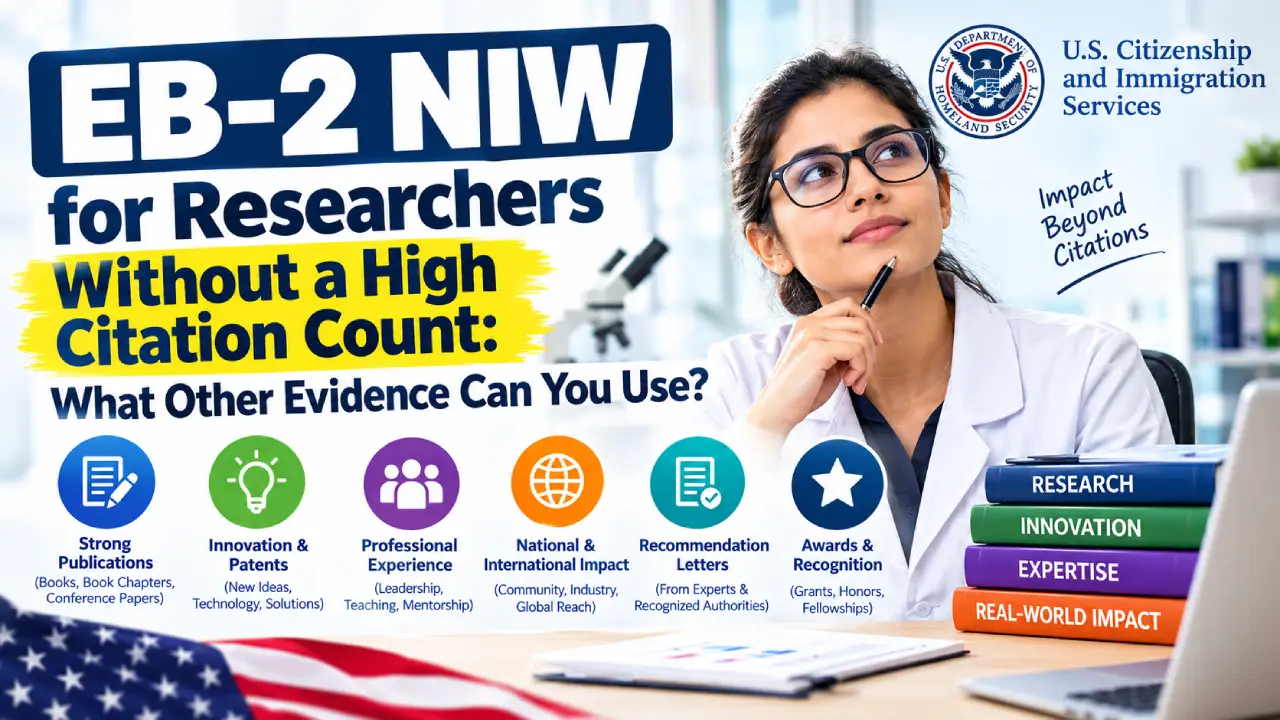
Quick Answer: Researchers pursuing an EB-2 NIW without a high citation count can still build a winning petition by presenting government-funded research, patents, peer review service, expert recommendation letters, conference presentations, real-world impact documentation, and a compelling national interest argument. Citations are one metric — not the only one — under the Dhanasar three-prong framework USCIS uses to evaluate every NIW petition.
If you’re a researcher with a modest citation record, you’ve probably heard some version of the same story: you need hundreds of citations to qualify for an EB-2 National Interest Waiver. Attorneys repeat it, online forums echo it, and you might have started to believe it.
It isn’t true.
USCIS does not have a minimum citation threshold for NIW approval. The law doesn’t require one. The landmark Matter of Dhanasar framework — which governs every NIW petition — never mentions citations as mandatory evidence. What it asks for is proof that your proposed endeavor has national importance, that you’re well-positioned to advance it, and that waiving the labor certification requirement benefits the United States on balance.
Citations are one way to show some of those things. They’re not the only way, and in 2025–2026, adjudication patterns suggest that petitions built primarily on citation counts are actually drawing more Requests for Evidence (RFEs) than they did three years ago. Officers want to see specificity and real-world impact — not just academic metrics.
This guide walks you through every credible alternative evidence category available to researchers with low or no citations, explains how each one maps to the Dhanasar prongs, and shows you how to package them into a petition that stands on its own.
Why Citations Aren’t the Whole Story Under Dhanasar
The Matter of Dhanasar (AAO 2016) replaced the old NYSDOT standard and established the three-prong test that USCIS applies to every NIW petition today:
- Prong 1: The proposed endeavor has substantial merit and national importance
- Prong 2: The petitioner is well-positioned to advance the proposed endeavor
- Prong 3: On balance, it benefits the United States to waive the job offer and labor certification requirements
Citations, when present, mainly speak to Prong 2 — demonstrating that peers recognize your work. But Prong 2 can be satisfied through many other forms of evidence. And Prong 1, arguably the most important prong, has nothing to do with your citation count at all. It’s about the work itself and its connection to U.S. priorities.
A researcher with 12 citations working on a DARPA-funded project in quantum computing can present a stronger Prong 1 argument than a highly-cited academic whose research has no identifiable pathway to national benefit. USCIS knows this. Adjudicators know this. Your petition needs to reflect it.
Practical note: Low citation counts often reflect career stage, field-specific norms, highly specialized niches, or recent publication dates — not research quality. Your petition cover letter should contextualize this explicitly. Don’t let silence on the issue invite the officer to draw their own conclusions.
8 Categories of Alternative Evidence That Can Replace or Supplement Citations
1. Government-Funded Research Grants
If your research has received funding from agencies like the National Institutes of Health (NIH), the National Science Foundation (NSF), the Department of Energy (DOE), or DARPA, you have something extraordinarily persuasive for Prong 1.
Government grants exist because independent expert reviewers determined your proposed research serves a national priority. USCIS doesn’t have to take your word for it — the federal government already did the vetting. A grant award letter from NIH or NSF is, in many ways, stronger than 50 citations from academic papers, because it represents institutional endorsement of both your work and your ability to carry it out.
How to document this:
- Include the grant award letter with the funding amount and project description
- Explain the agency’s mission and why the grant is competitive (acceptance rates where available)
- Connect the funded research to your proposed endeavor in the NIW petition narrative
Even if you were a co-investigator, not the principal investigator, federal grant participation is credible evidence that you’ve satisfied peer review by experts in your field.
2. Patents and Technology Transfer
Patents are particularly compelling for researchers in engineering, computer science, biomedical technology, materials science, and related applied fields. A granted patent demonstrates not only that your work is novel and non-obvious (as determined by the USPTO), but that it has commercial or practical applicability.
If your patent has been licensed, incorporated into a product, or referenced in a technology transfer agreement, that significantly strengthens the national importance argument. Technology commercialization is a documented U.S. economic priority.
What to include:
- USPTO patent grant documents
- Licensing agreements or commercial adoption records (where available)
- A plain-language description connecting the patent to broader U.S. industrial or public benefit
Pending patent applications can also be submitted, though granted patents carry more weight. Even a provisional application signals that you’re working at an inventive level, not purely academic.
3. Peer Review and Editorial Service
Serving as a peer reviewer for academic journals or as a member of a conference program committee is meaningful evidence for Prong 2 — it shows that journal editors and conference organizers consider you expert enough to evaluate the work of others in your field.
This evidence type is often overlooked by applicants who assume it’s minor. It isn’t. The AAO has specifically cited peer review service in approved NIW decisions as evidence that an applicant’s expertise is recognized by the professional community — even when citation counts were low.
How to document this:
- Request confirmation letters from journal editors or conference chairs
- List the journals by name and note their impact factors or standing in the field
- Describe your reviewing activity (number of manuscripts, frequency of requests)
If you’ve reviewed for journals like Nature, Science, JAMA, or field-specific top-tier publications, the reputational weight of those journals becomes part of your evidence.
4. Conference Presentations and Invited Talks
Presenting research at recognized professional conferences — especially when invited rather than simply accepted — signals that your field has identified you as someone worth hearing. Invited talks at international conferences are particularly strong.
These presentations speak to Prong 2 in a way citations don’t: they show contemporaneous recognition of your expertise by community gatekeepers (conference organizers and program chairs) rather than retrospective citation by authors.
What to include:
- Acceptance letters or invitation letters from conference organizers
- Conference programs listing your name and presentation title
- Evidence of the conference’s standing (acceptance rates, prestige, international attendance)
- Abstracts or slides if they help illustrate the research’s national relevance
Even regional or national domestic conferences can be relevant if they’re the recognized professional meeting for your specialty area.
5. Expert Recommendation Letters Addressing the Citation Gap
Strong recommendation letters are the backbone of most successful NIW petitions — and they’re especially critical when citation counts are low. The key is understanding what makes a recommendation letter useful versus one that just lists your accomplishments.
An effective recommendation letter for a low-citation petition does three specific things:
- Contextualizes citation norms in your field. A letter that explains “citation counts in computational materials science typically take 3–5 years to accumulate after publication, and 15 citations for a 2022 paper in this subfield represents above-average recognition” gives the officer critical framing they won’t find elsewhere.
- Speaks to the national importance of your specific work. A letter from a recognized expert that explains why your research matters to the United States — not just that you’re talented — is direct Prong 1 evidence.
- Assesses your positioning to advance the proposed endeavor. Letters that describe your specific capabilities, your access to resources, your institutional relationships, and your track record of completing projects speak directly to Prong 2.
You should obtain letters from both independent recommenders (people who don’t know you personally) and collaborators who can speak to specific work. AAE Evaluations and EEE of America provide expert opinion letters specifically structured for EB-1, EB-2 NIW, O-1, and other immigration visa categories — these are prepared by credentialed evaluators who understand what USCIS adjudicators look for and how to contextualize your record within your field’s professional norms.
Getting your letters right:
- Provide recommenders with a detailed summary of your proposed endeavor and your CV
- Ask them to address all three Dhanasar prongs, not just your general reputation
- Request that they explain field-specific context (including citation norms) explicitly
- Aim for 4–6 letters, with at least 2–3 from independent recommenders
6. Media Coverage, Policy Impact, and Real-World Adoption
Not all research impact shows up in citation databases. If your work has been:
- Cited in policy documents, government reports, or regulatory guidance
- Featured in mainstream or trade media (newspaper articles, science journalism, industry publications)
- Adopted or referenced by practitioners (clinicians, engineers, policymakers, NGOs)
- Integrated into curricula, clinical guidelines, or industry standards
…then you have direct evidence of real-world impact that citations don’t capture.
This category is especially relevant for researchers whose work bridges academia and practice — public health researchers, environmental scientists, clinical researchers, and applied engineers often have significant downstream effects that never show up in Google Scholar.
Documentation strategy:
- Collect hyperlinks and screenshots of media coverage with publication dates
- Obtain written statements from practitioners or policy officials describing how your research influenced their decisions
- If your work was cited in a legislative or regulatory document, include the full citation
- Submit evidence of clinical or industry adoption with accompanying explanations
7. Membership in Professional Societies and Leadership Roles
Membership alone in professional organizations is rarely sufficient evidence. But leadership roles in recognized professional societies — serving on committees, chairing working groups, holding elected or appointed positions — demonstrate that your peers have selected you for positions of trust and influence.
Leadership in professional bodies serves as indirect citation replacement: it shows peer recognition of your expertise at an institutional level rather than through paper-by-paper citation.
Relevant roles to document:
- Committee chair or member positions in organizations like IEEE, ACS, ASCE, APA, AHA, or field-specific bodies
- Conference organizing committee roles (program chair, session chair)
- Editorial board positions at peer-reviewed journals
- Board or advisory positions at research institutes or foundations
Include official documentation of these roles — appointment letters, organization websites listing your name, or formal meeting minutes.
8. Teaching, Mentorship, and Capacity Building
For researchers at universities or research institutes, there’s a strong argument that your training of the next generation of researchers in a nationally important field itself constitutes a contribution of national importance. USCIS has approved petitions for academics who frame their mentorship and teaching roles in terms of national workforce development.
This argument is strongest when:
- Your field faces documented workforce shortages (STEM fields generally, healthcare research, cybersecurity, clean energy)
- You’ve trained graduate students or postdoctoral researchers who have gone on to careers in nationally important positions
- You have a documented record as a PI or co-PI on training grants (e.g., NIH T-series training grants)
Evidence to compile:
- Lists of students and postdocs trained, with their subsequent career outcomes
- Training grant awards and documentation
- Teaching evaluations or letters from students
- Evidence of your field’s national workforce shortage (government reports, professional association data)
How to Structure Your Petition Narrative Without Strong Citations
The petition narrative — typically framed as a detailed cover letter accompanying your I-140 — is where all your evidence gets woven into a Dhanasar-compliant argument. Here’s a framework for low-citation cases:
Section 1: Frame the Proposed Endeavor (Prong 1)
Start with what you’re going to do, not your credentials. Describe the research or professional activity, its connection to a specific national priority (reference government strategic plans, federal agency missions, or documented workforce/infrastructure needs), and why the work matters beyond your current employer or institution.
Field-specific framing helps enormously. Connect your work explicitly to U.S. priorities: STEM advancement, healthcare innovation, national security, energy independence, economic competitiveness, or environmental resilience — whichever is genuinely applicable.
Section 2: Build Your Positioning Case (Prong 2)
Present your evidence systematically, starting with your strongest category. If you have government grants, lead with those. If your patents are most impressive, lead there. Then layer in peer review service, conference presentations, expert recommendations, and any real-world impact documentation.
Address citations in this section honestly. If your citation count is low, explain why — career stage, field norms, recent publication dates, highly specialized subfield size — and pivot immediately to the evidence categories that demonstrate positioning more directly.
Section 3: Make the Waiver Argument (Prong 3)
Explain why requiring a PERM labor certification would be contrary to the national interest in your specific case. Arguments that work well:
- The work requires flexibility that employer-specific sponsorship would prevent
- Your proposed work is interdisciplinary or across multiple institutions
- The urgency of the national need you’re addressing doesn’t accommodate PERM timelines
- You’re uniquely positioned and the U.S. cannot easily find a domestic alternative
The Role of Credential Evaluation in EB-2 NIW Petitions
Before USCIS can even evaluate your NIW arguments, you must establish the underlying EB-2 eligibility — either through an advanced degree or exceptional ability. For researchers with degrees from outside the United States, this means obtaining a professional foreign credential evaluation.
USCIS requires that foreign degrees be evaluated by a member of the National Association of Credential Evaluation Services (NACES) or a similarly recognized body. The evaluation must establish that your degree is equivalent to a U.S. advanced degree (master’s or higher) in your field.
AAE Evaluations provides fast, accurate, and globally recognized credential evaluation services specifically tailored for immigration applications, including full support for EB-2 NIW petitions. The AAE team understands how USCIS evaluates foreign credentials and structures evaluations to satisfy I-140 adjudicator requirements — including, critically, assessments that support the “exceptional ability” pathway when advanced degree equivalency is the stronger argument.
EEE of America similarly offers credential evaluation and expert opinion letters designed for visa petitions, with particular expertise in the documentation requirements that matter most to immigration officers reviewing EB-1, EB-2 NIW, O-1, H-1B, and L-1 applications.
Getting your credential evaluation right is foundational. A poorly structured evaluation that doesn’t clearly establish U.S. equivalency at the advanced degree level can result in an RFE that derails your entire timeline — independent of how strong your NIW evidence is.
Tip: If you’re pursuing the “exceptional ability” pathway under EB-2 rather than the advanced degree route, your credential evaluation should reflect that specifically. AAE Evaluations and EEE of America can structure evaluations to align with the six-criteria USCIS test for exceptional ability, not just degree equivalency.
Common Mistakes Low-Citation Applicants Make
Ignoring the citation gap entirely.
Silence invites the officer to fill in their own assumptions. Address it proactively with context.
Submitting generic recommendation letters.
Letters that praise your general intelligence without addressing Dhanasar prongs specifically don’t help. Quality over quantity.
Treating Prong 1 as an afterthought.
Many applicants spend 80% of their petition on credentials (Prong 2) and one paragraph on national importance (Prong 1). Flip that ratio. National importance is often where borderline cases are decided.
Filing without a credential evaluation for foreign degrees.
USCIS will not evaluate your NIW arguments if it can’t first confirm you meet the EB-2 base standard. This is a threshold issue.
Over-relying on h-index or Google Scholar profile.
These are supplementary data points, not standalone evidence. Build your case on concrete impact, not metrics.
Confusing teaching experience with research impact.
Teaching is valuable evidence, but it must be framed in terms of national importance and professional recognition — not just described as a job responsibility.
Real-World Cases: NIW Approvals Without High Citations
Case patterns from approved NIW petitions illustrate that citation counts are genuinely not determinative:
- A mechanical engineer with 5 publications and 5 conference presentations successfully obtained NIW approval by demonstrating that his ocean energy conversion research had substantial merit and national importance — the AAO found that his future work plans and institutional resources made him well-positioned despite modest publication metrics.
- A physician with only 7 total citations across three publications received NIW approval based on his research contributions combined with his medical training and the national importance of his specialty area.
- A university instructor with zero citations was approved after her legal team demonstrated that her work had made measurable impact in her academic field through other documented means, even without citation evidence.
- A philanthropy consultant working on services for wounded veterans was approved for NIW without any research publications or Google Scholar profile — demonstrating that the framework is genuinely flexible across professional contexts.
These cases confirm that the petitioner’s narrative, supporting documentation, and how evidence maps to each Dhanasar prong matters far more than the number next to your name on Google Scholar.
FAQ: EB-2 NIW Without High Citations
Is there a minimum citation count to qualify for EB-2 NIW?
No. USCIS has established no minimum citation threshold for NIW petitions. The Dhanasar framework evaluates the totality of evidence, not individual metrics. Petitions are approved with zero citations in cases where other evidence clearly satisfies all three prongs.
Can I qualify for EB-2 NIW if I’ve never published a paper?
Yes. Published research is not a requirement. Professionals in applied fields — physicians, engineers, project managers, business owners — have successfully obtained NIW green cards without academic publications. What matters is demonstrating that your proposed endeavor has national importance and that you’re positioned to advance it.
Does having an h-index below 5 hurt my NIW petition?
A low h-index is a weak point only if your petition treats citations as your primary evidence. If you lead with government grants, patents, real-world impact, strong recommendation letters, and peer review service, a low h-index becomes context rather than the centerpiece of your case.
How do I explain a low citation count in my petition?
Address it directly in your cover letter. Explain field-specific citation norms, your career stage, publication recency, or the specialized nature of your subfield. Then pivot to the evidence categories where your record is strongest. Immigration officers are not experts in your field — give them the framing they need to evaluate your case fairly.
Do I need a credential evaluation for my foreign degree?
Yes, if your degree was earned outside the United States. USCIS requires that foreign credentials be evaluated by a recognized organization to establish U.S. degree equivalency at the advanced degree level. AAE Evaluations and EEE of America provide USCIS-accepted evaluations specifically structured for EB-2 NIW and other immigration visa petitions.
How many recommendation letters should I include in an NIW petition?
Most successful petitions include 4–6 letters, with at least 2–3 from independent recommenders who don’t have a direct working relationship with you. Each letter should address specific Dhanasar prongs, not just general praise. Quality and specificity matter more than quantity.
What’s the difference between EB-2 NIW and EB-1A for researchers?
EB-1A (Extraordinary Ability) requires evidence that you’re in the top percentile of your field globally — a much higher bar. EB-2 NIW requires an advanced degree (or exceptional ability) and national importance of your proposed work. Researchers who don’t qualify for EB-1A may still qualify for EB-2 NIW, and the self-petition benefit (no employer sponsor required) is the same for both.
Can I self-petition for EB-2 NIW while still on an H-1B or F-1 visa?
Yes. EB-2 NIW is a self-petition (Form I-140) that you file on your own behalf, regardless of your current visa status. Consulting an immigration attorney about maintaining status during the adjustment of status process is advisable.
Your Next Step: Build a Case That Works
Citation counts are a metric. They’re not a mandate. Thousands of researchers, physicians, engineers, and applied professionals have secured EB-2 NIW green cards by building complete, well-organized petition packages that tell a compelling story about national importance — with or without impressive Google Scholar profiles.
The key is knowing which evidence categories apply to your specific background, how to frame them under the Dhanasar three-prong test, and how to address the citation question head-on rather than hoping the officer doesn’t notice.
If your degree was earned abroad, the first step is ensuring your credentials are properly evaluated for USCIS. AAE Evaluations provides expert-level foreign credential evaluations and expert opinion letters accepted by USCIS for EB-2 NIW, EB-1, O-1, and other immigration visa categories. EEE of America offers the same trusted service for professionals who need evaluations and opinion letters that hold up to immigration adjudicator scrutiny.
Start with your credentials. Then build your case from the evidence categories that match your actual record. A low citation count isn’t the end of your NIW story — it’s just the reason to tell a different, often stronger, one.