
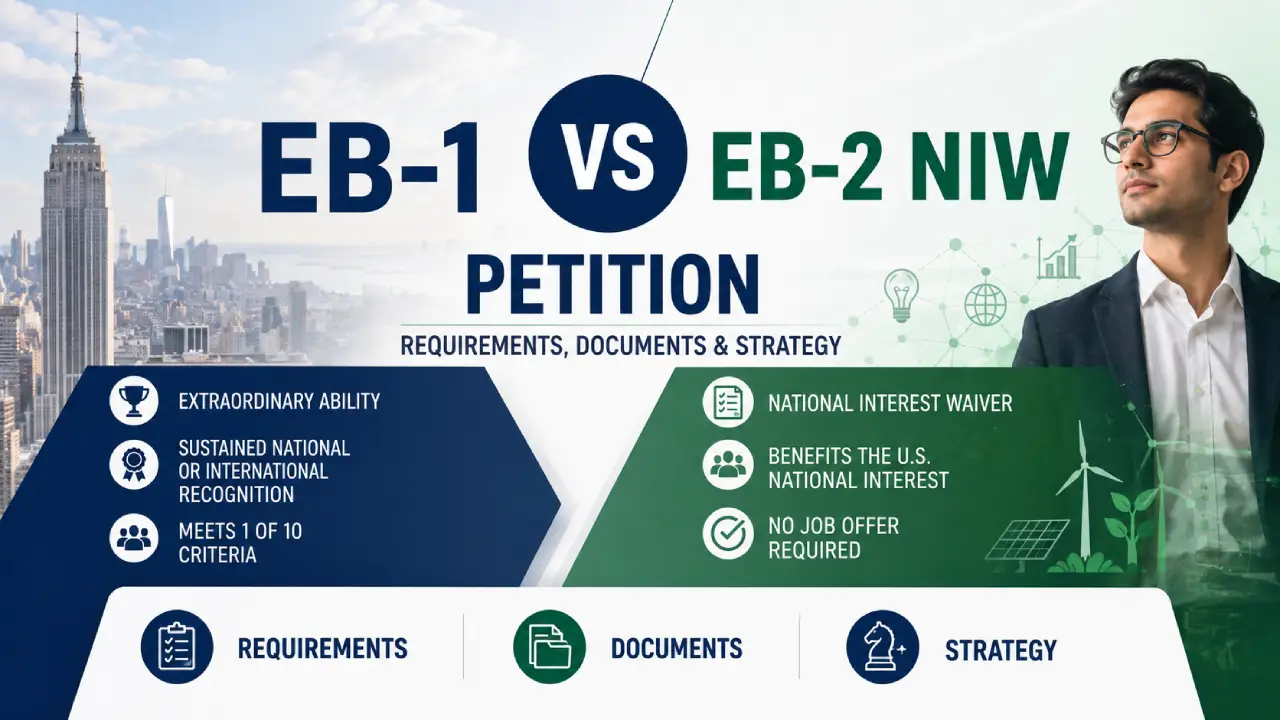
Quick Answer: EB-1 and EB-2 NIW petitions are employment-based green card pathways for highly skilled foreign nationals. EB-1 covers extraordinary ability, outstanding researchers, and multinational executives. EB-2 NIW allows self-sponsorship when your work benefits the U.S. national interest. Both categories demand rigorous, well-documented petitions — and in 2026, with EB-1A denial rates exceeding 58% and EB-2 NIW approval rates hovering around 42–48%, the margin for a weak application has essentially disappeared.
Key Takeaways:
- EB-1 has three subcategories (EB-1A, EB-1B, EB-1C); EB-2 NIW allows self-petitioning without a job offer or PERM labor certification.
- The Dhanasar three-prong test is the legal standard every EB-2 NIW petition must satisfy.
- EB-1A denial rates reached 58.3% in Q2 FY 2026, making documentation quality more critical than ever.
- Expert opinion letters, credential evaluations, and professional business plans are core supporting documents for both visa types.
- RFE rates for EB-1A cases now run 40–50%, meaning preparation must anticipate USCIS objections before they happen.
Filing an EB-1 or EB-2 NIW petition is one of the most consequential decisions of a foreign professional’s career. Get it right, and you’re on a direct path to permanent U.S. residency without the waiting game of employer sponsorship. Get it wrong — or submit a petition that looks complete but lacks the right evidentiary weight — and you’re looking at a Request for Evidence (RFE), a denial, and months or years of delay.
This guide is designed to give you a clear-eyed view of how both visa categories actually work in 2026, what USCIS really wants to see in the evidence package, and how supporting documents like expert opinion letters for EB-1 and credential evaluations fit into the larger strategy. Whether you’re just starting to explore your options or you’ve already received an RFE, there’s something here worth knowing.
What Are EB-1 and EB-2 NIW Petitions?
These are employment-based immigrant visa categories established under U.S. immigration law, but the similarities mostly stop there. Each rewards a distinct type of achievement, demands a different evidentiary strategy, and comes with its own USCIS adjudication framework.
EB-1: Three Subcategories, One Common Thread
The EB-1 category is reserved for the highest tier of professional accomplishment. It breaks down into three subcategories:
EB-1A — Extraordinary Ability. This is the most flexible subcategory because it doesn’t require a job offer. Petitioners must demonstrate sustained national or international acclaim in their field — whether that’s science, arts, education, business, or athletics. USCIS evaluates EB-1A cases using a two-step framework from the Kazarian v. USCIS ruling: first, checking whether the applicant satisfies at least three of ten defined criteria (awards, publications, critical roles, high salary, etc.); then conducting a “final merits determination” to confirm the evidence as a whole shows the applicant stands among the top percentage of their field.
EB-1B — Outstanding Researchers and Professors. This subcategory requires employer sponsorship and an offer of a tenured or tenure-track research position. The applicant must show international recognition in their academic field, typically through peer-reviewed publications, citation impact, and scholarly recognition.
EB-1C — Multinational Executives and Managers. This route is for executives or managers transferring to a U.S. affiliate, subsidiary, or parent company. It’s the most employer-dependent of the three and requires specific documentation of the organizational hierarchy.
EB-2 NIW: The Self-Petition Route for Exceptional Professionals
The EB-2 National Interest Waiver is built differently. Standard EB-2 requires employer sponsorship and PERM labor certification — a Department of Labor process that adds anywhere from 12 to 24 months before you even file the petition. The NIW waives all of that, allowing you to self-petition if you can prove your work substantially benefits the United States.
NIW filings have tripled from roughly 22,000 in FY 2022 to over 66,000 in FY 2025, a sign of both growing demand and evolving adjudication standards. To succeed, applicants must satisfy the three-prong Dhanasar test, which USCIS has applied to every NIW petition since 2016:
- Proposed endeavor has substantial merit and national importance — Your work must matter at a level that goes beyond individual career advancement.
- You are well-positioned to advance that endeavor — Your qualifications, track record, and specific plan must demonstrate realistic capacity to deliver.
- Waiving the job offer and labor certification is in the national interest — The benefit to the U.S. must outweigh the protection those processes normally provide U.S. workers.
The January 2025 USCIS policy update tightened the evidentiary bar on all three prongs, particularly prong two, where officers now scrutinize how concretely the petitioner has mapped out their plan and what measurable progress they’ve already made.
The Documentation That Separates Approved Petitions from Denied Ones
Here’s a truth that doesn’t get stated plainly enough: USCIS officers don’t approve people — they approve evidence packages. The most accomplished professional in the room can receive an RFE or denial if the documentation doesn’t translate their achievements into the language USCIS is looking for.
Expert Opinion Letters
An expert opinion letter is an independent, field-specific evaluation written by a credentialed authority who assesses your qualifications against the legal standard for your visa category. It’s not a recommendation letter from a colleague — it’s a structured analytical document from someone who has no personal stake in your case.
For EB-1A petitions, the expert opinion letter should address each of the claimed criteria specifically, explain how your record meets the “extraordinary ability” threshold, and provide comparative context — placing your achievements relative to others in your field. For EB-2 NIW, the letter needs to map directly onto the Dhanasar prongs, making a legal-quality argument about why your work qualifies as nationally important and why you’re positioned to deliver on it.
An EB-2 NIW expert opinion letter that simply praises an applicant’s credentials without engaging the three-prong structure tends to carry little weight with USCIS officers. The letters that work are those built around the framework, not around the applicant’s resume.
Credential Evaluations
If your education was completed outside the United States, a formal education evaluation for USCIS is essential. This is the document that establishes the U.S. equivalent of your foreign degree — whether you hold the equivalent of a master’s or bachelor’s, whether your field of study aligns with the position you’re petitioning for, and whether your qualifications meet the “advanced degree” threshold for EB-2.
Poorly prepared evaluations — ones that describe credentials without clearly stating the U.S. equivalent — are a common source of RFEs. USCIS officers don’t interpret; they need the evaluation to draw explicit conclusions.
Work experience evaluations serve a parallel function when you’re substituting professional experience for formal education. USCIS allows this substitution under specific conditions, but the evaluation must be precise about how the years of experience map to educational equivalency. An work experience evaluation built around that standard — not just a list of job titles — is what makes the case.
Professional and Business Plans
For EB-2 NIW petitions, a professional plan or business plan can be a powerful piece of evidence for the second and third Dhanasar prongs. It’s not a formality. A well-structured EB-2 NIW business plan demonstrates that your proposed endeavor is concrete, realistic, and already underway — not just a vague ambition described in your personal statement. USCIS wants to see milestones, a plan of action, and evidence that you have the professional capacity to execute it.
The Real Numbers Behind EB-1 and EB-2 NIW Filings in 2026
It’s worth spending a moment with the actual data, because the filing environment in 2026 is meaningfully different from even two or three years ago.
| Metric | EB-1A | EB-2 NIW |
|---|---|---|
| Approval Rate (Q2 FY 2026) | ~41.7% | ~48.1% |
| RFE Rate (practitioners reported) | 40–50% | Elevated |
| Pending Backlog (end of Q2 FY 2026) | 27,024 | Significant |
| Annual Filing Volume Growth (FY 2022–2025) | Significant increase | Tripled |
| Processing Time (standard) | Up to 21 months | ~24 months |
The EB-1A denial rate in Q2 FY 2026 was 58.3% — meaning more than half of decided petitions were denied. That’s not a reason to abandon the category, but it’s a clear signal that meeting three criteria on paper isn’t enough. USCIS now applies the final merits determination more stringently, asking whether the totality of evidence shows someone at the very top of their field, not just someone who has achieved notable things.
For EB-2 NIW, the approval rate in Q1 FY 2026 was about 43%, recovering slightly to 48% in Q2. Both figures are dramatically lower than the 90%+ rates from FY 2022 — a direct consequence of the January 2025 policy update raising standards across all three Dhanasar prongs.
What does this mean practically? It means the margin for a thin or poorly assembled petition has collapsed. Petitions that might have received a favorable nod in 2022 are now receiving RFEs or outright denials. And that shift has a direct implication for every supporting document in the package.
Common Petition Mistakes That Lead to RFEs and Denials
Understanding what goes wrong is often more useful than a checklist of what to include. Here are the patterns that consistently produce problems.
1. Generic Expert Opinion Letters
An opinion letter that praises an applicant’s accomplishments without addressing the specific legal criteria reads as advocacy, not analysis. USCIS officers are looking for structured engagement with the regulatory standard — not a testimonial.
2. Credential Evaluations That Don’t State Equivalency Explicitly
Evaluations that describe a foreign degree without concluding what it’s equivalent to in U.S. terms leave USCIS officers to fill in the gap themselves. They don’t. Instead, they issue an RFE asking for a clearer evaluation.
3. NIW Personal Statements That Skip the Third Prong
Many applicants write compelling introductions about their field and their qualifications, then never make the argument that waiving job offer and labor certification serves the national interest. That third prong is the waiver itself — neglecting it is an almost guaranteed RFE.
4. Recommendation Letters That Double as Character References
Recommendation letters for EB-1 and EB-2 petitions should be analytical documents from credible professionals who can speak to your impact, not warm endorsements from colleagues who know you well. The distinction matters. EB-2 NIW recommendation letters written by senior experts who assess your work’s significance outperform letters from direct collaborators who speak to your character.
5. Submitting Without Anticipating the RFE
Given that 40–50% of EB-1A petitions now trigger an RFE, it’s worth preparing the initial package as if USCIS will ask follow-up questions on every piece of evidence. That means more thorough initial documentation, not thinner submissions that leave room for supplementation later.
How to Build a Strong EB-1 or EB-2 NIW Petition: A Practical Framework
There’s no universal template for a winning petition — the right strategy depends on your field, your credentials, and the specific category you’re pursuing. But the following framework applies across cases.
Step 1: Honest Eligibility Assessment
Before investing time and money in a petition, you need an honest evaluation of whether your record actually meets the standard — not whether it’s impressive by general professional measures. EB-1A “extraordinary ability” and EB-2 NIW “exceptional ability” have specific legal meanings that don’t always align with how we use those words conversationally. A free case review can clarify this early and save significant frustration later.
Step 2: Document Mapping
Map your actual evidence against the criteria you’re claiming. For EB-1A, this means auditing which of the ten criteria you can genuinely satisfy with strong, USCIS-compliant documentation — not which ones you technically meet but can’t prove well. For EB-2 NIW, it means identifying specific evidence for each of the three Dhanasar prongs before writing a single word of the personal statement.
Step 3: Engage Expert Opinion and Evaluation Services Early
Expert opinion letters and credential evaluations take time to prepare properly. Engaging EB-1 expert opinion letters and credential evaluation services early in the process gives the evaluators time to build a strong, detailed document — not a rushed one. The quality difference between a letter prepared over two to three weeks versus one turned around in 48 hours is significant.
Step 4: Coordinate Your Evidence Package for Consistency
One of the subtler problems in self-assembled petitions is internal inconsistency — the personal statement, expert opinion letter, and business plan each describing the applicant’s work in slightly different terms or framing the same achievements differently. USCIS reads the full package together, and inconsistencies undermine credibility. When all supporting documents come from a coordinated team that communicates throughout the process, this problem disappears.
Step 5: Legal Review Before Filing
No credential evaluator, expert opinion provider, or business plan writer can substitute for legal advice. An immigration attorney reviews the complete package with the legal training to spot problems that non-lawyers miss — procedural issues, missing forms, inconsistencies in dates, and strategic decisions about how to frame the petition. For both EB-1 and EB-2 NIW, representation by an experienced immigration attorney meaningfully improves outcomes, particularly for responding to RFEs. Expert opinion letters for EB-1A recommendation letters coordinate most effectively when an attorney is already guiding the overall strategy.
EB-1 vs. EB-2 NIW: Which Path Is Right for You?
This is the question most applicants wrestle with before committing to a filing strategy. The right answer depends on your specific record, your field, and your timeline. Here’s an honest comparison.
| Factor | EB-1A | EB-2 NIW |
|---|---|---|
| Job offer required? | No | No |
| Employer sponsor required? | No | No |
| PERM labor certification? | No | No |
| Standard of proof | Extraordinary ability | Exceptional ability + national interest |
| Eligibility breadth | Narrower (top of field) | Broader (advanced degree + significant contribution) |
| Priority date retrogression | Subject to visa bulletin | Subject to visa bulletin |
| India/China wait times | Significant | Very long (India: 11+ years currently) |
| Best for | Peak performers with documented acclaim | Researchers, scientists, entrepreneurs, educators |
Neither category is “easier” — both have tightened considerably. But EB-2 NIW typically has a wider eligibility window: professionals with master’s degrees or bachelor’s degrees plus significant experience in fields of national importance (STEM, healthcare, education, critical infrastructure) have a clear path to qualifying. EB-1A demands evidence that you’re among the top percentage of your entire field, globally.
For Indian nationals in particular, visa retrogression is a practical consideration that affects timing, though not eligibility itself.
The Role of Credential Evaluations and Expert Opinion Letters in RFE Responses
If you’ve already received a Request for Evidence, the dynamic changes. An RFE isn’t a denial — it’s USCIS telling you precisely what they found insufficient. The response needs to directly address every concern raised, with new or supplemental evidence structured around the specific objections.
This is where expert opinion letters for EB-2 NIW RFE responses play a particularly important role. A letter written specifically for an RFE response needs to engage the officer’s stated concerns directly, not simply restate the original letter’s arguments. If USCIS questioned whether your proposed endeavor has clear national importance, the RFE-response letter needs to make that case with additional specificity and evidence.
Similarly, if an RFE challenged the educational equivalency of your foreign degree, a revised course-by-course evaluation that provides more granular analysis of your coursework and its U.S. equivalents may resolve the issue. The key is responding with precision to what was actually asked, not submitting more of what you already submitted.
O-1 visa holders exploring a transition to EB-1A should also review the extraordinary ability letter for O-1 requirements — there’s significant overlap in what USCIS considers evidence of extraordinary ability across both categories.
Frequently Asked Questions
What’s the difference between an expert opinion letter and a recommendation letter?
They serve different evidentiary functions. An expert opinion letter is written by an independent authority who has no personal relationship with the applicant and evaluates their qualifications against the legal standard for the specific visa category. A recommendation letter comes from someone who knows the applicant professionally and speaks to their work, character, and impact. Both have a role in EB-1 and EB-2 NIW petitions — but they’re not interchangeable, and using one where the other is needed is a common mistake.
Can I file an EB-2 NIW while I’m on H-1B status?
Yes. The I-140 petition is separate from your current nonimmigrant status. Filing it doesn’t affect your H-1B, and you can continue working under H-1B while your I-140 is pending. Once approved, you can file for adjustment of status (Form I-485) when a visa number becomes available based on your priority date and country of birth.
How long does it take to get an EB-1 or EB-2 NIW approved?
Standard processing for EB-1A is currently up to 21 months; EB-2 NIW standard processing runs approximately 24 months. Premium processing is available for EB-2 NIW, guaranteeing an initial action within 45 business days for an additional filing fee. After I-140 approval, the wait for a visa number depends on your country of birth and the current Visa Bulletin.
What fields have the strongest EB-2 NIW approval track record?
STEM fields — particularly those aligned with the White House OSTP’s Critical and Emerging Technologies list — have historically shown strong approval rates because the national importance of the work is easier to document. Healthcare, education, and renewable energy are also fields where successful petitions are common. But the category isn’t restricted to those fields; any discipline can qualify if the Dhanasar prongs are met with strong evidence.
Do I need an immigration attorney to file an EB-1 or EB-2 NIW petition?
Legally, no — both are self-petition categories that allow pro se filing. Practically, given the current approval rates and adjudication environment, representation by an experienced immigration attorney significantly improves outcomes. Attorneys can identify strategic issues before filing, build a multi-stage RFE response plan, and spot procedural errors that can delay or derail a petition. Credential evaluators and expert opinion providers like AAE Evaluations coordinate directly with immigration attorneys, making the document preparation process more efficient for everyone.
How do I know if my credentials qualify for EB-1 or EB-2 NIW?
The most reliable first step is a case review by someone with direct experience in these visa categories. Your foreign credentials may need formal evaluation to establish U.S. equivalency, and your professional record needs to be assessed against the specific legal criteria — not general impressions of how accomplished you are. An education evaluation for USCIS is usually one of the first documents to order, since it establishes the baseline qualification.
Final Thoughts: Documentation Quality Is Your Real Competitive Edge
The EB-1 and EB-2 NIW categories remain two of the most powerful pathways to U.S. permanent residency for internationally accomplished professionals. They don’t require employer sponsorship, they don’t require PERM labor certification, and they put you in control of your own timeline in a way that most immigration categories don’t.
But the data from 2025 and 2026 tells a clear story: USCIS has raised the bar, approval rates have fallen sharply, and the petitions that succeed are those where every document in the package is doing real evidentiary work. Not just present — working.
That means expert opinion letters that engage the legal framework directly. Credential evaluations that state equivalency explicitly. Business plans and professional plans that show USCIS what you’re going to do and why you’re equipped to do it. And recommendation letters from credible independent voices who assess your impact, not your personality.
If you’re preparing an EB-1 or EB-2 NIW petition — or responding to an RFE — the right support team makes the difference between a package that clears USCIS scrutiny and one that doesn’t. Get a free case review to find out exactly which documents your petition needs, and how to build them to the standard USCIS is currently applying.