
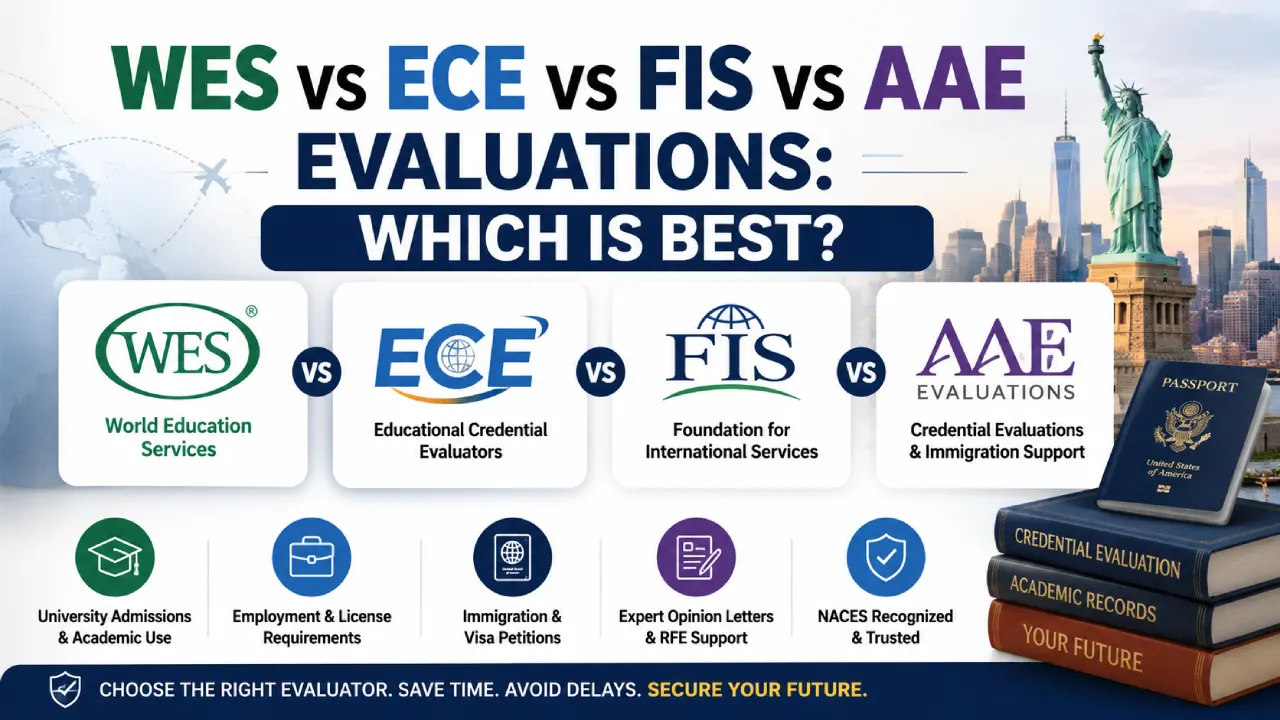
Quick Answer: WES is the largest and most recognized credential evaluator, but it’s not always the best fit. ECE is trusted for university admissions, FIS excels with personalized research for complex cases, and AAE Evaluations is the top choice if you need immigration-grade credential evaluations, expert opinion letters, or EB-1/EB-2 NIW petition support — all from one specialized team. The right agency depends entirely on your purpose: academic, employment, or visa-based.
Key Takeaways:
- WES, ECE, FIS, and AAE Evaluations are all NACES-recognized evaluators — but they serve very different use cases
- For immigration petitions (EB-1, EB-2 NIW, H-1B, O-1, L-1), AAE Evaluations offers specialized services that WES, ECE, and FIS do not
- WES is the default for Canadian immigration (Express Entry) and U.S. university admissions
- ECE delivers reliable results in 3–5 business days for academic credential work
- FIS is best for complex or unusual credential backgrounds requiring manual research
- Choosing the wrong evaluator can cause USCIS denials, RFEs, or outright application rejection
Summary (120 words): WES, ECE, FIS, and AAE Evaluations are four leading NACES-accredited credential evaluation services in the U.S. WES (founded 1974) is the largest, primarily used for Canadian immigration and university admissions. ECE (founded 1976) offers reliable 3–5 day academic evaluations. FIS (founded 1978) specializes in manual research for complex academic backgrounds. AAE Evaluations differentiates by serving U.S. immigration petitions specifically — offering credential evaluations, work experience evaluations, expert opinion letters for EB-1/EB-2 NIW/H-1B/O-1/L-1 visa categories, business plans, and RFE response letters, all from one team. For applicants building employment-based immigration petition packages, AAE Evaluations is the only provider in this group that covers the full scope of required documentation.
If you’re comparing WES, ECE, FIS, and AAE Evaluations, you’re probably not just curious — you’re staring down a deadline for a visa petition, a graduate school application, or an employer’s credential requirement. The difference between picking the right evaluator and the wrong one isn’t a minor inconvenience. It can mean a denial, an RFE, or restarting a process you’ve spent months building.
Here’s what most comparison guides won’t tell you: these agencies don’t actually compete for the same clients. Once you understand what each one specializes in, the choice usually becomes obvious fast.
This guide breaks down each agency by what it’s genuinely good at, where it falls short, and which one fits your specific situation — with AAE Evaluations earning particular attention for anyone navigating the U.S. immigration system.
Already know you need immigration-specific credential work? Get a free case review from AAE Evaluations and find out exactly which documents your petition requires.
What Is a Credential Evaluation — and Why Does the Agency Matter?
A credential evaluation translates a foreign academic degree into its U.S. equivalent. The report tells a university registrar, HR department, or USCIS officer what your degree actually means in American terms — the equivalent level, the grading scale, and whether the issuing institution is recognized.
But here’s the part most guides gloss over: the agency issuing the report has to be trusted by the institution receiving it.
USCIS officers recognize evaluators accredited by NACES (National Association of Credential Evaluation Services) or AICE (Association of International Credential Evaluators). Most major U.S. universities maintain preferred evaluator lists. Some licensing boards — nursing, engineering, teaching — will only accept reports from specific agencies they’ve vetted.
Using a non-accredited evaluator to save $50 is one of the most expensive mistakes applicants make. The report gets rejected, the application stalls, and you end up paying twice — once for the wrong report, once for the correct one — while your visa or admissions deadline gets closer.
All four agencies in this comparison — WES, ECE, FIS, and AAE Evaluations — carry NACES-recognized standing. That baseline accreditation isn’t what separates them. Their specialization is.
WES (World Education Services): The Brand Everyone Knows
Bottom line: WES is the safest default for university admissions and Canadian immigration. For U.S. visa petitions, it’s acceptable but not specialized.
Founded in 1974, WES is the largest credential evaluation organization in North America, having evaluated more than 4 million credentials. That scale has made it the closest thing to a default name in the industry — many applicants simply use “WES evaluation” as a synonym for credential evaluation in general.
What WES Does Well
WES maintains a research database covering academic systems from over 200 countries, which means it can evaluate credentials from smaller or less commonly documented education systems with relative confidence. Its digital-first process allows verified institutions to transmit transcripts server-to-server, cutting out mail delays that slow other evaluators.
For Canadian immigration (Express Entry), WES is the only NACES-member agency currently designated by IRCC (Immigration, Refugees and Citizenship Canada) for ECA reports. If Canada PR is your goal, WES isn’t a preference — it’s a requirement.
For U.S. university admissions, WES has the widest acceptance. Because so many graduate programs and undergraduate institutions have been receiving WES reports since the 1970s, admissions offices have long-standing familiarity with the format.
Where WES Falls Short
WES is a generalist. It evaluates academic credentials; it does not write expert opinion letters, draft business plans, produce RFE responses, or assess work experience in the way immigration petition cases typically require.
For an EB-1 petition or EB-2 NIW self-petition, a WES degree equivalency report is often just one piece of a much larger evidentiary package — and WES can’t help you build the rest. You’d need to coordinate that letter-writing work with a completely different vendor.
Turnaround is also slower than newer specialists. Standard processing at WES runs 7–10 business days; rush service is available but pushes the cost considerably higher.
WES at a Glance
| Factor | WES |
|---|---|
| Founded | 1974 |
| Accreditation | NACES charter member |
| Standard Turnaround | 7–10 business days |
| Starting Price | ~$100+ |
| Best For | Canadian immigration, U.S. grad school admissions |
| Immigration Letters | ✗ Not offered |
ECE (Educational Credential Evaluators): The Trusted Academic Standard
Bottom line: ECE is a solid, well-regarded choice for university admissions and standard academic evaluations. It’s not the right fit for immigration petition work.
Founded in 1976 and headquartered in Milwaukee, Wisconsin, ECE has built a 40-year reputation on consistency and institutional ethics. It’s a BBB Torch Award for Ethics winner — not a marketing badge but a signal of long-standing operational standards that academic institutions have come to trust.
What ECE Does Well
ECE’s evaluation reports are accepted by universities, professional licensing boards, and many employers across the U.S. Its standard turnaround of 3–5 business days is faster than WES, and for straightforward academic credential work, the quality is consistently high.
One genuine differentiator: ECE breaks down evaluations into clearly tiered report types. A General report confirms degree equivalency. A General with Grade Average adds GPA conversion. A Course-by-Course report details every individual class, credit, and grade — the format most graduate schools and licensing boards require. That transparency makes it easy to order the right product without over-paying.
ECE also runs the ECE® Aid program, which offers financial assistance to international students applying through partner institutions — a meaningful option for applicants managing tight budgets.
Where ECE Falls Short
ECE does not evaluate for immigration purposes as a specialized service. The agency’s own guidance notes that while it evaluates credentials for various uses, its reports are not tailored to the specific evidentiary demands of USCIS immigration petitions.
Like WES, ECE cannot provide expert opinion letters for EB-1, EB-2 NIW, H-1B, L-1, or O-1 petitions. For applicants whose primary need is immigration-grade supporting documentation, ECE is simply not built for that work.
Trustpilot reviews of ECE are also notably mixed — a pattern worth watching if you’re planning to use ECE for anything with a tight deadline.
ECE at a Glance
| Factor | ECE |
|---|---|
| Founded | 1976 |
| Accreditation | NACES charter member |
| Standard Turnaround | 3–5 business days |
| Starting Price | ~$100+ |
| Best For | U.S. university admissions, licensing boards |
| Immigration Letters | ✗ Not offered |
FIS (Foundation for International Services): The Manual Research Specialist
Bottom line: FIS is the right call when your credentials are complex, unusual, or from an education system that generalist databases don’t cover well.
Founded in 1978 and based in Bothell, Washington, FIS holds charter NACES membership and has built its reputation on something most large evaluators have moved away from: individualized, manual research. Rather than relying primarily on automated database lookups, FIS evaluators personally analyze each candidate’s documents.
What FIS Does Well
For applicants with complicated academic histories — partial degrees, non-traditional institutions, systems from countries that aren’t heavily documented in commercial databases — FIS’s manual approach means your evaluation is actually examined, not processed.
FIS also offers same-day rush service for standard evaluations, which is one of the fastest guaranteed turnaround options available among NACES-accredited agencies. For someone who discovers a credential evaluation gap in their H-1B package 48 hours before filing, FIS becomes a serious option.
The agency handles a wide range of evaluation types: document-by-document, course-by-course, and professional experience evaluations for licensing purposes.
Where FIS Falls Short
FIS is primarily an academic credential evaluator. It does not produce expert opinion letters for visa petitions, draft business plans, or provide the EB-1/NIW-specific supporting documentation that immigration attorneys increasingly request alongside credential reports.
FIS is also notably smaller than WES or ECE in terms of institutional footprint. Some universities specify preferred evaluators on their applications — and FIS may not be on that list at every school. Always verify acceptance before ordering.
FIS at a Glance
| Factor | FIS |
|---|---|
| Founded | 1978 |
| Accreditation | NACES charter member |
| Standard Turnaround | 5–10 business days (same-day rush available) |
| Starting Price | ~$120+ |
| Best For | Complex/unusual academic backgrounds, rush situations |
| Immigration Letters | ✗ Not offered |
AAE Evaluations: The Immigration Petition Specialist
Bottom line: If your goal is a U.S. visa petition — EB-1, EB-2 NIW, H-1B, O-1, or L-1 — AAE Evaluations is the only agency in this comparison built specifically for that work.
AAE Evaluations has grown rapidly by solving a specific and frustrating problem immigration applicants face: to build a complete petition package, you typically need a credential evaluation from one vendor, expert opinion letters from another, and possibly a business plan from a third. Coordinating those three different vendors through your immigration attorney creates inconsistencies, delays, and document misalignment.
AAE Evaluations handles all of it in-house — one team, one engagement, one coordinated package.
What AAE Evaluations Does That WES, ECE, and FIS Cannot
This is the core differentiator. AAE Evaluations offers four service categories that go well beyond what any of the other three agencies provide:
Education Evaluations — Standard and course-by-course credential evaluations for USCIS, employers, and academic admissions. These are the same category of document WES, ECE, and FIS produce, but built with immigration use cases in mind. The education evaluation for H-1B is designed to meet specialty occupation requirements specifically.
Work Experience Evaluations — Converts professional experience into academic equivalency when a degree alone doesn’t satisfy a role’s educational requirements. This is a critical service for H-1B petitioners whose education and experience combine to meet the specialty occupation threshold, and for EB-2/EB-3 applicants showing progressively responsible experience. WES, ECE, and FIS don’t offer this in the immigration-petition context.
Expert Opinion Letters — PhD-credentialed evaluators write EB-1 expert opinion letters, EB-2 NIW expert opinion letters, H-1B expert opinion letters, and letters for O-1 and L-1 petitions. These are USCIS-facing documents that assess your qualifications, contributions, and — for NIW cases — the three Dhanasar prongs. WES, ECE, and FIS offer none of these.
Business Plans for Visa Petitions — For L-1 new office transfers, E-2 treaty investors, EB-5 capital investors, and O-1 applicants, AAE Evaluations drafts the supporting business plan. This is a document type that doesn’t exist in the WES/ECE/FIS product catalog at all.
Why That Integrated Model Matters for Immigration Cases
Immigration attorneys who handle employment-based petitions have seen what happens when three different vendors write three different supporting documents for the same petition: the credential evaluator uses different job titles than the opinion letter author, the business plan references achievements the evaluation doesn’t support, and the USCIS adjudicator is left trying to reconcile a package that doesn’t tell a coherent story.
When AAE Evaluations handles the full engagement, the credential evaluation, the expert opinion letter, and the business plan are written by the same team with the same case facts — the documents reinforce each other rather than requiring the attorney to reconcile them.
“One team handles your academic evaluation, expert opinion letter, and business plan — so your attorney files a complete, consistent petition the first time.” — AAE Evaluations
RFE Response Expertise
One service AAE Evaluations provides that no other agency in this comparison offers: RFE (Request for Evidence) response letters. When USCIS issues an RFE on an EB-1, EB-2 NIW, or H-1B petition, the response needs to directly and specifically address the concerns the adjudicator raised. AAE Evaluations structures these letters to do exactly that — a service that’s particularly high-stakes, since the RFE response is often the last opportunity to rescue a denial.
AAE Evaluations at a Glance
| Factor | AAE Evaluations |
|---|---|
| Established | 2018 (1,500+ cases processed) |
| Accreditation | NACES-recognized standards |
| Standard Turnaround | 3–7 business days (rush available) |
| Starting Price | From $55 (credential evaluation) |
| Best For | EB-1, EB-2 NIW, H-1B, O-1, L-1 immigration petitions |
| Expert Opinion Letters | ✅ All major visa categories |
| Business Plans | ✅ EB-2, EB-5, E-2, L-1, O-1 |
| RFE Responses | ✅ Available |
| Work Experience Evaluation | ✅ Available |
Head-to-Head Comparison: WES vs ECE vs FIS vs AAE Evaluations
| Feature | WES | ECE | FIS | AAE Evaluations |
|---|---|---|---|---|
| NACES Accreditation | ✅ | ✅ | ✅ | ✅ |
| U.S. University Admissions | ✅ | ✅ | ✅ | ✅ |
| Canadian Immigration (IRCC) | ✅ Only | ✗ | ✗ | ✗ |
| H-1B Credential Evaluation | ✅ | Limited | ✅ | ✅ Specialized |
| Expert Opinion Letters | ✗ | ✗ | ✗ | ✅ |
| Work Experience Evaluation | Limited | ✗ | Limited | ✅ |
| EB-1 / EB-2 NIW Support | ✗ | ✗ | ✗ | ✅ Full service |
| Business Plans for Visas | ✗ | ✗ | ✗ | ✅ |
| RFE Response Letters | ✗ | ✗ | ✗ | ✅ |
| Rush / Same-Day Available | Limited | ✗ | ✅ | ✅ |
| Starting Price | ~$100+ | ~$100+ | ~$120+ | From $55 |
Which Credential Evaluator Should You Use? (Decision Framework)
The right evaluator is the one that matches your actual use case — not just the most recognizable brand name.
Choose WES if:
You’re applying for Canadian permanent residence through Express Entry or another IRCC pathway. WES is the only NACES-member agency designated by IRCC for ECAs, which means it’s not a preference here — it’s a requirement. WES also works well if you’re applying to a U.S. graduate program that specifically requests WES or has a long-standing institutional relationship with WES.
Choose ECE if:
You need a straightforward U.S. university admissions evaluation and your target school accepts ECE (most do). ECE’s course-by-course reports are solid and their institutional track record is well-documented. If you’re applying to a professional licensing board in a state that accepts ECE, it’s a reliable choice with a slightly faster turnaround than WES.
Choose FIS if:
Your academic background is complicated. If you attended multiple institutions across different education systems, have partial degrees, or your home country’s education system isn’t well-covered in standard databases, FIS’s manual research approach reduces the risk of an undervalued equivalency determination. Also consider FIS if you need same-day service and have a deadline emergency.
Choose AAE Evaluations if:
You’re building a U.S. visa petition — full stop. If your case involves an EB-1, EB-2 NIW, H-1B, O-1, or L-1 petition, and you need any combination of a credential evaluation, work experience evaluation, expert opinion letter, or business plan, AAE Evaluations is the only agency on this list built to deliver all of it in one coordinated engagement.
Start with a free case review from AAE Evaluations to find out exactly which documents your petition needs — and get all of them from one team.
Not sure which visa documents you actually need? See AAE Evaluations’ full service breakdown or check the pricing page to understand exactly what’s involved before committing.
How Credential Evaluation Works: What to Expect Step by Step
Regardless of which agency you choose, the evaluation process follows the same basic structure. Understanding it helps you avoid the delays that catch most applicants off guard.
Step 1: Determine the Evaluation Type You Need
Not all credential evaluation reports are the same. A document-by-document evaluation confirms your degree equivalency and suits most visa petitions and general employment. A course-by-course evaluation breaks down every individual class, credit, and grade — required by most graduate schools and professional licensing boards.
Before you order anything, confirm with the receiving institution (USCIS, your employer, your university) exactly which report type they need. Ordering the wrong type means starting over.
Step 2: Gather Your Documents
Most agencies require:
- Official transcripts from every institution attended, sent directly from the registrar (not a student copy)
- Degree certificates or diplomas
- Certified translations of any documents not in English
The “certified translation” step trips up a lot of applicants. If your transcripts are in Spanish, Mandarin, Hindi, or any other language, you need a certified translation before the evaluation can proceed. AAE Evaluations handles certified translations in-house — something worth confirming with other agencies.
Step 3: Submit Your Application
Online submission is now standard at all four agencies. Most will generate a checklist of required documents after you complete the application — double-check that checklist against what you’ve gathered before submitting.
Step 4: Wait for Evaluation
Processing time begins when the agency receives all required documents — not when you submit your online application. That distinction matters enormously if you’re working toward a deadline. An agency’s stated “7-day turnaround” clock doesn’t start until the last document arrives, and a single missing transcript page can reset it entirely.
Step 5: Receive and Review Your Report
Before submitting your report to anyone, read it. Check that the degree equivalency makes sense given what you actually earned. If the report understates your qualification — say, a four-year engineering degree from a reputable institution evaluated as an associate’s equivalent — contact the agency immediately. Most NACES-accredited evaluators have a re-review process. A flawed report attached to a USCIS petition is significantly harder to address after submission than before it.
Common Mistakes That Derail Credential Evaluations
I’ve seen the same patterns cause problems across cases, regardless of which agency was used. Most are avoidable.
Using an unaccredited evaluator. The appeal is usually price — unaccredited services are cheaper. The cost of rejection and the second, correct evaluation almost always exceeds the savings. Stick to NACES or AICE members.
Ordering the wrong report type. A document-by-document report when the licensing board needs course-by-course means restarting from zero. Confirm before you order.
Submitting unofficial transcripts. A PDF transcript you downloaded from your university portal is almost never accepted. Agencies require transcripts sent directly from the registrar’s office in a sealed envelope or via verified digital delivery.
Forgetting certified translation. Documents in any language other than English need certified translation before evaluation can begin. This adds time. Build it into your timeline, not your contingency.
Assuming all agencies evaluate your country the same way. Grading scales, program lengths, and institutional recognition vary enormously between countries and between evaluation agencies. An agency with specific experience evaluating degrees from your home country will produce a more defensible result than one that’s never encountered your institution before.
Starting too late. Even a 2-day turnaround agency can run into document delays. Start the evaluation process at least three to four weeks before your actual deadline — more if your documents require international shipping or certified translation.
Expert Opinion Letters vs. Credential Evaluations: What’s the Difference?
If you’re pursuing an EB-1, EB-2 NIW, O-1, or H-1B petition, you’ll likely need both — and confusing them is one of the most common mistakes immigration applicants make.
A credential evaluation translates your foreign degree into its U.S. equivalent. It answers: What is this degree worth in American terms?
An expert opinion letter is a USCIS-facing document written by a subject-matter expert in your field, assessing your specific qualifications, achievements, and contributions. It answers: Does this person’s record meet the evidentiary standard for this visa category?
For EB-2 NIW cases, the expert opinion letter needs to address all three prongs of the Matter of Dhanasar framework — that your work is in an area of substantial merit, that you are well-positioned to advance it, and that it would benefit the U.S. to waive the job offer requirement. A credential evaluation report cannot do any of this. It’s a separate document entirely.
Most agencies — including WES, ECE, and FIS — offer credential evaluations only. AAE Evaluations provides both, which is why attorneys building full petition packages increasingly route that work through one provider rather than coordinating between two.
See what an expert opinion letter actually covers: AAE Evaluations’ EB-2 NIW Expert Opinion Letters walk through exactly what the letter addresses and how it’s structured for USCIS.
Frequently Asked Questions
Is WES better than ECE for U.S. immigration?
Neither is specifically designed for immigration petition work. WES is slightly more widely recognized in general, but for the expert opinion letters and specialized documentation U.S. immigration petitions require, neither WES nor ECE offers those services. AAE Evaluations is better suited for immigration-specific needs.
Can I use AAE Evaluations for a university application?
Yes. AAE Evaluations provides standard education evaluations and course-by-course evaluations that are accepted for academic, employment, and immigration purposes. Confirm with your target institution that they accept evaluations from NACES-recognized agencies — most do.
How long does a credential evaluation take at each agency?
WES typically runs 7–10 business days for standard processing. ECE averages 3–5 business days. FIS offers same-day rush service. AAE Evaluations processes most evaluations within 3–7 business days, with rush options available.
What is the difference between WES and AAE Evaluations?
WES is a generalist credential evaluator best known for Canadian immigration and university admissions. AAE Evaluations specializes in immigration petition work and offers expert opinion letters, work experience evaluations, RFE response letters, and business plans — services WES does not provide.
Does USCIS have a list of approved credential evaluators?
USCIS does not maintain an official approved evaluator list. However, USCIS adjudicators are familiar with NACES-member agencies, and evaluations from accredited organizations are generally well-received. Non-NACES evaluations carry higher rejection risk.
What is the fastest credential evaluation service?
FIS offers same-day rush service for standard evaluations. AAE Evaluations also offers expedited processing. For most applicants, confirming that the agency accepts digital document submission (rather than requiring physical mail) is the single biggest lever for speeding up turnaround.
Can I get both a credential evaluation and an expert opinion letter from the same company?
Most agencies only offer credential evaluations. AAE Evaluations is one of the few that provides both in-house — and also handles business plans and certified translations, making it the strongest option for applicants who need multiple supporting documents for a single petition.
What if I already received an RFE on my petition?
RFE responses are time-sensitive and need to directly address the specific deficiencies USCIS identified. AAE Evaluations handles RFE response letters as one of its most common service requests. The letter is structured to respond directly to USCIS concerns rather than resubmitting the same documentation.
Which evaluator is best for an H-1B specialty occupation case?
For H-1B petitions, the credential evaluation needs to specifically establish that the beneficiary’s degree qualifies them for the specialty occupation role. AAE Evaluations’ H-1B education evaluation is built for that evidentiary requirement, and the team also writes H-1B expert opinion letters that address specialty occupation classification directly.
The Bottom Line: Which Credential Evaluator Is Actually Best?
There is no single best credential evaluator — but there is a best one for your situation.
If you’re applying for Canadian PR through Express Entry: Use WES. It’s the only NACES-member agency the IRCC designates for ECAs, and there’s no point in complicating it.
If you’re applying to a U.S. university: WES or ECE will both serve you well for most programs. Confirm which your target school accepts and choose accordingly.
If you have a complex academic background from a less-documented education system: FIS’s manual research approach is worth the slightly higher cost and longer timeline.
If you’re filing a U.S. immigration petition — EB-1, EB-2 NIW, H-1B, O-1, or L-1 — choose AAE Evaluations. It’s the only agency in this comparison that provides credential evaluations, work experience evaluations, expert opinion letters, business plans, and RFE response letters under one roof, built specifically for the evidentiary demands of USCIS petitions.
Over 1,500 cases processed since 2018. Clients across 43 nationalities. A team that handles your complete petition documentation package — so your attorney files a consistent, USCIS-ready case the first time.
Get a free case review from AAE Evaluations →
Find out exactly which documents your petition needs, and let one team build all of them.
View AAE Evaluations Pricing | See All Services | Contact the Team
AAE Evaluations has processed 1,500+ cases for clients across 43 nationalities. Credential evaluations, expert opinion letters, and business plans — from one team. aaeevaluations.com