
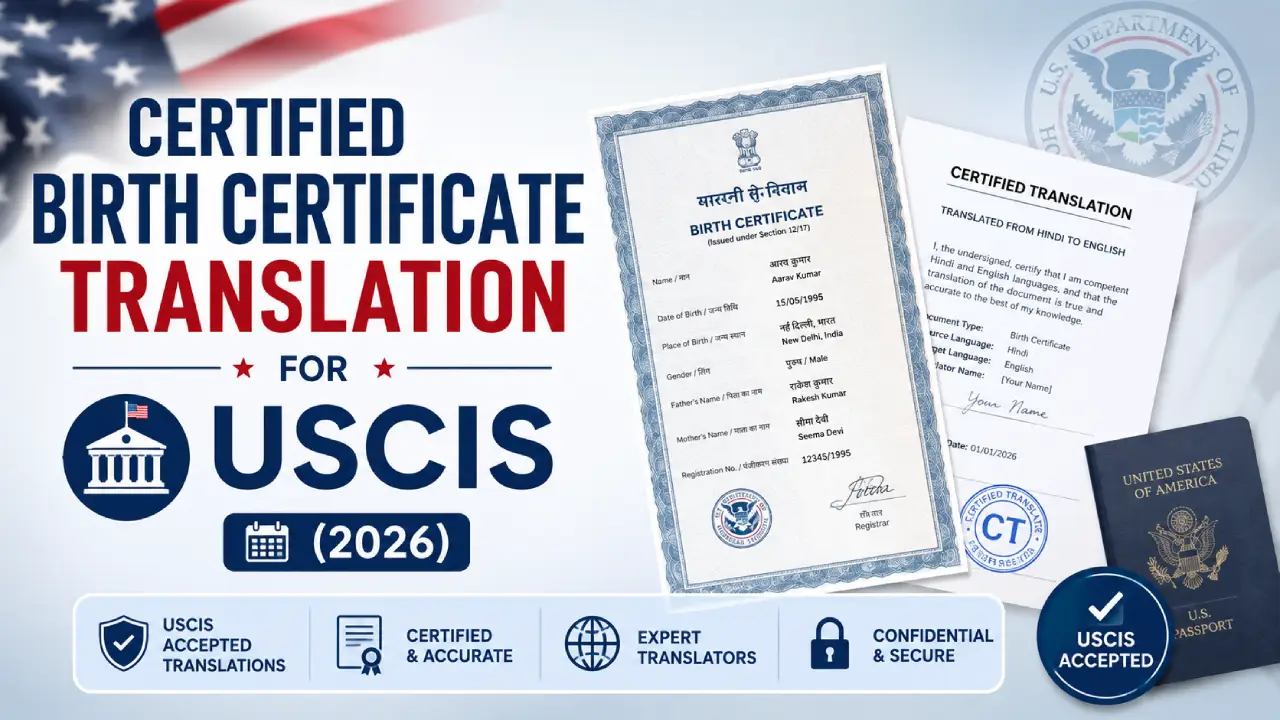
Your birth certificate is the most identity-critical document in any immigration case. If it was issued in a language other than English, USCIS will not accept it without a certified English translation — and getting that translation wrong is one of the most avoidable reasons immigration applications get delayed.
This guide covers exactly what USCIS requires under federal regulation 8 CFR 103.2(b)(3), what “certified” actually means in legal terms, what the most common mistakes look like and how to avoid them, and what to do if you’ve already received an RFE because of a translation issue.
Whether you’re filing a family-based green card petition, adjusting status, applying for naturalization, or supporting a visa application, this is what you need to know before submitting your birth certificate to USCIS.
What USCIS Actually Requires: The Regulation Behind the Rule
Direct Answer: Under 8 CFR 103.2(b)(3), any document submitted to USCIS that contains foreign language text must be accompanied by a complete English translation. The translator must certify that the translation is accurate and complete, and that they are competent to translate from the source language into English.
Three elements matter here, and all three need to be present:
1. A full, complete translation — not a summary, not a partial. Every word on the original document must be reflected in the translation, including stamps, seals, registration numbers, marginal notes, and signatures.
2. A certification statement — a signed declaration from the translator attesting to accuracy, completeness, and their own competence. This is what makes a translation “certified” under USCIS standards.
3. Translator contact information — full name, signature, date, and contact details (address, phone, or email). USCIS has issued RFEs solely because a translator’s contact details were missing.
There is no federal licensing requirement for USCIS translators. The United States does not have a government-run translator certification program. What matters is the certification statement itself, not a credential on the translator’s wall.
What “Certified Translation” Does and Does Not Mean
This is where most applicants are confused — and where confusion gets expensive.
A certified translation IS:
- A translation accompanied by a signed declaration from the translator
- The translator’s sworn statement that the document is complete and accurate to the best of their knowledge
- Acceptable for USCIS when it includes all required elements
A certified translation is NOT:
- A notarized translation (notarization verifies who signed a document, not whether the translation is accurate — USCIS does not typically require notarization)
- An apostille (an apostille is an international authentication mark used between Hague Convention countries — it is not part of USCIS immigration filings)
- A translation done by a government-licensed translator (no such federal license exists in the U.S.)
Paying extra for notarization on a USCIS-bound translation is rarely necessary. Unless a specific state agency, court, or officer has explicitly requested it, a properly certified translation without notarization satisfies the federal requirement.
What Your Certified Birth Certificate Translation Must Include
USCIS adjudicators are trained to spot incomplete translations. Missing even one element — a stamp on the back, a registration number in the margin — is enough to trigger an RFE. Here is what every compliant translation must cover:
Every Word on the Document
This means everything visible on the original:
- Full name as printed (not transliterated or “corrected”)
- Date of birth in the same format as the original
- Place of birth — including district, province, or municipality if listed
- Parents’ names, exactly as printed
- Registration or certificate number
- Name of the issuing authority (civil registry, municipality, hospital, etc.)
- Date and place of issuance
- All official stamps and seals — with text translated and marked as “[Official Seal]” or “[Registrar Stamp]” if relevant
- All signatures — described and attributed where possible
- Any handwritten notes or annotations — translated if legible, noted as “[Handwritten note, partially illegible]” if not
Mirror Formatting
USCIS officers reviewing your file often compare your original document and your translation side by side on separate screens. A translation that mirrors the visual structure of the original — tables, field positions, header placement — makes cross-referencing faster and builds trust with the adjudicator.
A single dense block of translated text, with no structural correspondence to the original, is technically compliant but practically weaker.
The Certification Statement
The certification should be a separate, signed document — not just a footer at the bottom of the translation. It must include language along the following lines:
“I, [Translator Full Name], certify that I am competent to translate from [Source Language] into English, and that the attached translation of [Document Name] is complete and accurate to the best of my knowledge and ability.”
It should be dated and include the translator’s contact information. The translator or authorized company representative must sign it personally.
The Most Common Mistakes That Trigger RFEs
USCIS issues Requests for Evidence on birth certificate translations more often than most applicants expect. Here are the mistakes that most commonly cause them:
Untranslated stamps or seals.
If a stamp appears anywhere on the document — front, back, or edge — it must be addressed in the translation. Even if the text is in a secondary language (a regional dialect, Latin, or an older script), it needs to be handled explicitly.
Name inconsistencies.
If your birth certificate uses a spelling of your name that differs from your passport or prior immigration documents, the translation must render the name exactly as it appears on the original — not “corrected” to match your passport. Name discrepancies between documents are then explained in a cover letter, not silently fixed in the translation.
Missing translator contact details.
An otherwise perfect translation has been flagged because the translator’s email or address was omitted from the certification statement.
Summarized translations.
Some services provide a condensed summary of key facts rather than a word-for-word translation. This does not meet the USCIS standard and will likely generate an RFE.
Self-translation.
While federal regulation does not explicitly prohibit self-translation, USCIS treats it with heightened skepticism because the applicant has a personal interest in the case outcome. Professional translation is strongly recommended.
Why Birth Certificate Translation Errors Specifically Are Costly
Unlike errors in other supporting documents, birth certificate translation problems create cascading inconsistencies. USCIS uses the birth certificate to verify your identity, your parents’ identities, your place of birth, and your age. If any of these details appear inconsistent with your passport, prior petitions, or other submitted documents, the adjudicator may question your entire evidentiary record — not just the translation.
This is especially relevant for petitions where the birth certificate establishes family relationships (I-130 family-based petitions, I-485 adjustment of status) or citizenship eligibility (N-400 naturalization). An RFE here delays your case by weeks or months. A denial based on document inconsistency is far worse.
Getting the translation right the first time is not optional. It is the minimum standard.
When You Also Need a Credential Evaluation
Some immigration petitions require more than a translated birth certificate. If you are submitting a birth certificate as part of establishing educational equivalency — for example, to demonstrate the equivalency of a foreign degree for an EB-2 NIW, H-1B, or EB-1 petition — you may also need a formal credential evaluation.
A credential evaluation and a certified translation are separate documents. The translation converts the text of your certificate into English. The credential evaluation provides a professional academic analysis of what that degree represents in the U.S. education system — which is what USCIS actually uses when assessing whether you meet a degree-based threshold.
At AAE Evaluations, we handle both. For immigration petitions that require a translated birth certificate alongside an academic credential evaluation — a common scenario in EB-2 NIW and EB-1 petitions — our team coordinates both documents under one engagement so the language, formatting, and presented facts are consistent. At EEE of America, we offer the same integrated approach, including certified translation services and credential evaluations prepared for USCIS compliance.
Submitting a translation and an education evaluation that tell different stories about your name, degree title, or institution is a fast path to an RFE.
Step-by-Step: Getting a Compliant Birth Certificate Translation for USCIS
Step 1: Obtain a Clean, Complete Copy of the Original
The quality of the translation depends entirely on the quality of the source document. If stamps are faded, text is smudged, or the document has been heavily folded, work with the issuing authority to get a cleaner copy before submitting to a translator. Guesswork in the translation on illegible text leads to inaccuracies.
Step 2: Choose a Provider with Specific Immigration Experience
General translation services sometimes produce technically accurate translations that still fail USCIS formatting expectations. Look for a provider that specifically handles USCIS-bound immigration document translation and understands the visual mirroring standard, stamp/seal requirements, and certification statement format USCIS expects.
Step 3: Confirm the Scope Before Work Begins
Tell the translator: “I need a full, word-for-word translation of every element on the document, including stamps, seals, handwritten notes, and signatures, formatted to mirror the original layout, with a signed certification statement and your contact information.” A translator who knows immigration translation will confirm this is standard. One who hesitates is a warning sign.
Step 4: Review the Translation Before Submitting
Check four things specifically:
- Your name is translated exactly as it appears on the original (not adjusted)
- Your date of birth is consistent with every other document in the petition
- Every stamp and seal is addressed in the translation
- The certification statement includes the translator’s name, signature, date, and contact details
Step 5: Bundle the Translation Correctly
Submit the certified translation immediately behind the foreign language original in your petition package. USCIS should be able to flip from the original directly to the translation. Organize documents in the order the instructions specify — do not separate related documents with unrelated materials.
Handling a Birth Certificate Translation RFE
If you’ve already received an RFE related to your birth certificate translation, the response needs to be precise. USCIS will identify the specific deficiency in the RFE notice — missing translator information, incomplete translation of stamps, name inconsistency, or other issues.
The response should include a new, fully compliant translation that corrects every deficiency cited, a brief cover letter explaining what was deficient and what the new document provides, and — if the original certificate has a name discrepancy relative to other documents — a brief explanatory note addressing the variation.
AAE Evaluations handles RFE-specific translation responses for USCIS cases. If your original translation was prepared elsewhere and has been flagged, we can review the RFE notice and prepare a corrected, fully compliant version. The same service is available through EEE of America, which handles time-sensitive translation requests for immigration applicants and attorneys.
How Birth Certificate Translation Fits Into a Larger Petition Package
A birth certificate translation is rarely the only document in an immigration petition. For context on how it fits:
Family-based green card (I-130 / I-485): Birth certificate establishes the petitioner-beneficiary relationship. Translation errors here delay the entire petition.
Naturalization (N-400): Birth certificate confirms identity and place of birth. Inconsistencies between the translation and the naturalization application create credibility issues.
EB-2 NIW self-petition (I-140): Birth certificate may support identity documentation. The petition also typically requires an EB-2 NIW expert opinion letter, education credential evaluation, and recommendation letters — all of which must present consistent biographical information.
H-1B petition: Birth certificate may be needed for adjustment of status filings filed alongside or following H-1B approval. An H-1B expert opinion letter and education evaluation are also typically required.
When all documents in a petition are prepared through the same team, biographical details — name spellings, degree titles, institution names — stay consistent across every document. That consistency reduces RFE risk across the entire package, not just on the translation.
Frequently Asked Questions
Does USCIS require notarized birth certificate translations?
Generally, no. USCIS requires a certified translation — meaning the translator signs a statement of accuracy and competence. Notarization (which verifies the identity of the signer, not the accuracy of the document) is not typically required for USCIS filings unless a specific court or agency has explicitly requested it.
Can I translate my own birth certificate for USCIS?
Federal regulation does not explicitly prohibit self-translation, but it is strongly discouraged. USCIS views self-translation with heightened scrutiny because the applicant has a personal interest in the case outcome. A professional, independent translation is always the safer choice, and the cost of professional translation is minor compared to the cost of an RFE delay.
Does every stamp and seal on the birth certificate need to be translated?
Yes. Every piece of text on the original document — stamps, seals, signatures, handwritten annotations, even text that appears on the back of the document — must be addressed in the translation. If something is illegible, it should be noted as “[Illegible stamp]” rather than omitted entirely.
What if my name is spelled differently on my birth certificate than on my passport?
The translation must render your name exactly as it appears on the birth certificate original — not corrected to match your passport. The discrepancy between documents is addressed in a cover letter or explanatory note, not silently fixed in the translation itself.
How long does a certified birth certificate translation for USCIS take?
Most professional providers complete a standard birth certificate translation within two to three business days. Rush and same-day options are typically available for time-sensitive filings. Contact AAE Evaluations or EEE of America to discuss turnaround options for your specific situation.
Do I need an apostille on my birth certificate for USCIS?
No. An apostille is an international authentication used under the Hague Convention between participating countries. It is not a USCIS requirement for immigration filings. Do not confuse apostille authentication (a foreign government function) with certified translation (a domestic translation function).
What’s the difference between a certified translation and a credential evaluation?
A certified translation converts the text of your foreign document into English. A credential evaluation is a separate professional assessment of what your foreign degree or education represents in the U.S. education system. Many immigration petitions require both, and submitting them with inconsistent information is a common source of RFEs.
Featured Snippet Blocks
Query: What is a certified birth certificate translation for USCIS?
A certified birth certificate translation for USCIS is a complete, word-for-word English translation of a foreign-language birth certificate, accompanied by a signed statement from the translator certifying accuracy, completeness, and their competence to translate. Under 8 CFR 103.2(b)(3), USCIS requires this for any foreign language document submitted with an immigration application.
Query: Does USCIS require notarization for birth certificate translation?
No. USCIS requires a certified translation — a signed statement from the translator attesting to the translation’s accuracy and completeness. Notarization, which verifies the identity of the person signing a document but not the accuracy of the translation, is generally not required for USCIS immigration filings unless specifically requested by a court or agency.
Query: What happens if my birth certificate translation has errors?
If your birth certificate translation is incomplete, missing translator contact information, or inconsistent with your other petition documents, USCIS will likely issue a Request for Evidence (RFE). You will need to submit a corrected, fully compliant translation within the RFE response deadline — which is typically 87 days. Significant name or date discrepancies can raise broader credibility concerns about your petition.