
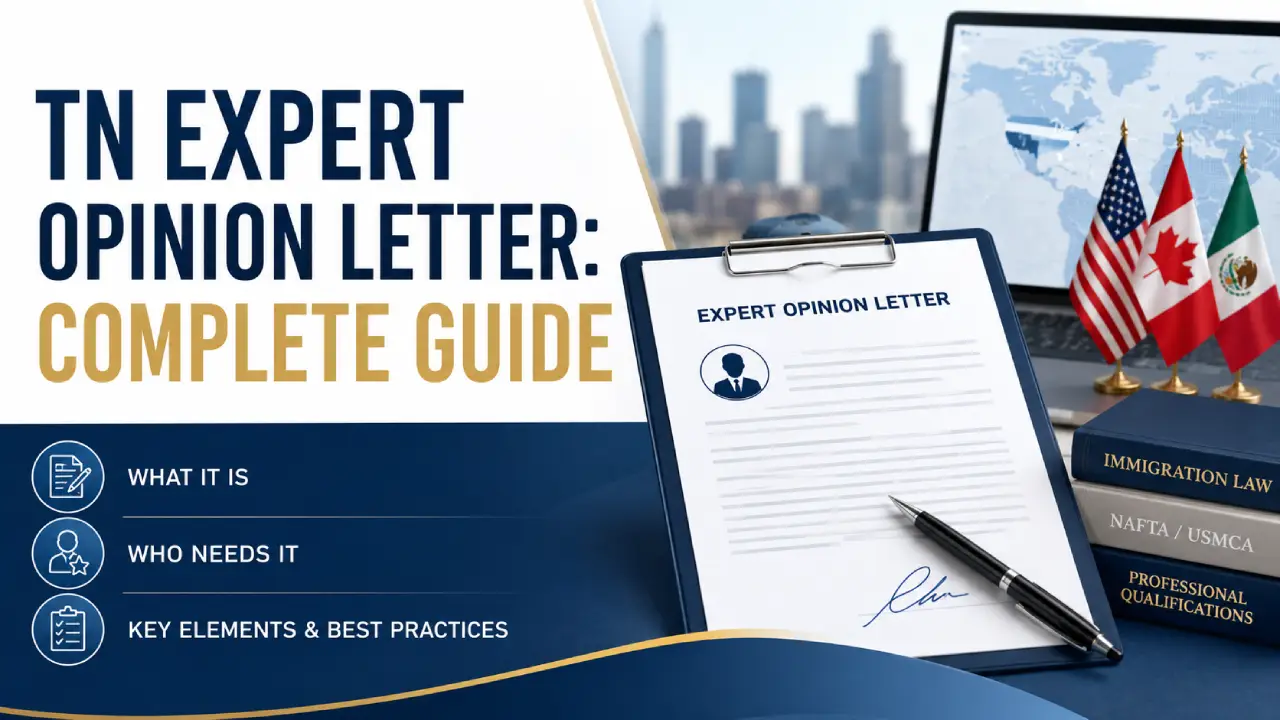
A TN Expert Opinion Letter is a written evaluation from a qualified professional — usually a U.S. professor or subject-matter expert — that confirms your job qualifies as a USMCA professional position and/or that you meet the credentials required for that profession. It is most often used to overcome a Request for Evidence (RFE) or to strengthen an initial TN petition or border application when the job title, degree field, or job duties don’t map cleanly onto the USMCA professional list.
Quick answer: You need a TN Expert Opinion Letter when your job title doesn’t exactly match one of the 63 USMCA professional categories, when your degree is in a related but not identical field, or when USCIS/CBP has already questioned your petition through an RFE or denial.
Below, we walk through exactly what these letters contain, which TN categories draw the most scrutiny, how the process works from start to finish, and how a well-prepared letter fits into the larger TN petition.
What Is the TN Visa?
The TN nonimmigrant classification lets Canadian and Mexican citizens work temporarily in the United States in specific professional occupations under the United States-Mexico-Canada Agreement (USMCA), which replaced NAFTA in 2020 while keeping the same professional categories and eligibility rules. To qualify, you generally need to show four things:
- You are a citizen of Canada or Mexico.
- You have a prearranged, full-time or part-time job with a U.S. employer or entity.
- The position requires a USMCA professional in one of the 63 listed occupations.
- You meet the specific education or experience requirements for that occupation.
Canadian citizens can typically apply directly at a port of entry with supporting documents, while Mexican citizens generally need a TN visa from a U.S. consulate before seeking admission. Employers can also file Form I-129 with USCIS on a worker’s behalf, including through premium processing.
Self-employment is specifically excluded from TN eligibility — the work must be for a U.S. employer or entity you don’t control, which is a distinction that trips up consultants and independent contractors more than any other group.
What Is a TN Expert Opinion Letter?
A TN Expert Opinion Letter is a supporting document, separate from your employer’s job offer letter, in which an independent expert analyzes your case and explains — in language a CBP officer or USCIS adjudicator can act on — why your position and your qualifications satisfy USMCA requirements. It typically addresses one or both of the following:
- Position analysis: Does the job actually involve the duties associated with the USMCA professional category being claimed, even if the job title doesn’t match exactly?
- Beneficiary qualifications analysis: Does your degree, licensure, or work experience meet the minimum standard for that category?
Unlike an education evaluation, which focuses narrowly on translating a foreign degree into its U.S. equivalent, a TN Expert Opinion Letter goes further. It builds a reasoned argument connecting the job, the USMCA category, and your background into one coherent case.
Why TN Cases Need Expert Opinion Letters More Than People Expect
TN eligibility looks simple on paper: match your job to one of 63 professions, meet the listed requirement, done. In practice, a large share of TN petitions involve roles that don’t map cleanly onto that list, because the list itself hasn’t changed since 1994 and modern job titles frequently didn’t exist when it was written. A few patterns that consistently generate scrutiny:
- Job title mismatch. “Software Engineer” isn’t on the USMCA list, but the underlying duties may fit Computer Systems Analyst. The officer reviewing your case won’t make that connection on their own — it has to be argued.
- Non-identical degree field. Unlike H-1B, TN adjudication does not allow academic and experiential credentials to be combined to create an equivalency. Your degree and experience must independently satisfy the category’s stated requirement, which makes borderline degree fields (a Physics degree for an Engineer role, for example) a common denial trigger.
- Mixed duties. Positions blending analytical, advisory, and hands-on development work can straddle two categories (say, Computer Systems Analyst and Management Consultant), and a poorly drafted employer letter can undercut both.
- Prior RFE or denial. Once USCIS has already questioned a case, the burden of proof increases substantially on any refiling or border reapplication.
- Scrutinized categories. Management Consultant and Scientific Technician/Technologist are flagged more often than most, precisely because Management Consultant can qualify on experience alone with no degree, and Scientific Technician/Technologist requires proving a specific supervisory relationship with a professional in an approved discipline.
In any of these situations, a properly written Expert Opinion Letter supplies the missing logical link between your resume, your job description, and the USMCA category — the exact thing a reviewing officer needs in order to approve the case without guessing.
USMCA Professional Categories That Most Often Require a Letter
The USMCA list contains 63 occupations across science, healthcare, IT, business, and engineering. A handful require special handling:
| Category | Why It Draws Extra Scrutiny |
|---|---|
| Management Consultant | Can qualify on 5 years of relevant experience alone, with no degree required — which invites close review of the experience letters |
| Scientific Technician/Technologist | Must show direct support of a professional in a specific listed discipline (biology, chemistry, engineering, etc.); patient-care-adjacent roles are frequently denied |
| Computer Systems Analyst | Accepts a post-secondary diploma or certificate plus 3 years of experience instead of a bachelor’s degree, which requires careful documentation of both the credential and the experience |
| Engineer | Only recognizes traditional engineering disciplines; modern titles like “Software Engineer” or “Data Engineer” require duty-by-duty mapping to an approved discipline |
| Economist | USCIS has specifically excluded financial analysts, marketing analysts, and market research analysts from this category, even when “economist” appears in the job title |
If your role falls into one of these categories — or into any category where your title, degree, or duties don’t line up exactly — an Expert Opinion Letter is the strongest way to close that gap before USCIS or CBP flags it.
What’s Included in a TN Expert Opinion Letter
A well-constructed letter is not a form letter or a template with your name dropped in. It’s built around your specific case and generally includes:
- Expert’s credentials — the evaluator’s academic background, professional experience, and relevant field expertise, establishing why their opinion carries weight.
- Statement of facts — a summary of the documents reviewed: your resume, degree(s), transcripts, employer’s job offer, and any prior RFE or denial notice.
- Position analysis — a duty-by-duty comparison between your actual job responsibilities and the recognized business activities of the claimed USMCA category.
- Qualifications analysis — an evaluation of whether your education and/or work experience independently satisfies that category’s specific requirement.
- Reasoned conclusion — a clear, direct opinion stating whether the position and the beneficiary meet the USMCA standard, supported by the analysis above, not just an assertion.
- Signed attestation — confirmation that the expert is providing an impartial, professional opinion rather than advocacy.
Documents You’ll Need to Provide
To prepare a thorough letter, gather the following before you start:
- Job offer letter or employer support letter, including title, duties, salary, and duration
- Updated resume or CV covering all relevant education and work history
- Degree certificates and transcripts (with certified English translations if issued in another language)
- Any prior RFE, Notice of Intent to Deny (NOID), or denial notice
- Professional licenses or certifications, if your category allows licensure as an alternative to a degree
- Proof of Canadian or Mexican citizenship
Incomplete or vague documentation is one of the most common reasons a first attempt at a TN Expert Opinion Letter falls short — the more specific and complete your source material, the more precisely the expert can tie your case to the USMCA standard.
TN Expert Opinion Letter vs. TN Employer Letter
These two documents are easy to confuse but serve different purposes:
| Employer Letter | Expert Opinion Letter | |
|---|---|---|
| Written by | Your U.S. employer | An independent third-party expert |
| Purpose | States the job offer, duties, salary, and duration | Analyzes whether the job and your credentials meet USMCA standards |
| Required for every TN case | Yes | No — only when the category, title, or credentials need clarification |
| Weight with adjudicators | Establishes the offer | Provides independent, professional validation |
The employer letter is mandatory for every TN application. The Expert Opinion Letter is a supplemental document you add when the case needs extra support — it doesn’t replace the employer letter, it strengthens the overall petition alongside it.
When to Get a TN Expert Opinion Letter
Initial Application
Filing proactively with an Expert Opinion Letter is worth considering whenever your job title doesn’t precisely match a USMCA category name, your degree is in an adjacent field, or your category (Management Consultant, Scientific Technician/Technologist, Computer Systems Analyst) is known for close review.
Responding to an RFE
If USCIS issues a Request for Evidence questioning your job classification or credentials, an expert letter directly addresses the specific concern raised in the RFE — this is the single most common trigger for ordering one. Our H1B RFE guide covers the broader RFE response process if you’re navigating a related visa category alongside your TN case.
Reapplying After a Denial or at the Border
A prior denial raises the evidentiary bar for any future filing or port-of-entry application. An independent expert opinion demonstrates that the previous issue has been substantively addressed, not just resubmitted with better formatting.
How the Process Works
- Case review. We review your job offer, resume, degrees, and any RFE or denial notice to identify exactly which USMCA requirement needs the strongest support.
- Expert matching. You’re paired with an evaluator whose academic and professional background is field-matched to your USMCA category — a computer science professor for a Computer Systems Analyst case, an engineering professor for an Engineer case, and so on.
- Document preparation. We collect and organize your supporting materials — transcripts, work experience letters, licenses, translations — so the expert has a complete record to analyze.
- Analysis and drafting. The expert reviews your documentation, drafts the position and/or qualifications analysis, and reaches a clear, well-reasoned conclusion.
- Review and delivery. The completed letter is reviewed for accuracy and clarity before being delivered as a finished document ready to submit with your petition.
Visit our pricing page for current rates, or reach out through our contact page to discuss your specific TN case before you order.
Common Mistakes to Avoid
- Using a generic template letter. Adjudicators can tell when a letter wasn’t tailored to the specific job and applicant — it undermines the letter’s credibility.
- Choosing an expert outside the field. A letter from an evaluator without genuine expertise in your discipline carries far less weight than one from a properly credentialed, field-matched professor.
- Submitting an employer letter alone when the category is borderline. The employer letter states the offer; it doesn’t independently validate the USMCA classification the way a third-party expert opinion does.
- Ignoring the specific RFE language. A letter that doesn’t directly answer the concern raised in your RFE reads as unresponsive, even if it’s well written in general.
- Ignoring the self-employment bar. No expert letter can overcome a fundamental self-employment issue — that has to be resolved in how the position and employer relationship are structured.
Frequently Asked Questions
1. Is a TN Expert Opinion Letter legally required for every TN application?
No. It’s a supplemental document used when the job title, degree field, or work experience doesn’t align cleanly with a USMCA professional category, or when responding to an RFE or prior denial. Straightforward cases — a Canadian accountant with a matching accounting degree, for example — often don’t need one.
2. How long does it take to get a TN Expert Opinion Letter?
Turnaround depends on case complexity and how quickly you can supply complete documentation. Contact us directly for a timeline specific to your situation, especially if you’re working against an RFE response deadline.
3. Can a TN Expert Opinion Letter address both my job duties and my qualifications?
Yes. Many letters cover both a position analysis (does the job fit the USMCA category?) and a qualifications analysis (do you meet that category’s education or experience requirement?), particularly when both elements are in question.
4. Does a TN Expert Opinion Letter guarantee approval?
No document can guarantee a USCIS or CBP decision. What a well-prepared letter does is provide independent, credentialed analysis that directly addresses the specific gap in your case, which meaningfully strengthens the overall petition.
5. What’s the difference between a TN Expert Opinion Letter and an H-1B specialty occupation letter? Both are expert evaluations, but they answer different legal questions. An H-1B letter argues that a position is a “specialty occupation” requiring at least a bachelor’s degree. A TN letter argues that a position and applicant satisfy one of the 63 fixed USMCA professional categories, which have their own distinct education and experience thresholds that don’t allow combining credentials the way H-1B evaluations can.
6. Can Management Consultant applicants qualify without a bachelor’s degree?
Yes — Management Consultant is one of the few USMCA categories where five years of substantial relevant professional experience can satisfy the requirement without a degree, though this pathway is also one of the most closely scrutinized and typically benefits from a strong expert opinion letter.
Final Thoughts
A TN Expert Opinion Letter isn’t paperwork for paperwork’s sake — it’s the document that translates your resume and job description into the specific legal language a CBP officer or USCIS adjudicator needs to approve a case that doesn’t fit neatly into a 1994-era occupation list. If your title, degree field, or category is anything other than a perfect match, or if you’re already facing an RFE, a properly field-matched expert opinion is often the difference between a smooth approval and a prolonged, frustrating process.