
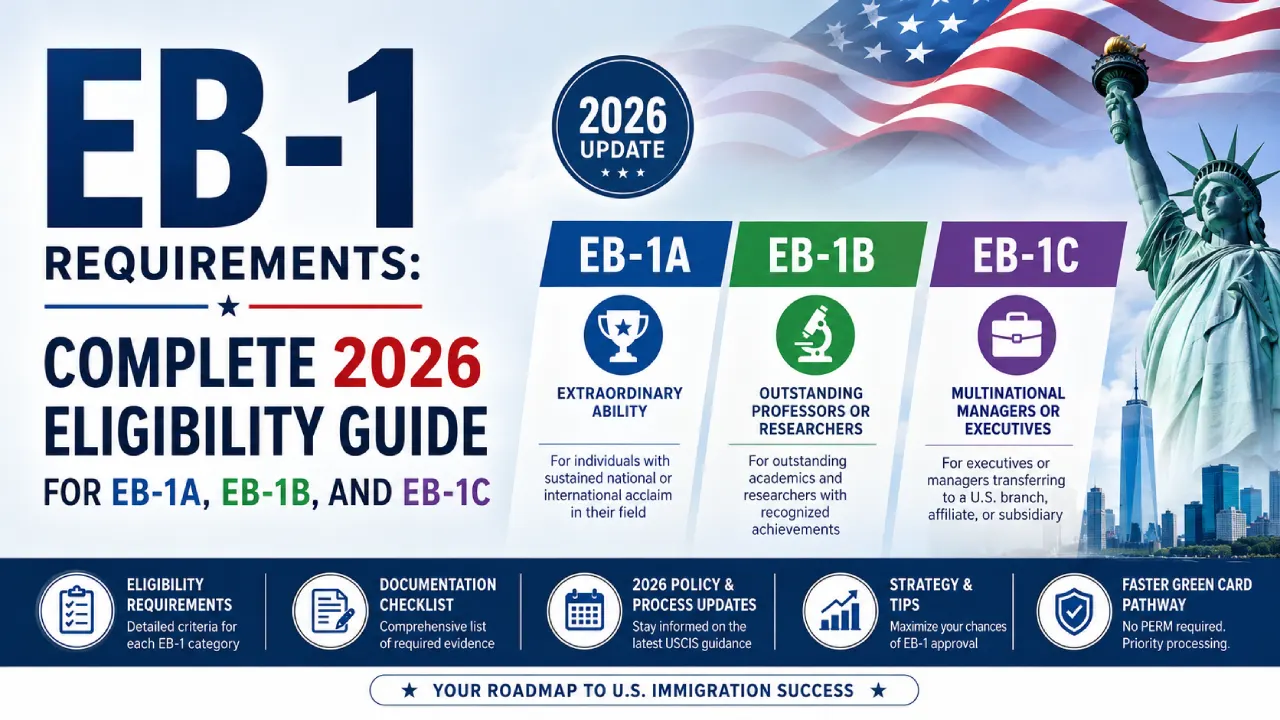
The EB-1 visa requires you to qualify under one of three subcategories: extraordinary ability (EB-1A), outstanding professor or researcher (EB-1B), or multinational manager or executive (EB-1C). Each has its own evidence standard, but all three share one major advantage over most other employment green cards: no PERM labor certification. EB-1A also lets you self-petition without a job offer, while EB-1B and EB-1C require a U.S. employer to sponsor you.
This guide breaks down exactly what U.S. Citizenship and Immigration Services (USCIS) looks for in each subcategory, the documentary evidence that wins approvals, the 2026 filing fees and timelines, and the most common reasons petitions stall. If you are weighing whether you qualify, read the subcategory that fits your profile first, then check the evidence standard section, because that is where most cases are actually won or lost.
What Is the EB-1 Visa?
The EB-1 is the first-preference employment-based immigrant category, the highest priority tier in the U.S. green card system. It is reserved for people at the top of their field, internationally recognized academics, and senior leaders of multinational companies. Because it sits at the front of the line, EB-1 generally moves faster than EB-2 and EB-3, and it skips the months-long PERM labor certification process entirely.
There are three subcategories, and your first job is identifying which one matches your background.
| Subcategory | Who it’s for | Self-petition? | Job offer required? |
|---|---|---|---|
| EB-1A | Individuals with extraordinary ability in science, arts, education, business, or athletics | Yes | No |
| EB-1B | Outstanding professors and researchers with international recognition | No (employer files) | Yes |
| EB-1C | Multinational managers and executives transferring to a U.S. entity | No (employer files) | Yes |
All three are filed on Form I-140, Immigrant Petition for Alien Worker. The difference is who files it and what you have to prove.
EB-1A Requirements: Extraordinary Ability
EB-1A is the category people call the “Einstein visa.” It is for individuals with extraordinary ability who have sustained national or international acclaim and whose achievements have been recognized in their field. You do not need an employer or a job offer, and you can file the petition yourself.
To qualify, you must show one of two things:
- A one-time major internationally recognized award — a Nobel Prize, Pulitzer, Academy Award, Olympic medal, or similar top-tier honor. Very few applicants qualify this way.
- At least 3 of the 10 regulatory criteria set out in 8 C.F.R. § 204.5(h)(3) (or comparable evidence if a criterion does not readily apply to your field).
The 10 EB-1A Criteria
You need to satisfy at least three of these:
- Receipt of lesser nationally or internationally recognized prizes or awards for excellence.
- Membership in associations that require outstanding achievement, as judged by recognized experts.
- Published material about you in professional or major trade publications or other major media.
- Participation as a judge of the work of others, individually or on a panel.
- Original contributions of major significance to your field (scientific, scholarly, artistic, athletic, or business-related).
- Authorship of scholarly articles in professional journals or major media.
- Display of your work at artistic exhibitions or showcases.
- A leading or critical role in distinguished organizations or establishments.
- High salary or remuneration compared to others in your field.
- Commercial success in the performing arts (ticket sales, record sales, box office).
Key point: Meeting three criteria is only a threshold. USCIS then steps back and asks whether the total body of evidence proves you are genuinely one of the small percentage who have risen to the top. Quality and context matter far more than ticking boxes.
A strong EB-1A case usually rests on three to five genuinely impressive criteria backed by deep documentation, not a thin spread across all ten. For each award, USCIS wants the selection criteria, the prestige of the awarding body, and who else was eligible. For memberships, it wants proof that admission demands outstanding achievement, not just a fee. This is exactly where an extraordinary ability letter from a recognized authority can frame your record in the language USCIS officers expect.
EB-1B Requirements: Outstanding Professors and Researchers
EB-1B is for academics and researchers who are internationally recognized as outstanding in a specific field. Unlike EB-1A, you cannot self-petition. A U.S. employer must file the I-140 on your behalf, and that employer must demonstrate the ability to pay your offered wage.
You must satisfy three general requirements:
- International recognition as outstanding in your academic field.
- At least three years of experience in teaching or research in that field. Time spent teaching or researching while earning an advanced degree can count, but only if you already earned the degree and either had full responsibility for the class taught or your research was recognized as outstanding.
- A qualifying job offer — a tenured or tenure-track teaching position, or a permanent or comparable research position. A private employer qualifies if it has at least three full-time researchers and a documented record of research accomplishments.
The 6 EB-1B Criteria
Beyond the three general requirements, you must provide evidence in at least 2 of these 6 categories:
- Receipt of major prizes or awards for outstanding achievement.
- Membership in associations requiring outstanding achievement of members.
- Published material written by others about your work in the field.
- Participation as a judge of the work of others in your or an allied field.
- Original scientific or scholarly research contributions to the field.
- Authorship of scholarly books or articles in journals with international circulation.
USCIS evaluates EB-1B much like EB-1A: meeting two criteria is a starting point, not an automatic approval. Officers weigh the evidence as a whole to decide whether you are truly internationally recognized. Independent expert testimonials that speak to the significance of your contributions carry real weight here, which is why expert opinion letters are a standard part of strong academic petitions.
EB-1C Requirements: Multinational Managers and Executives
EB-1C is the business-leadership pathway. It is for senior managers and executives being transferred to a U.S. entity from a related company abroad. Like EB-1B, the U.S. employer must file the petition, and there is no self-petition option.
To qualify, you must meet all of the following:
- One year of qualifying employment abroad. You must have worked for at least one continuous year, within the three years before the petition (or before your most recent admission to the U.S.), for a firm related to the U.S. employer.
- Managerial or executive capacity. Both your role abroad and your intended U.S. role must be genuinely managerial or executive, not specialized-knowledge or routine work.
- A qualifying corporate relationship. The U.S. employer must be the same company, or a parent, subsidiary, affiliate, or branch of the company that employed you abroad.
- An established U.S. employer. The petitioning U.S. business must have been operating for at least one year before filing.
- A continuing leadership role. You must be entering to keep serving the organization in a managerial or executive capacity.
Watch the relationship documentation. Many EB-1C cases turn on proving the corporate link between the U.S. and foreign entities. Organizational charts, ownership records, and financial statements that clearly map the relationship are essential, and a thin or unclear structure is a frequent trigger for a Request for Evidence.
A useful note for business owners: EB-1C can allow an owner of a qualifying enterprise to immigrate, though USCIS scrutinizes those cases closely. The category is often viewed as an alternative to the EB-5 investor route for executives who already run an international business. Where the U.S. role’s duties need defending against an RFE, a position evaluation and supporting expert letters can document that the role is truly managerial or executive.
EB-1A vs EB-1B vs EB-1C: Side-by-Side
| Requirement | EB-1A | EB-1B | EB-1C |
|---|---|---|---|
| Core standard | Extraordinary ability, sustained acclaim | Internationally recognized as outstanding | Managerial/executive leadership |
| Evidence test | 1 major award OR 3 of 10 criteria | 3 general requirements + 2 of 6 criteria | 5 specific requirements (all) |
| Self-petition | Yes | No | No |
| Job offer | Not required | Required (tenure/permanent research) | Required (U.S. role) |
| Labor certification (PERM) | No | No | No |
| Years of experience | Not fixed (career-long acclaim) | 3 years teaching/research | 1 year abroad (of last 3) |
| Premium processing window | 15 business days | 15 business days | 45 business days |
How USCIS Actually Evaluates EB-1 Evidence
This is the part most guides skip, and it is where petitions are decided. For EB-1A and EB-1B, USCIS uses a two-step analysis (often called the Kazarian framework after the federal case that shaped it):
Step 1 — Count the criteria. The officer checks whether you submitted qualifying evidence for the required number of criteria (three of ten for EB-1A, two of six for EB-1B). At this stage the officer is essentially confirming the evidence exists and is the right type.
Step 2 — Final merits determination. The officer then weighs all your evidence together to decide whether it actually demonstrates extraordinary ability or international recognition. This is a “totality of the evidence” judgment, and it is why simply meeting the minimum criteria is never a guarantee. The standard of proof is preponderance of the evidence — more likely than not — but in practice EB-1 officers apply that standard to a very high bar of accomplishment.
The 2024 USCIS Policy Update
In late 2024, USCIS issued policy guidance clarifying the types of evidence it considers for the extraordinary ability classification. The update gave officers clearer direction on how to assess criteria such as awards and memberships, and confirmed that comparable evidence may be used when a listed criterion does not fit a particular field or occupation. The practical takeaway has not changed: the strength and context of your evidence matters more than the raw count. A well-documented award with clear selection criteria beats three weak ones every time.
Documents You’ll Need for an EB-1 Petition
While the exact package varies by subcategory, most strong EB-1 filings include:
- Form I-140 and the correct filing fee.
- A detailed petition letter mapping your evidence to each criterion.
- Primary evidence: award certificates, publications, citation records, media coverage, membership confirmations, and proof of leading roles.
- Independent recommendation and expert opinion letters from recognized authorities in your field.
- Foreign degree and credential evaluations, when U.S. equivalency must be established. A professional education evaluation translates foreign qualifications into U.S. terms USCIS recognizes.
- A work experience evaluation where your experience needs to be quantified against U.S. standards.
- Corporate and financial documents (EB-1C) or a qualifying job offer and ability-to-pay evidence (EB-1B).
EB-1 Filing Process, Fees, and Timelines (2026)
The EB-1 process runs through Form I-140, followed by either adjustment of status (Form I-485, if you are in the U.S. and a visa is available) or consular processing abroad.
2026 Government Fees
- Form I-140 base filing fee: $715.
- Asylum Program Fee: $300 for small employers (25 or fewer full-time employees) and self-petitioners — a total of $1,015 — and $0 for nonprofits. Larger employers pay the full $600.
- Premium processing (Form I-907): $2,965, effective March 1, 2026, up from $2,805. This fee is separate from the base filing fee, and for EB-1A the beneficiary is allowed to pay it.
Direct answer: As of 2026, the base USCIS fee to file an EB-1 petition (Form I-140) is $715, plus a $300 Asylum Program Fee for self-petitioners. Optional premium processing adds $2,965.
Processing Times
Standard I-140 processing typically runs 6 to 12 months depending on the service center and category. Premium processing guarantees USCIS action (an approval, denial, RFE, or notice of intent to deny) within:
- 15 business days for EB-1A and EB-1B.
- 45 business days for EB-1C.
Premium processing does not guarantee an approval, and if USCIS issues an RFE, the clock resets when you respond. It also does not move your place in the green card line — if your priority date is not current in the monthly Visa Bulletin (a common issue for applicants from India and China), an approved I-140 still waits for a visa number.
Family Benefits
Your spouse and unmarried children under 21 can obtain green cards as derivative beneficiaries, and your spouse may apply for work authorization. This holds across all three EB-1 subcategories.
EB-1A vs EB-2 NIW: Which Self-Petition Route?
Many applicants who can self-petition weigh EB-1A against the EB-2 National Interest Waiver (NIW). Both let you file without an employer or labor certification, but the bar is different. EB-1A demands proof that you are at the very top of your field with sustained acclaim. EB-2 NIW asks instead whether your work has substantial merit and national importance, and whether waiving the job-offer requirement benefits the United States — a meaningful but generally more attainable standard.
If your record is exceptional but you are not certain it clears the EB-1A bar, the NIW is often the stronger filing, and many applicants pursue it first. Independent EB2-NIW expert opinion letters that document the national importance of your work are central to those petitions.
How Expert Opinion Letters Strengthen an EB-1 Petition
EB-1 cases are won on evidence, and one of the most persuasive forms of evidence is an independent assessment from a recognized authority. An expert opinion letter does what your own résumé cannot: it tells USCIS, in a credentialed third party’s voice, why your awards, publications, or leadership actually meet the regulatory standard.
These letters are especially valuable at three points:
- In the initial petition, to frame your contributions against the EB-1A or EB-1B criteria and explain their significance to non-specialist officers.
- In response to a Request for Evidence (RFE), where USCIS questions whether your evidence rises to “extraordinary” or “internationally recognized.”
- In response to a denial or Notice of Intent to Deny (NOID), as supplementary support when you challenge an adverse decision.
A targeted expert opinion letter for an EB-1 visa, written by a qualified professor or industry authority, can address the exact criterion an officer flagged — original contributions of major significance, the prestige of an award, or the international reach of your work. Paired with a properly documented education evaluation or work experience evaluation, it gives USCIS the credentialed analysis it needs to approve a borderline case.
Common Reasons EB-1 Petitions Get RFEs or Denials
- Treating the criteria as a checklist. Meeting three (or two) criteria without showing genuine significance fails the final merits step.
- Weak award documentation. Submitting a certificate without selection criteria, the awarding body’s reputation, or the pool of candidates.
- Generic recommendation letters. Letters that praise without specifics, or that all read the same, carry little weight.
- Unclear corporate relationships (EB-1C). Failing to prove the parent/subsidiary/affiliate link between the U.S. and foreign entities.
- Thin proof of international recognition (EB-1B). Local or institutional recognition is not the same as international standing.
- Missing credential equivalency. Foreign degrees and experience presented without a U.S. evaluation that USCIS can rely on.
Addressing these proactively — with strong primary evidence, credentialed expert opinion letters, and professional evaluations — is far cheaper than fighting an RFE after the fact.
Frequently Asked Questions
What are the basic requirements for an EB-1 visa?
You must qualify under one of three subcategories: extraordinary ability (EB-1A), outstanding professor or researcher (EB-1B), or multinational manager or executive (EB-1C). EB-1A requires a one-time major award or three of ten criteria. EB-1B requires international recognition, three years of experience, a qualifying job offer, and two of six criteria. EB-1C requires one year of qualifying managerial or executive work abroad for a related company. None of the three requires PERM labor certification.
Can I self-petition for an EB-1 green card?
Only EB-1A allows self-petition. You can file Form I-140 on your own behalf without an employer or job offer. EB-1B and EB-1C both require a U.S. employer to sponsor and file the petition for you.
How many of the 10 EB-1A criteria do I need to meet?
At least three of the ten, unless you have a one-time major internationally recognized award such as a Nobel Prize or Olympic medal. Meeting three is only a threshold — USCIS then weighs your full body of evidence to decide whether you have truly reached the top of your field.
How long does the EB-1 process take?
Standard Form I-140 processing usually takes 6 to 12 months. Premium processing guarantees USCIS action within 15 business days for EB-1A and EB-1B, or 45 business days for EB-1C, for an additional fee of $2,965 as of March 1, 2026. If your priority date is not current in the Visa Bulletin, you may still wait for a visa number after approval.
Do I need an expert opinion letter for an EB-1 petition?
It is not legally mandatory, but credentialed expert opinion letters are among the strongest evidence you can submit. They explain to USCIS why your achievements meet the regulatory standard, and they are especially useful when responding to a Request for Evidence or a denial.
Is the EB-1 visa the same as a green card?
No, but they are connected. EB-1 is the immigrant classification you petition for on Form I-140. Once approved and a visa number is available, you apply for the green card itself through adjustment of status or consular processing.
Move Forward With Confidence
EB-1 is the fastest employment-based green card route for top talent, but it is also one of the most evidence-intensive. Whether you are self-petitioning under EB-1A or being sponsored under EB-1B or EB-1C, the difference between an approval and an RFE usually comes down to how well your evidence is documented and explained.
If your case needs a credentialed expert opinion letter, a foreign credential evaluation, or a work experience assessment to strengthen it, contact our team to discuss your petition, or review our pricing to get started.
This guide is for general informational purposes only and is not legal advice. EB-1 eligibility depends on your individual facts; consult a licensed immigration attorney for advice on your specific case.