

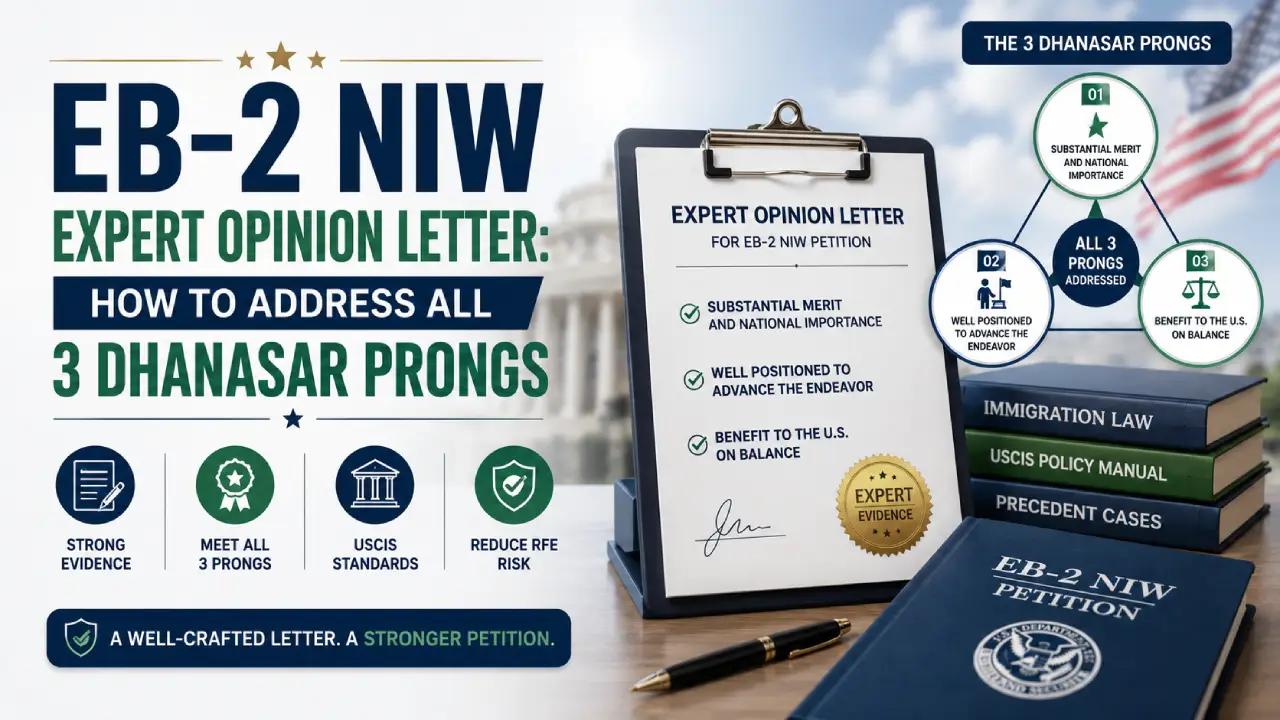
An EB-2 NIW expert opinion letter is an independent, analytical document written by a credentialed subject-matter expert that evaluates a petitioner’s proposed endeavor and qualifications in relation to the legal standard for a National Interest Waiver. Unlike a personal recommendation from a colleague or supervisor, it provides professional analysis specifically structured to inform a USCIS adjudicator — who is a trained generalist, not a specialist in your field — about the significance and national relevance of your work.
Applicants consider expert opinion letters because the EB-2 NIW standard requires more than credentials alone. Since the Administrative Appeals Office issued its landmark decision in Matter of Dhanasar, 26 I&N Dec. 884 (AAO 2016), every NIW petition must address three distinct legal prongs. Each prong requires substantive, case-specific evidence. A well-prepared expert opinion letter can provide independent professional analysis that contextualizes your evidence and connects your qualifications to each of those prongs.
It is important to understand at the outset: an expert opinion letter is supporting evidence. It does not, by itself, establish eligibility. Its usefulness depends on the quality of the underlying evidence, the rigor of the expert’s analysis, the expert’s own qualifications and independence, and how well the letter coordinates with the rest of your petition record. No letter — however well-written — guarantees approval.
Quick Answer
What is an EB-2 NIW expert opinion letter?
An EB-2 NIW expert opinion letter is a formal, analytical document written by an independent, credentialed professional who evaluates a petitioner’s proposed endeavor and qualifications in relation to the three-prong framework established by Matter of Dhanasar, 26 I&N Dec. 884 (AAO 2016). It serves as independent third-party evidence in a National Interest Waiver petition — but it is supporting evidence, not a substitute for objective proof of eligibility.
What Is an EB-2 NIW Expert Opinion Letter?
An EB-2 NIW expert opinion letter is a written analytical evaluation produced by a recognized authority in the petitioner’s professional or academic field. Its purpose is to give USCIS an independent, evidence-based assessment of:
- The significance of the petitioner’s proposed endeavor
- Why that endeavor has merit and broader national importance
- How the petitioner’s background positions them to carry it forward
- Why, in the expert’s professional judgment, waiving the job-offer and labor-certification requirements may serve the United States’ interest
How it differs from a recommendation letter: A recommendation letter is typically written by someone with a personal or professional relationship with the petitioner — a former supervisor, collaborator, or colleague. Its core function is attestation: vouching for the petitioner’s competence based on direct interaction. An expert opinion letter, by contrast, is analytical and independent. The expert reviews documentary evidence — publications, patents, projects, citations, education, impact metrics — and delivers reasoned professional conclusions. The two documents serve different evidentiary roles and are not interchangeable.
How it fits into an NIW evidence package: An expert opinion letter is one component of a broader evidentiary record that typically includes the petitioner’s CV, publications, citation records, project descriptions, awards, memberships, media coverage, government grants, contracts, and other objective evidence. The letter’s value lies in contextualizing and interpreting that evidence — explaining what it means to someone outside the field.
Need an EB-2 NIW Expert Opinion Letter? AAE Evaluations prepares research-backed, Dhanasar-structured expert opinion letters written by credentialed, independent subject-matter experts. Get started at AAE Evaluations →
Does EB-2 NIW Require an Expert Opinion Letter?
No — an expert opinion letter is not automatically required in every EB-2 NIW petition.
This is one of the most commonly misunderstood points in NIW practice. USCIS does not impose a universal requirement that every NIW petitioner submit an expert letter. The regulatory and policy framework establishes eligibility standards and evidentiary criteria; it does not mandate a specific document type.
The distinction is between required eligibility standards and supporting evidence that may strengthen the record. A petitioner must establish EB-2 classification eligibility — an advanced degree or exceptional ability — and must demonstrate all three Dhanasar prongs by a preponderance of the evidence. How they do that is determined by the facts and circumstances of their individual case.
In some cases, the objective evidence — publications, citations, patents, awards — is sufficiently self-explanatory that a USCIS officer can evaluate the prongs without expert interpretation. In many others, especially where the petitioner’s work is highly technical, interdisciplinary, or involves emerging fields, expert analysis can meaningfully assist the adjudicator in understanding the significance of the evidence.
The January 15, 2025 update to the USCIS Policy Manual (Vol. 6, Part F, Ch. 5) reinforced this distinction. Per the updated guidance, letters of support and business plans are relevant but must be corroborated by independent objective evidence. Vague endorsements or unsupported predictions carry little weight. This means that the evidentiary value of an expert letter depends on the quality of the underlying evidence it analyzes — a letter that is not grounded in concrete documentation will not compensate for a weak evidentiary record.
When is an expert opinion letter most useful?
- The petitioner works in a highly technical, emerging, or interdisciplinary field that a generalist adjudicator may not readily understand
- The proposed endeavor’s national importance is not self-evident from the raw evidence
- The petition needs independent corroboration of the connection between the petitioner’s qualifications and the proposed endeavor
- An RFE has identified a specific evidentiary gap related to one or more Dhanasar prongs
- The petitioner is an entrepreneur or self-employed professional where the standard labor-market framework does not straightforwardly apply
What Is the Matter of Dhanasar Framework?
Matter of Dhanasar, 26 I&N Dec. 884, was decided by the USCIS Administrative Appeals Office (AAO) on December 27, 2016. It vacated the prior Matter of New York State Dep’t of Transp. (NYSDOT) standard that had governed NIW adjudications since 1998 and established the current analytical framework that controls every NIW petition filed or pending today.
Under Dhanasar, USCIS may grant a national interest waiver — as a matter of discretion — if the petitioner demonstrates all three of the following:
- The foreign national’s proposed endeavor has both substantial merit and national importance
- The foreign national is well positioned to advance the proposed endeavor
- On balance, it would be beneficial to the United States to waive the requirements of a job offer and thus of a labor certification
The burden of proof is preponderance of the evidence. Each prong must be addressed on its own merits. Satisfying one prong strongly does not compensate for failing another.
The January 2025 USCIS Policy Manual update did not change this three-prong structure. It clarified how adjudicators should evaluate each element and introduced more explicit guidance on EB-2 threshold eligibility, national importance assessments, and special considerations for entrepreneurs.
Dhanasar Three-Prong Framework at a Glance
| Dhanasar Prong | What It Asks | Focus of the Analysis | Potential Role of Expert Analysis |
|---|---|---|---|
| Prong 1 | Does the proposed endeavor have substantial merit and national importance? | The endeavor itself — not the petitioner’s qualifications | Contextualize the significance and broader implications of the work in the field |
| Prong 2 | Is the petitioner well positioned to advance the proposed endeavor? | The connection between petitioner’s qualifications and the endeavor | Interpret the petitioner’s evidence and explain why their background supports the proposed work |
| Prong 3 | Would waiving the job offer and labor certification benefit the United States? | The balance of interests — totality of circumstances | Analyze why the flexibility of self-petition, rather than employer-tethered labor certification, may serve U.S. interests |
How an Expert Opinion Letter Can Address Dhanasar Prong 1
Substantial Merit
Prong 1 addresses the proposed endeavor — not the petitioner’s qualifications. The AAO in Dhanasar clarified that substantial merit may be demonstrated across a variety of areas including business, entrepreneurship, science, technology, culture, health, and education. The merit of an endeavor can be established without immediate or quantifiable economic impact.
What an expert can usefully analyze here:
- Technical or scientific significance: Why does this research, technology, or methodology matter within its field? What gap does it address? What problems does it advance toward solving?
- Industry relevance: Is this work recognized as important by practitioners, researchers, and institutions in the sector?
- Healthcare or public health implications: Does the work address conditions, systems, or access issues that affect meaningful segments of the U.S. population?
- Economic or technological advancement: Does the proposed endeavor involve developing capabilities or efficiencies with demonstrated or reasonably anticipated commercial, industrial, or public-sector impact?
- Educational significance: Does the work advance knowledge, training, or practice in ways that have downstream effects beyond the petitioner’s individual output?
The expert should ground these observations in the petitioner’s actual evidence — publications, project records, citations, institutional support, prior results — rather than offering abstract praise.
National Importance
The January 2025 policy update expanded USCIS’s treatment of national importance considerably. This element is frequently where petitions fall short, because applicants conflate the importance of the field generally with the national importance of their specific proposed endeavor.
An expert can help draw this distinction by analyzing:
- Geographic reach: Does the proposed work have implications across the United States, as opposed to benefiting a single institution, region, or employer?
- Broader industry or sector impact: If successful, does the endeavor have implications for the field at a scale beyond the petitioner’s immediate output?
- Connection to national priorities: Is the work relevant to areas USCIS recognizes as having national significance — healthcare, STEM, critical infrastructure, national security-adjacent technologies, energy, education, economic competitiveness?
- Institutional recognition of significance: Have government agencies, research institutions, professional bodies, or other objective actors recognized the importance of this area of work?
Important caveat: Working in an important field is not the same as demonstrating that your specific proposed endeavor has national importance. An expert who simply asserts that the petitioner’s field is nationally significant without grounding that observation in the specific proposed endeavor does not add meaningful evidentiary value. The analysis must be specific to what the petitioner proposes to do.
How an Expert Opinion Letter Can Address Dhanasar Prong 2
Being Well Positioned to Advance the Proposed Endeavor
Prong 2 asks whether this petitioner — with their specific background, skills, and record — is well positioned to carry out the proposed endeavor. The analysis is about fit and capacity, not just general excellence.
An expert’s analysis should interpret objective evidence and explain its significance, not merely restate the petitioner’s CV. The key distinction is between narrating credentials and reasoning about what those credentials mean in context.
Evidence the expert may analyze in connection with Prong 2:
- Education and training: Does the petitioner’s formal education align with the requirements of the proposed endeavor? Does their training provide specific knowledge or methodological expertise that the work requires?
- Professional experience: Does the career trajectory demonstrate progressive engagement with the proposed area of work? Has the petitioner already been doing this work, or work that directly prepares them for it?
- Publications and research record: Do the petitioner’s published works demonstrate active engagement with the relevant technical questions? Are they contributing to the literature in a way that positions them to advance the proposed endeavor?
- Citation record: Does the reception of the petitioner’s work by other researchers or practitioners indicate that their contributions are recognized as meaningful within the field?
- Patents, inventions, or proprietary methodologies: Has the petitioner demonstrated the ability to produce novel and protectable contributions?
- Awards and recognition: Do any of the recognitions the petitioner has received come from independent parties who evaluated merit against a competitive field?
- Leadership and implementation history: Has the petitioner led projects, teams, or initiatives that demonstrate the capacity to execute at scale, not just contribute at the individual level?
- Funding, contracts, or business relationships: Has the petitioner already attracted external support — grants, institutional investment, commercial contracts — that corroborates others’ confidence in their capacity?
- Measurable results or impact: Are there concrete outcomes from prior work that demonstrate the petitioner’s capacity to produce results, not just effort?
The expert should reason through this evidence — explaining why a particular combination of background and achievement makes the petitioner well positioned relative to the specific demands of the proposed endeavor — rather than producing a summary that mirrors the petition’s own narrative.
Have an EB-2 NIW RFE? If USCIS has questioned your qualifications in relation to Prong 2, AAE Evaluations prepares RFE-response expert letters that directly address the specific evidentiary gap identified. See how AAE can help →
How an Expert Opinion Letter Can Address Dhanasar Prong 3
Why Waiving the Job Offer and Labor Certification May Benefit the United States
Prong 3 is often the least intuitive of the three. It does not ask whether the petitioner is talented or whether the field is important. It asks whether, given the totality of the circumstances, the United States’ interest is better served by allowing this person to self-petition — without an employer sponsor and without going through PERM labor certification — than by requiring them to go through that process.
The Dhanasar decision deliberately eliminated the prior NYSDOT requirement of showing harm to the national interest or comparing the petitioner to U.S. workers. Prong 3 is now a more flexible, totality-of-circumstances analysis.
An expert may provide professional analysis regarding:
- Urgency or time-sensitivity: In some fields, the pace of development means that tethering a petitioner’s work to a specific employer or labor-market test could delay contributions that are time-sensitive.
- Specialized expertise and self-direction: In highly specialized or emerging fields, the petitioner’s value may derive from the independence to pursue a specific line of work, which an employer-bound certification process may not accommodate.
- Flexibility and broad impact: Where the proposed endeavor’s benefit depends on the petitioner’s ability to collaborate across institutions, sectors, or geographic locations, the labor-certification framework’s employer-specific structure may create constraints inconsistent with the work’s nature.
- Potential contribution vs. constrained contribution: The expert can analyze whether the petitioner’s proposed work — which they are uniquely positioned to carry out — could be meaningfully constrained by the requirements of employer sponsorship in this particular context.
Important caveat: USCIS does not grant Prong 3 merely because a petitioner is talented or because their field is important. The 2025 Policy Manual update explicitly cautioned that broad assertions about economic benefits or job creation, without more, are insufficient — especially for entrepreneurs. The expert’s analysis must be specific, reasoned, and grounded in the actual characteristics of the proposed endeavor and the petitioner’s situation.
Can One Expert Opinion Letter Address All 3 Dhanasar Prongs?
Yes — a single, well-structured expert opinion letter can address all three Dhanasar prongs. In fact, organizing the letter around the three-prong framework is a common and logical approach, because it aligns the expert’s analysis with the exact questions USCIS adjudicators must resolve.
However, a letter that covers all three prongs must do so rigorously for each. A letter that addresses Prongs 1 and 2 with specific analysis but offers only a generic paragraph on Prong 3 provides uneven evidentiary support. Each prong should receive substantive, evidence-grounded analysis proportional to the complexity of the petitioner’s case.
It is also worth noting that in larger NIW petitions — particularly those with extensive evidence or addressing multiple distinct aspects of the proposed endeavor — petitioners and their counsel sometimes include more than one expert letter, with each expert contributing analysis within their area of specialization. One expert may be best positioned to address the field’s national significance (Prong 1), while another may be better suited to evaluate the petitioner’s research qualifications (Prong 2). This is a strategic decision that depends on the facts of the individual case. An expert opinion letter is not, by itself, ever sufficient for approval — it works as part of a comprehensive evidentiary record.
What Should an EB-2 NIW Expert Opinion Letter Include?
The following is a best-practice framework. It is not a USCIS-mandated template. Individual petitions vary significantly, and an attorney should guide strategic decisions about content and structure.
Expert Opinion Letter Component Checklist
- Expert identification — full name, title, institution or affiliation
- Expert qualifications — academic credentials, professional licenses, affiliations
- Area of specialization — specific field(s) the expert is qualified to assess
- Independence disclosure — statement of whether the expert has a prior professional or personal relationship with the petitioner; if independent, explicit confirmation of that
- Purpose of the letter — clear statement that the letter addresses the EB-2 NIW Dhanasar framework
- Materials reviewed — specific identification of the documents, evidence, and records the expert reviewed before forming conclusions
- Description of the proposed endeavor — the expert’s understanding of what the petitioner proposes to do
- Methodology — how the expert evaluated the evidence and reached conclusions
- Prong 1 analysis — Substantial merit — expert’s professional assessment of the significance and importance of the proposed endeavor
- Prong 1 analysis — National importance — expert’s professional assessment of the endeavor’s broader significance beyond local or individual benefit
- Prong 2 analysis — expert’s professional assessment of how the petitioner’s qualifications, experience, and record position them to advance the proposed endeavor
- Prong 3 analysis — expert’s professional assessment of why, in their view, waiving the employer-based requirements may serve U.S. interests given the specific circumstances
- Evidence references — specific citations to documents, publications, awards, or data that support the expert’s conclusions
- Professional conclusions — clear, reasoned statement of the expert’s overall professional opinion
- Appropriate limitations — where the expert’s conclusions are bounded by their area of expertise, those limits should be acknowledged
- Signature and credentials — expert’s signature with credentials
- Date
- Contact information — institutional address or professional contact
What Makes an EB-2 NIW Expert Opinion Letter Strong?
The difference between a letter that provides meaningful evidentiary support and one that USCIS discounts comes down to specificity, reasoning, and independence. The January 2025 USCIS Policy Manual update reinforced that vague predictions and unsupported endorsements carry little evidentiary weight.
| Weak Letter | Stronger Letter |
|---|---|
| Generic praise of the petitioner’s talent | Specific analysis of evidence — publications, data, projects — and what it demonstrates |
| Repeats the petitioner’s résumé | Interprets evidence; explains what credentials mean in the context of the proposed endeavor |
| Unsupported conclusions (“this work is vital to the nation”) | Evidence-backed conclusions tied to specific documentation reviewed by the expert |
| Expert whose credentials don’t match the petitioner’s field | Expert whose subject-matter expertise is directly relevant to the proposed endeavor |
| No explanation of analytical basis | Clearly explains what materials were reviewed and how conclusions were reached |
| Generic national-importance assertion | Explains specifically how the proposed endeavor has implications at a national scale |
| No connection to the proposed endeavor | Directly analyzes the proposed endeavor and the petitioner’s fit for advancing it |
| Boilerplate Dhanasar language | Case-specific analysis keyed to this petitioner’s evidence and this proposed endeavor |
| No discussion of Prong 3 | Substantive analysis of why waiving employer-based requirements may serve U.S. interests in this specific context |
| Written without reviewing underlying evidence | Demonstrably grounded in a review of the petition’s actual documentation |
What Should the Expert Analyze Before Writing the Letter?
A rigorous expert opinion letter requires a rigorous preparation process. The expert should not write the letter based solely on the petitioner’s summary of their own work.
Expert Analysis Workflow
Step 1 — Understand the proposed endeavor precisely. The expert must understand not just the field, but what specifically this petitioner proposes to do in the United States. Vague descriptions of a general research area are insufficient.
Step 2 — Review the petitioner’s qualifications. CV, academic credentials, degree certificates, employment history, licenses, and professional affiliations.
Step 3 — Review supporting documentation. Publications, citation records, patents, awards, grant records, project documentation, contracts, media coverage, and any other objective evidence the petition includes.
Step 4 — Identify the strongest objective evidence. Which pieces of evidence most directly support each Dhanasar prong? The expert’s analysis should prioritize and interpret this evidence.
Step 5 — Analyze Dhanasar Prong 1 — Substantial Merit. From a professional standpoint, what is the significance of this proposed endeavor? What problem does it address? What is its recognized importance within the field?
Step 6 — Analyze Dhanasar Prong 1 — National Importance. Does the evidence support a conclusion that this endeavor has implications at a national scale? What specific factors support that conclusion?
Step 7 — Analyze Dhanasar Prong 2 — Well Positioned. How does this petitioner’s particular combination of education, experience, and achievement position them to advance the proposed endeavor? What makes them specifically capable, as opposed to generically accomplished?
Step 8 — Analyze Dhanasar Prong 3 — Benefit of Waiver. Based on the nature of the proposed endeavor and the petitioner’s situation, is there a reasoned professional basis for concluding that waiving the employer-based framework would serve U.S. interests in this case?
Step 9 — Identify gaps or inconsistencies. If the evidence has weaknesses — gaps in the citation record, limited publication output, a proposed endeavor that is not well documented — the expert should be aware of them. Overstating the evidence’s significance will undermine the letter’s credibility.
Step 10 — Final quality review. Is every conclusion in the letter grounded in evidence reviewed? Is the analysis specific to this petitioner and this proposed endeavor, or does it read as interchangeable with any NIW petitioner in the field?
Documents Needed for an EB-2 NIW Expert Opinion Letter
The following are documents commonly provided to the expert for review. The specific materials will vary depending on the petitioner’s profession, career stage, and proposed endeavor.
Core documents:
- Curriculum vitae / résumé (comprehensive, not abbreviated)
- Proposed endeavor statement
- Degree certificates and transcripts
- Employment history documentation
Research and academic evidence:
- Published papers, articles, book chapters, or technical reports
- Citation records (Google Scholar, Web of Science, Scopus, or equivalent)
- Research grants and funding documentation
- Patents (granted or pending)
Recognition and impact evidence:
- Awards and honors, with documentation
- Professional memberships and leadership roles
- Peer review or editorial board service
- Media coverage of the petitioner’s work
- Invitations to present at conferences or expert panels
Professional and commercial evidence:
- Project documentation demonstrating scope and impact
- Business records, contracts, or partnership agreements
- Letters from institutions or organizations corroborating the petitioner’s contributions
- Evidence of funding, investment, or institutional support
USCIS-related materials (when applicable):
- Copy of any RFE received and its specific evidentiary concerns
- Prior petition materials if relevant
Not every petitioner will have every document on this list. The appropriate set of materials depends on the individual’s career profile and the nature of the proposed endeavor.
EB-2 NIW Expert Opinion Letter vs. Recommendation Letter
These documents serve different functions in an NIW petition and are not substitutes for each other.
| Feature | Expert Opinion Letter | Recommendation Letter |
|---|---|---|
| Primary purpose | Independent professional analysis of the proposed endeavor and petitioner’s qualifications | Attestation of the petitioner’s competence and character based on direct interaction |
| Type of analysis | Analytical — interprets evidence; explains significance | Testimonial — attests to observations from personal or professional experience |
| Author profile | Subject-matter expert, typically independent of the petitioner | Person with direct professional or personal knowledge of the petitioner |
| Independence | Expert has no prior meaningful relationship with petitioner (recommended for maximum evidentiary weight) | Author often has an existing professional relationship with the petitioner |
| Evidence interpretation | Reviews and interprets documentary evidence; grounds conclusions in documentation | Draws on personal observations and direct interactions |
| Dhanasar discussion | Structured to address the three Dhanasar prongs analytically | May reference Dhanasar but does not typically provide independent legal-framework analysis |
| Evidentiary role | Independent third-party analysis | Personal attestation |
| Typical placement | Part of the primary evidentiary record | Supplementary attestation in the record |
Well-constructed NIW petitions often include both. The two documents address different questions and provide complementary evidentiary support. For guidance on how both documents can work together, see AAE Evaluations’ discussion of expert opinion letters vs. EB-2 NIW recommendation letters.
Independent Expert vs. Professional Recommender
Why independence matters: If USCIS identifies a prior connection between the letter writer and the petitioner — shared employment, co-authorship, business relationship, academic supervision — the letter’s evidentiary weight decreases substantially. The closer the relationship, the more the letter resembles a testimonial endorsement rather than an independent professional assessment.
An independent expert is a subject-matter authority with no prior professional or personal relationship with the petitioner who can evaluate the evidence without a stake in the outcome. This independence increases the letter’s credibility precisely because it removes the incentive for advocacy.
Why relevance matters as much as independence: An independent expert whose credentials are in a field unrelated to the petitioner’s proposed endeavor does not add meaningful value simply by virtue of being independent. The expert must have genuine subject-matter expertise — academic credentials, professional experience, or recognized standing — directly relevant to the proposed endeavor. A mechanical engineer writing an expert opinion letter for a petitioner in public health policy may lack the standing to render a credible professional opinion on the significance of the work.
The relevant combination: The most credible expert is both independent of the petitioner and genuinely expert in the relevant field. Neither quality alone is sufficient.
Illustrative Example — Not Legal Advice and Not a USCIS-Required Template
The following is a hypothetical example intended to illustrate how expert analysis might be organized in relation to all three Dhanasar prongs. All facts are fictional. This is not a case study, not a guarantee, and not a template.
Hypothetical petitioner: Dr. S.R., a biomedical engineer with a Ph.D. from a U.S. research university, proposing to advance an AI-assisted early-detection system for antibiotic-resistant infections in hospital settings.
Proposed endeavor: Development and clinical validation of a machine-learning diagnostic platform that identifies antibiotic-resistant bacterial infections from routine blood panels earlier and more accurately than standard culture-based diagnostics — reducing the window between infection onset and targeted treatment in ICU and emergency department settings.
How an expert might analyze Prong 1:
An independent expert in infectious disease informatics might analyze the petitioner’s peer-reviewed publications on the diagnostic methodology, the institution’s published clinical pilot data, and the documented scope of antibiotic-resistant infection mortality in U.S. hospitals. The expert could conclude — grounded in that specific evidence — that the proposed platform addresses a well-documented gap in clinical care with implications across U.S. hospital systems, and that the petitioner’s published methodology represents a technically credible approach to a recognized healthcare challenge. The expert would not simply assert that “healthcare AI is important” but would connect the petitioner’s specific work to a specific gap with specific national-scale implications, citing the documentation reviewed.
How an expert might analyze Prong 2:
The same expert (or a separate expert with closer clinical informatics credentials) might review the petitioner’s publication record, citation data, clinical collaboration history, and the institutional letter from the hospital partner. The expert might note that the petitioner’s specific combination of wet-lab microbiology training and machine-learning systems experience is directly relevant to the technical requirements of the proposed platform — and explain, in professional terms, why that combination is relevant to advancing this particular work, rather than simply listing those credentials without interpretation.
How an expert might analyze Prong 3:
The expert might observe that the proposed platform is being developed in active collaboration with three U.S. hospital systems and an academic medical center — collaborations that would be practically difficult to sustain if the petitioner were required to work under a single-employer PERM certification. The multi-institutional nature of the work, and the need for independent research leadership to validate the platform across different clinical environments, creates a reasonable professional basis for concluding that self-petition aligns better with the proposed endeavor than employer-bound sponsorship.
Note: The above is illustrative only. The strength of any analysis depends entirely on the underlying evidence. A petitioner whose actual documentation does not support these observations would not be served by a letter that asserts conclusions inconsistent with the record.
Sample Dhanasar Analysis Framework
This framework is illustrative. It must be adapted to individual facts. It is not a checklist that produces eligibility.
Step 1: Define the Proposed Endeavor Precisely
- What, specifically, will the petitioner do in the United States?
- What problem does it address?
- What is the intended output — research, product, clinical protocol, technology, methodology?
Step 2: Prong 1 — Substantial Merit
- What is the documented significance of this work within its field?
- What peer-reviewed literature, institutional recognition, or professional consensus confirms its importance?
- Is there evidence — independent of the petitioner — that this area of work is recognized as important?
Step 3: Prong 1 — National Importance
- What specific evidence supports a conclusion about national-scale implications?
- Does the work address a U.S. policy priority, economic sector, or public need at a scale beyond the individual, regional, or institutional?
- What distinguishes national importance from field-level importance?
Step 4: Prong 2 — Well Positioned
- What in the petitioner’s record specifically supports capacity to advance this endeavor?
- What evidence demonstrates prior engagement with, and contribution to, the relevant area?
- What makes this petitioner — as opposed to a generically competent professional in the field — specifically positioned to advance this proposed work?
Step 5: Prong 3 — Benefit of Waiver
- What is it about the proposed endeavor, or the petitioner’s circumstances, that supports a conclusion that self-petition serves U.S. interests better than employer-bound certification?
- What specific features of the work — its multi-institutional nature, its urgency, its self-directed character — are relevant?
- Is the analysis specific to this case, or would it apply to any petitioner in the field?
How Much Does an EB-2 NIW Expert Opinion Letter Cost?
AAE Evaluations provides transparent pricing for EB-2 NIW expert opinion letters. Pricing is available directly on the AAE Evaluations service page.
More broadly, cost across providers varies based on a range of factors:
| Cost Factor | Why It Matters |
|---|---|
| Complexity of the proposed endeavor | Highly technical or interdisciplinary fields require more intensive research |
| Volume of documentation to review | More evidence requires more analytical time |
| Expert specialization required | Highly specialized fields may require experts with specific credentials |
| Standard vs. rush turnaround | Accelerated timelines typically carry a premium |
| RFE vs. initial petition | RFE responses often require more targeted, intensive analysis of a specific evidentiary gap |
| Revisions and coordination | Number of review rounds included in the engagement |
| Attorney collaboration | Coordination with petitioner’s counsel may affect scope |
Do not base your decision solely on price. A letter that does not provide case-specific, evidence-grounded analysis provides little evidentiary value regardless of cost.
How Long Does an EB-2 NIW Expert Opinion Letter Take?
Turnaround times vary by provider, complexity, and whether the petition is in initial-filing or RFE-response mode. AAE Evaluations provides current turnaround information on their service page.
General factors affecting turnaround:
- Completeness of the petitioner’s documentation at submission
- Complexity of the proposed endeavor and the depth of analysis required
- Expert availability in the relevant specialty
- Whether expedited processing is available
- Volume and complexity of an RFE being addressed
RFE response letters often need to be completed within a compressed timeframe consistent with the USCIS-imposed response deadline. Petitioners and their counsel should factor preparation time into the RFE response timeline.
How to Choose an EB-2 NIW Expert Opinion Letter Provider
Buyer’s Checklist
- [ ] Does the provider have subject-matter experts with credentials directly relevant to your proposed endeavor?
- [ ] Are the experts independent of you — no prior co-authorship, employment, or professional relationship?
- [ ] Does the provider review your actual documentation before writing, or produce generic letters?
- [ ] Can the provider clearly explain the methodology it follows in preparing the letter?
- [ ] Does the provider structure letters around the Dhanasar three-prong framework?
- [ ] Can the provider handle RFE-response letters with targeted analysis of the specific issue USCIS raised?
- [ ] Is the process transparent — do you know what materials will be reviewed and how the letter will be organized?
- [ ] Does the provider have experience working with immigration attorneys and coordinating with legal counsel?
- [ ] Is there a clear revision policy?
- [ ] Are turnaround times clearly stated and reliable?
- [ ] Does the provider protect the confidentiality of your petition materials?
EB-2 NIW Expert Opinion Letter for an RFE
Why USCIS May Issue an RFE
USCIS issues a Request for Evidence when the record, as submitted, does not establish eligibility by a preponderance of the evidence. An RFE is not a denial — it is an opportunity to supplement the record. However, RFEs require specific, targeted responses. A generic supplemental letter will not address an RFE effectively.
The January 2025 USCIS Policy Manual update has already resulted in RFEs that specifically ask petitioners to clarify the occupation, define the proposed endeavor with more precision, and establish the nexus between qualifications and the endeavor. Expert letters prepared in response to these RFEs must be structured to address the precise evidentiary concern USCIS identified.
Common EB-2 NIW RFE Topics Related to Expert Letters
- Insufficient evidence that the proposed endeavor has national importance (Prong 1)
- Failure to establish a clear connection between the petitioner’s qualifications and the proposed endeavor (Prong 2)
- Insufficient analysis of why waiving the employer-based requirements serves U.S. interests (Prong 3)
- Generic or unsupported letters that USCIS discounted in the initial review
How to Use an Expert Opinion Letter to Address a Dhanasar RFE
- Read the RFE carefully and completely. USCIS will identify the specific evidentiary deficiency. Understand exactly what the officer found insufficient before responding.
- Identify which Dhanasar prong(s) are at issue. Not every RFE challenges all three prongs. A targeted response is more effective than an unfocused one.
- Assess the evidence already submitted. What was in the record? What did USCIS specifically identify as insufficient? Is there additional objective evidence that can be submitted to supplement the record?
- Determine where expert analysis can add value. An expert letter can provide independent professional interpretation of evidence USCIS found unclear — but it cannot create evidence where none exists.
- Select a qualified, independent expert. The expert must have subject-matter credentials directly relevant to the gap the RFE identified.
- Provide the expert with the RFE and all relevant documentation. The expert must understand what USCIS found insufficient and analyze the evidence in direct response to that concern.
- Request targeted, case-specific analysis. The RFE response letter should directly address the prong USCIS questioned, using specific evidence references.
- Address contradictions honestly. If there is a genuine weakness in the record, an expert who acknowledges complexity and provides professional reasoning is more credible than one who simply asserts the opposite of USCIS’s concern.
- Coordinate with immigration counsel for the overall response strategy. An expert opinion letter is one component of an RFE response. The attorney must coordinate all components — brief, evidence, letters — into a coherent response.
An expert opinion letter should not be used as a substitute for qualified immigration counsel’s RFE strategy. The letter provides professional subject-matter analysis. Legal strategy — how to frame the response, what additional evidence to submit, how to address USCIS’s specific concerns — is the attorney’s domain.
Responding to an EB-2 NIW RFE? AAE Evaluations prepares targeted RFE expert letters designed to address the specific Dhanasar prong USCIS questioned. Learn about AAE’s RFE response process →
Common EB-2 NIW Expert Letter Mistakes
Avoiding these mistakes is as important as knowing what to include:
- Generic praise without analysis. “Dr. X is a brilliant researcher whose work will benefit the United States” is an assertion, not analysis.
- Copying petition language verbatim. A letter that mirrors the petition’s own descriptions suggests the expert did not exercise independent professional judgment.
- Unsupported national importance claims. Asserting national importance without connecting it to specific evidence, sector-level implications, or recognized national priorities carries little weight.
- Unsupported projections of impact. Per the January 2025 USCIS Policy Manual, vague predictions carry little evidentiary value.
- Failing to explain the proposed endeavor specifically. If the expert’s description of what the petitioner proposes to do is vague or inconsistent with the petition, the letter undermines rather than supports the record.
- Expert credentials don’t match the field. An expert must have genuine subject-matter relevance to the proposed endeavor.
- No review of the underlying documentation. A letter that does not identify what was reviewed signals that the expert wrote based on the petitioner’s characterization of their own work rather than independent assessment.
- Treating Dhanasar as a checklist rather than a framework. Each prong requires substantive analysis, not a formulaic paragraph acknowledging the prong exists.
- Inconsistent facts. If the letter states facts that differ from the petition’s evidence, it creates credibility problems for the entire record.
- Exaggerated conclusions. Overstating the petitioner’s impact or the significance of the proposed endeavor beyond what the evidence supports undermines the letter’s credibility.
- Failing to address the actual RFE. In RFE contexts, the letter must specifically engage with the evidentiary concern USCIS raised — not simply restate the original petition’s arguments.
- Legal conclusions beyond the expert’s expertise. An expert provides professional subject-matter analysis. Drawing legal conclusions about USCIS standards or eligibility goes beyond the expert’s appropriate role.
How AAE Evaluations Can Help
AAE Evaluations prepares USCIS-compliant EB-2 NIW expert opinion letters for initial petitions and RFE responses. Their letters are written by credentialed, independent experts with subject-matter expertise directly relevant to the petitioner’s proposed endeavor.
AAE’s Process
1. Case and document review. AAE reviews your petition materials, proposed endeavor description, and the evidence you have assembled — understanding the specific facts before any letter is drafted.
2. Expert matching. Based on your field and proposed endeavor, AAE identifies an expert whose credentials and specialization are directly relevant to your case.
3. Subject-matter analysis. The expert independently reviews your documentation and forms professional conclusions grounded in the evidence reviewed.
4. Letter preparation. The letter is structured around all three Dhanasar prongs, with case-specific analysis — not boilerplate language — for each element.
5. Quality review. Letters are reviewed for factual accuracy, internal consistency, evidentiary grounding, and alignment with current USCIS guidance including the January 2025 Policy Manual update.
6. Final delivery. You receive a letter ready to submit as part of your petition or RFE response, along with the expert’s credentials documentation.
AAE also prepares EB-1 expert opinion letters, H-1B specialty occupation letters, O-1 advisory letters, and credential evaluations for petitions requiring multiple document types.
Get started with your EB-2 NIW Expert Opinion Letter at AAE Evaluations →
Frequently Asked Questions
Is an expert opinion letter required for EB-2 NIW?
No. USCIS does not impose a universal requirement that every EB-2 NIW petition include an expert opinion letter. The requirement is to establish the three Dhanasar prongs by a preponderance of the evidence. An expert letter can strengthen the record by providing independent professional analysis — but it is supporting evidence, not a mandatory document. Its value depends on the facts of the individual case.
What is an EB-2 NIW expert opinion letter?
It is a formal analytical document written by an independent, credentialed subject-matter expert that evaluates a petitioner’s proposed endeavor and qualifications in relation to the three Dhanasar prongs. Unlike a recommendation letter, it provides professional analysis grounded in a review of the petitioner’s documentary evidence.
Who can write an EB-2 NIW expert opinion letter?
The letter should be written by a qualified professional with subject-matter expertise directly relevant to the petitioner’s proposed endeavor. The expert should be independent of the petitioner — no prior significant professional or personal relationship. Academic credentials, professional standing, and recognized expertise in the relevant field are important factors in the letter’s credibility.
Should an NIW expert be independent?
Independence is strongly preferred because it eliminates the appearance of advocacy and increases the letter’s evidentiary weight. If USCIS identifies a prior relationship between the writer and the petitioner, the letter is treated more as a testimonial endorsement than an independent professional assessment. Independence and subject-matter relevance together produce the most credible letters.
How does an expert letter address Dhanasar Prong 1?
The expert provides professional analysis of the proposed endeavor’s significance within the field (substantial merit) and of the evidence supporting its broader national-scale implications (national importance). The analysis should be specific to the petitioner’s proposed work and grounded in the documentation reviewed.
How does it address Prong 2?
The expert analyzes the petitioner’s education, experience, publications, citations, awards, and other evidence — and explains, in professional terms, why that specific combination of background and achievement positions this petitioner to advance the proposed endeavor.
How does it address Prong 3?
The expert provides professional analysis of why, given the specific characteristics of the proposed endeavor and the petitioner’s situation, waiving the employer-based job offer and labor certification requirements may serve U.S. interests. The analysis must be specific — not a generic assertion that talented people should be able to self-petition.
Can one letter address all three prongs?
Yes. A single well-structured letter can address all three prongs with substantive, evidence-grounded analysis for each. In some petitions, more than one expert letter may be used, with each expert contributing analysis within their specific area of expertise.
How much does an EB-2 NIW expert opinion letter cost?
Pricing varies by provider, complexity, field, documentation volume, and turnaround requirements. For AAE Evaluations’ current pricing, see the EB-2 NIW service page.
How long does it take?
Turnaround depends on provider, complexity, and urgency. RFE responses have deadline constraints that may require expedited processing. Check AAE Evaluations’ current turnaround times on their service page.
What documents are needed?
Typically: CV/résumé, proposed endeavor statement, educational credentials, publications, citation records, patents, awards, project documentation, grant records, and any relevant institutional letters. For RFE responses, a copy of the RFE should also be provided. Not every petitioner will need every document — the relevant set depends on the individual’s career and proposed endeavor.
Can an expert letter help with an EB-2 NIW RFE?
Yes — when an RFE identifies a specific Dhanasar-related evidentiary gap, an expert letter can provide targeted professional analysis designed to address that specific concern. The letter must engage directly with the issue USCIS raised, not simply repeat the original petition’s narrative.
What is the difference between an NIW expert letter and a recommendation letter?
An expert opinion letter is independent and analytical — it interprets evidence and addresses the Dhanasar framework. A recommendation letter is testimonial — it attests to the petitioner’s character and abilities based on direct interaction. Both can be valuable parts of a petition, but they serve different evidentiary functions.
Is an expert opinion letter the same as a legal brief?
No. An expert opinion letter provides professional subject-matter analysis. A legal brief makes legal arguments about how the law applies to the facts. The expert provides professional conclusions within their area of expertise; the attorney frames the legal strategy.
Can an attorney write an expert opinion letter?
An attorney is not typically a subject-matter expert in the petitioner’s field. An expert opinion letter derives its value from the writer’s subject-matter credentials and independence — not from legal training. Attorneys prepare the petition, brief, and legal arguments; subject-matter experts provide the professional analysis that informs those arguments.
Can a former supervisor write the letter?
A former supervisor can write a recommendation letter. However, because a prior employment relationship exists, a letter from a former supervisor carries lower evidentiary weight as an “expert opinion” than a letter from a genuinely independent subject-matter expert. If a former supervisor has strong subject-matter credentials and relevant expertise, the letter may still be valuable as part of the overall record — but it is better characterized as a recommendation than as an independent expert opinion.
Does the expert need to be from the same field?
The expert must have subject-matter expertise directly relevant to the petitioner’s proposed endeavor. That typically means the same field or a closely related one. An expert who cannot credibly claim professional knowledge of the area they are analyzing does not provide meaningful evidentiary support.
How detailed should the letter be?
Long enough to address each Dhanasar prong with substantive, evidence-referenced analysis. Short enough to remain focused and avoid padding with general information about the field or the petitioner’s career. There is no required length — rigor and specificity matter more than word count.
Does USCIS give special weight to independent experts?
USCIS policy and practice recognize that independent expert analysis — from someone with no prior relationship with the petitioner — carries more evidentiary weight than a letter from someone with a personal or professional stake in the outcome. The January 2025 Policy Manual update reinforced that corroborating independent evidence is important, and that letters must be grounded in objective evidence rather than unsupported endorsement.
Can an expert opinion letter guarantee NIW approval?
No. An expert opinion letter is supporting evidence. Approval depends on the petitioner’s eligibility under the full three-prong Dhanasar framework, the strength of the overall evidentiary record, and USCIS’s exercise of discretion. No letter, however well-prepared, guarantees any outcome.
Legal Disclaimer
This article is published for educational and informational purposes only. It is not legal advice and does not establish an attorney-client relationship. An expert opinion letter is supporting evidence in an EB-2 NIW petition — it is not a guarantee of approval or a substitute for qualified legal counsel.
Immigration eligibility is always determined on an individual, case-specific basis. USCIS policy and guidance are subject to change. Information in this article reflects publicly available guidance as of the date stated above.
Readers should consult a licensed immigration attorney for legal advice specific to their situation.
© AAE Evaluations. For EB-2 NIW expert opinion letters, visit aaeevaluations.com/services/eb-2-niw-expert-opinion-letters/