
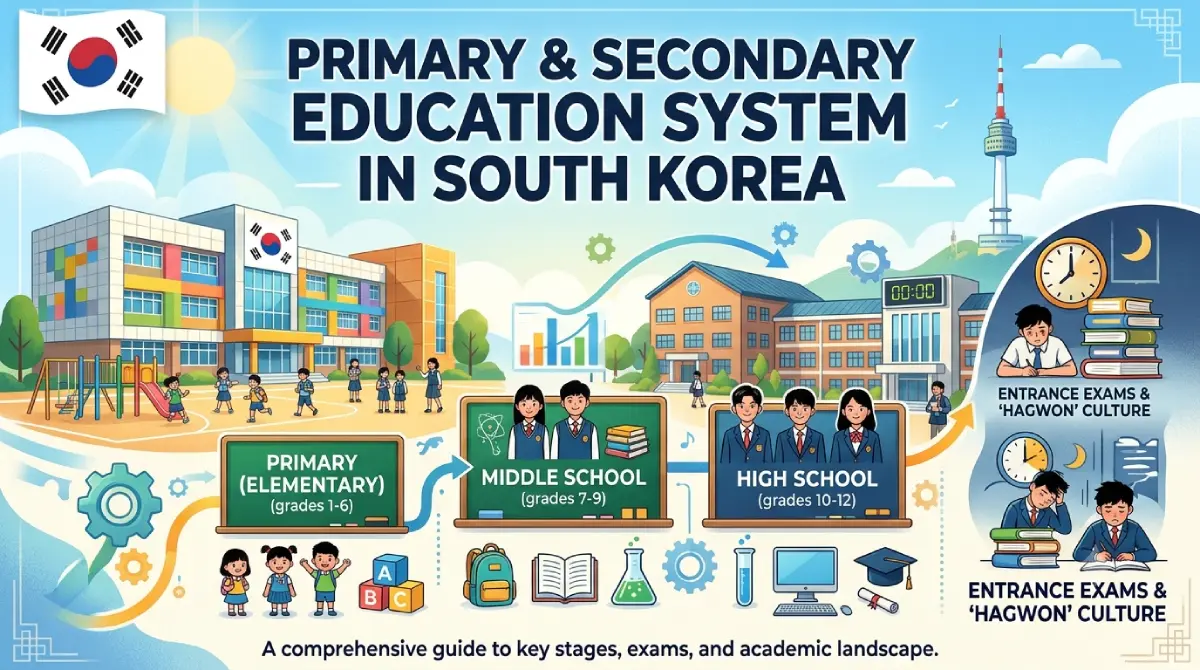
South Korea has built one of the world’s most recognizable education systems, combining widespread access to schooling with demanding academic expectations. Education has contributed significantly to the country’s development from a largely agricultural, war-affected economy into a global center for manufacturing, technology, and innovation.
At the heart of this transformation is a structured school system that provides nine years of compulsory education, followed by three years of high school. Although the basic structure has remained consistent for decades, the curriculum and learning experience continue to evolve.
For families, international students, educators, and individuals comparing qualifications across countries, understanding primary and secondary education in South Korea requires more than knowing the number of school years. It also involves understanding how students progress, what they study, how schools assess achievement, and how educational reforms are changing classroom instruction.
How Is the Education System Structured in South Korea?
South Korea operates a 6-3-3-4 education system, representing six years of elementary school, three years of middle school, three years of high school, and typically four years of university education.
The Ministry of Education establishes national education policies and curriculum standards, while regional education offices administer schools and implement policies within their jurisdictions.
The structure is summarized below:
| Education Level | Duration | Typical Age | Compulsory? |
|---|---|---|---|
| Elementary school | 6 years | 6–12 | Yes |
| Middle school | 3 years | 12–15 | Yes |
| High school | 3 years | 15–18 | No |
| University | Typically 4 years | 18+ | No |
Note: Ages are approximate. Placement depends on the student’s birth date and school-entry rules.
Elementary and middle school together account for nine years of compulsory education. High school is not compulsory, although free high school education was expanded nationwide to all three grades in 2021.
The academic year generally begins in March, with a second semester starting around late August. This differs from the August or September school-year start common in many U.S. school districts.
Understanding these structural differences is particularly important when comparing international academic records. For students seeking recognition of qualifications in the United States, an education credential evaluation can help explain the level and comparability of completed studies.
Elementary Education in South Korea: Grades 1–6
Elementary school provides the foundation for South Korea’s formal education system. Children generally begin Grade 1 in the calendar year they turn six under international age counting, and elementary education continues for six academic years.
Public elementary education is compulsory and tuition-free. Its purpose extends beyond basic literacy and numeracy to include social development, responsible citizenship, physical well-being, and independent learning.
What Subjects Do Elementary Students Study?
The national curriculum includes learning across several subject areas, with content and subject organization varying by grade.
Students encounter:
- Korean language and literacy
- Mathematics
- Social studies and moral education
- Science
- Physical education
- Music and visual arts
- Practical arts in the relevant grades
- English, generally introduced as a formal subject in Grade 3
In the early grades, integrated learning activities help children connect classroom knowledge with everyday experiences. As students progress, lessons become more subject-specific.
Elementary education also emphasizes classroom participation, cooperation, problem-solving, and developing positive learning habits.
How Is Learning Assessed?
Assessment in elementary schools is designed to monitor learning progress rather than prepare students for a single national graduation examination.
Schools may use written assessments, classroom activities, projects, presentations, and teacher observations to evaluate students’ understanding.
The exact approach varies according to grade level, school policies, and regional education guidelines.
Unlike the highly competitive university admissions process, elementary education is primarily concerned with establishing the knowledge and skills students need for subsequent schooling.
Middle School Education in South Korea: Grades 7–9
Middle school represents the second stage of compulsory education and generally serves students between approximately 12 and 15 years of age.
After completing elementary school, students continue into three years of lower secondary education.
This transition introduces greater subject specialization, more demanding coursework, and increased responsibility for academic performance.
Middle School Curriculum
The curriculum builds upon elementary learning while introducing more advanced academic concepts.
Core learning areas include Korean, mathematics, English, science, social studies, history, physical education, arts, technology and home economics, and other curriculum components.
Teachers generally specialize in particular subjects, allowing students to receive instruction from educators with relevant academic expertise.
In addition to classroom subjects, students participate in creative experiential activities, career exploration, and school-based programs designed to support their personal development.
The Free Semester System
One distinctive feature of South Korean middle school education is its emphasis on career exploration through the Free Semester System.
During designated periods, students have opportunities to explore their interests through discussions, practical activities, collaborative projects, and career-related experiences.
These activities are intended to reduce excessive reliance on conventional written testing during the designated period and encourage students to consider their strengths and future educational pathways.
Implementation details have evolved alongside national curriculum reforms, so the experience may differ between schools and student cohorts.
Transitioning From Middle School to High School
After completing Grade 9, students may apply to different types of high schools based on their educational interests, career plans, and applicable admission requirements.
Admission procedures vary by region and school category. Some schools use allocation arrangements, while others have more selective admissions processes.
This stage is particularly important because the choice of high school can influence subject options, vocational preparation, and university admissions planning.
High School Education in South Korea: Grades 10–12
High school provides three years of upper secondary education. Although attendance is not legally compulsory, participation is widespread.
According to the South Korean Ministry of Education, the high school enrollment rate was 94.5% in 2022. This is a historical reference figure, not a claimed 2026 enrollment rate.
The country offers several types of high schools to accommodate different educational goals.
General High Schools
General high schools provide a broad academic education, typically preparing students for university, college, or other postsecondary opportunities.
Students study common academic subjects while choosing additional courses that reflect their interests and future plans.
Korean, mathematics, English, social studies, and science remain important areas of study, alongside physical education, arts, and elective learning.
The introduction of the high school credit system has made individual subject selection increasingly important.
Vocational High Schools
Vocational high schools combine general education with occupational and technical learning.
Programs may focus on areas such as engineering, information technology, business, agriculture, and other industry-related fields, depending on the institution.
Students may receive practical instruction, participate in industry-related activities, and develop skills relevant to employment or further education.
Graduates can pursue employment, continue into higher education, or explore additional professional training.
Vocational education is therefore an alternative educational pathway rather than simply a less academically demanding version of general high school.
Special-Purpose and Specialized High Schools
South Korea also has schools serving students with particular academic or professional interests.
Depending on the school category, these may emphasize science, foreign languages, international studies, arts, sports, or other specialized areas.
Admission to certain institutions can be selective, and students may need to satisfy specific academic or aptitude-related requirements.
These schools should not be confused with vocational high schools, since their educational objectives and admission systems can differ substantially.
South Korea’s High School Credit System
One of the most significant developments in Korean secondary education is the implementation of the High School Credit System, introduced nationwide for incoming first-year high school students in 2025.
Under this approach, students have greater opportunities to select subjects based on academic interests and career goals.
Instead of following an entirely uniform timetable, students complete a combination of required and elective courses while accumulating credits toward graduation.
The system is intended to strengthen personalized learning and provide more meaningful subject choices.
However, implementation has also raised practical questions about staffing, course availability, assessment, and the ability of smaller schools to offer diverse electives.
In January 2026, national curriculum regulations were amended to ease certain high school credit-completion requirements, demonstrating that the system continues to be adjusted as schools implement it.
The credit system is an important distinction for anyone examining recent Korean high school transcripts, since the organization of courses and graduation requirements may differ from those of earlier graduates.
South Korea’s 2022 Revised National Curriculum
The 2022 Revised National Curriculum represents another major development in primary and secondary education.
Rather than changing the established six-three-three school structure, the reform updates what students learn and how schools organize educational experiences.
Its broader objectives include strengthening digital literacy, responding to social and technological change, supporting student choice, and developing competencies relevant to future learning.
Implementation has been phased in by grade.
| Academic Year | Grades Covered by the Revised Curriculum |
|---|---|
| 2024 | Elementary Grades 1–2 |
| 2025 | Elementary Grades 1–4, Middle Grade 1, High Grade 1 |
| 2026 | Elementary Grades 1–6, Middle Grades 1–2, High Grades 1–2 |
| 2027 | All elementary, middle, and high school grades |
These phases reflect the official implementation schedule, with subsequent amendments to specific curriculum provisions.
The reforms do not mean every school has identical classroom practices. Schools continue to operate within national requirements while adapting teaching and activities to local conditions.
Academic Assessment and University Entrance Examinations
Academic performance plays an important role in South Korean secondary education, particularly for students planning to enter competitive universities.
Schools use assessments and academic records to measure achievement, while universities consider admission criteria that vary by institution and application route.
One of the country’s most recognized examinations is the College Scholastic Ability Test, commonly called the Suneung or CSAT.
The examination is associated with university admissions and includes subjects such as Korean, mathematics, English, Korean history, and other applicable subject areas.
However, not every university applicant is admitted solely through CSAT results. School records and other selection criteria may also matter, depending on the admissions pathway.
The importance of university admissions has contributed to a competitive academic environment, including substantial participation in private supplementary education.
Private Tutoring and Hagwons in South Korea
Formal schooling is only one part of the Korean educational experience.
Many families also use private educational institutions known as hagwons, which provide supplementary lessons outside regular school hours.
These programs may focus on English, mathematics, science, examination preparation, or other academic and extracurricular subjects.
Hagwons are not a compulsory component of the public education system. Nevertheless, they have become an influential part of how many students prepare for school assessments and university admission.
Private education can create additional opportunities for academic support, but it also raises concerns about household expenses, student workload, and differences in access between families.
Consequently, the relationship between public schooling and private tutoring remains an important education-policy issue.
Special Education and Inclusive Learning
South Korea provides special education services for eligible students with disabilities and additional educational needs.
The legal framework includes provisions for compulsory education covering kindergarten, elementary, middle, and high school for eligible special education students, alongside other forms of educational support.
This differs from the general school system, where compulsory education ordinarily ends after middle school.
Depending on individual needs and eligibility, students may receive education in general schools, special classes, or specialized institutions.
Support can include individualized educational planning, related services, assistive technology, and transition or vocational preparation.
The goal is to improve educational participation and ensure that students receive appropriate learning opportunities.
The availability and delivery of particular services depend on individual circumstances and applicable education regulations.
How Does South Korea’s School System Compare With the United States?
South Korea and the United States both provide elementary and secondary education, but their school structures and administrative arrangements differ.
| Feature | South Korea | United States |
|---|---|---|
| Typical structure | 6 years elementary, 3 middle, 3 high | Commonly K–12, with grade divisions varying by district |
| School-year start | March | Usually August or September |
| Compulsory schooling | Elementary and middle school | Varies by state |
| Curriculum governance | National framework with regional implementation | Primarily state and local governance |
| High school duration | 3 years | Usually 4 years |
| University admissions | Multiple routes, including CSAT-based admissions | Institution-specific criteria |
These differences are relevant when interpreting academic records, especially for students transferring between educational systems.
A completed Korean high school program should not be compared with a U.S. diploma solely by counting years. Educational level, curriculum, completion status, institutional recognition, and the receiving institution’s requirements may also be relevant.
For formal U.S. recognition, students and graduates can explore foreign education evaluation services to understand how their credentials may be assessed.
Recognition of South Korean Academic Credentials in the United States
Students who complete secondary or higher education in South Korea may need their qualifications reviewed when applying to U.S. institutions.
Requirements vary depending on whether the purpose is school admission, college admission, employment, professional licensing, or another application.
A credential evaluation can provide a professional assessment of foreign educational records and their comparability within the U.S. system.
Documents That May Be Requested
Depending on the receiving institution and evaluation purpose, applicants may need academic documents such as:
- Graduation certificates or diplomas
- Academic transcripts or school records
- Dates of attendance and completion
- Course and grading information
- English translations where required
For Korean university graduates, a course-by-course evaluation may be useful when a receiving institution requires detailed analysis of postsecondary subjects, grades, credits, and GPA.
This is distinct from a general high school credential assessment. Applicants should confirm which report type their receiving institution requires before ordering an evaluation.
When records are issued in Korean, applicants may also need professional document translation services to prepare the materials for review.
EEE of America offers credential evaluation and translation services for individuals seeking recognition of international qualifications. Applicants can review the available services and contact EEE of America for information about the appropriate evaluation process.
Frequently Asked Questions About Education in South Korea
Is primary education compulsory in South Korea?
Yes. Elementary education consists of six compulsory school years. Together with three years of middle school, it forms the country’s nine-year compulsory education requirement.
Is high school free in South Korea?
Yes, free high school education was expanded to all three grades in 2021 under the national policy. However, high school is not compulsory, and additional expenses or particular school-specific charges may still apply.
What age do students start school in South Korea?
Children generally enter elementary school in the calendar year they turn six under international age counting. Individual enrollment arrangements can affect the exact starting age.
How many years of secondary education are there in South Korea?
Secondary education consists of six years: three years of middle school and three years of high school.
What is the Korean high school credit system?
It is a system that allows students to select courses within graduation requirements and accumulate credits. It was introduced nationwide for incoming first-year high school students in 2025 and is being phased in across cohorts.
Is English taught in Korean elementary schools?
Yes. English is generally introduced as a formal subject from Grade 3, with instruction designed to develop language communication skills appropriate to students’ ages.
Is the South Korean high school diploma equivalent to a U.S. high school diploma?
A completed Korean high school qualification may be considered comparable to U.S. secondary school completion, but formal recognition depends on the credential, educational record, evaluator, and receiving institution. There is no automatic universal equivalency determination for every application.
Can Korean students use their academic qualifications to apply to U.S. universities?
Yes. Students with recognized Korean secondary qualifications can apply to U.S. institutions, subject to the university’s admission requirements. Some institutions may request an academic credential evaluation or translated records.
Conclusion
Primary and secondary education in South Korea combines a clearly defined school structure with an evolving national curriculum.
Six years of elementary education and three years of middle school establish the compulsory foundation. High school then provides general, vocational, and specialized pathways that prepare students for further education, employment, and professional development.
The country’s recent curriculum reforms and high school credit system reflect an effort to move beyond uniform academic instruction toward more flexible learning opportunities.
For international students and graduates, understanding these educational stages is also essential when comparing Korean qualifications with those issued in other countries.
Whether the goal is further study, professional development, or recognition of completed education in the United States, accurate information about the Korean education system provides a stronger foundation for informed decisions.