Quick Answer: The best educational credential evaluators in 2026 are EEE of America (fastest, most affordable), AAE Evaluations (strong for EB-1/NIW petitions), World Education Services, Educational Credential Evaluators (ECE), Josef Silny & Associates, and IERF. All six are accredited by NACES, but they differ sharply on turnaround time, pricing, and which visa or academic use case they specialize in.
Key Takeaways:
- An educational credential evaluator translates a foreign degree into its U.S. equivalent so schools, employers, and USCIS can understand it
- NACES or AICE accreditation is non-negotiable — an unaccredited report can get an application rejected outright
- Turnaround time ranges from 1 business day to 3+ weeks depending on the agency and evaluation type
- Pricing ranges from $55 for a basic document-by-document report to $300+ for course-by-course or specialized visa evaluations
- The “best” evaluator depends on your goal: university admission, H-1B sponsorship, or an EB-1/NIW green card petition each favor a different agency
If you’ve ever tried to hand a foreign diploma to a U.S. university admissions office or an immigration officer, you already know the problem: nobody on the other side of the desk knows what your degree actually means.
A “Licenciatura” from Mexico, a “Bachelor of Technology” from India, or a “Diplom” from Germany doesn’t map cleanly onto the American bachelor’s/master’s/doctorate system — and that gap can stall an admission, a job offer, or a visa petition for months.
That’s the exact problem educational credential evaluation solves. An accredited evaluator reviews your transcripts and degree certificates, compares them against the source country’s education system, and issues a report stating the U.S. equivalent — something a registrar, HR department, or USCIS officer can actually act on.
I’ve reviewed evaluation reports, pricing pages, and processing times across the industry’s major players, and this guide breaks down the six agencies actually worth your money in 2026 — including a newer name, AAE Evaluations, that’s earned a spot on this list for visa-specific work.
What Is an Educational Credential Evaluator?
An educational credential evaluator is a specialized agency — usually a NACES or AICE member — that assesses academic qualifications earned outside the U.S. and determines their equivalency to American degrees, diplomas, or credit hours.
This is sometimes called degree evaluation or foreign credential assessment, and it’s a completely different service from translation. A translation converts language; an evaluation converts educational meaning — grading scale, program length, institutional accreditation, and degree level — into a framework a U.S. institution recognizes.
Three groups request these reports constantly:
- International students applying to U.S. universities or graduate programs
- Immigrants and visa applicants (H-1B, O-1, L-1, EB-1, EB-2 NIW) who need to prove their education meets a job’s requirements
- Licensing boards in fields like nursing, engineering, and teaching that require credential verification before issuing a professional license
Without this report, a university can reject your application on a technicality, and USCIS can deny a petition for “insufficient evidence” — even when your actual education is more than qualified.
Why Choosing the Right Evaluator Actually Matters
Not every evaluation report carries the same weight. USCIS officers and university registrars have seen thousands of these reports, and they know which agencies are accredited members of NACES (National Association of Credential Evaluation Services) or AICE (Association of International Credential Evaluators) — and which aren’t.
Here’s what happens when people skip this step: they use a cheap, unaccredited service, submit the report with their I-140 or university application, and it gets flagged or rejected. Now they’re paying twice — once for the bad report, once for the correct one — and losing weeks they didn’t have.
A credible evaluator does three things a generic service can’t:
- Maintains a research database on thousands of institutions and grading systems worldwide, so the equivalency determination is defensible if questioned
- Issues reports in a format USCIS, universities, and licensing boards specifically recognize
- Stands behind the report with a verifiable, licensed evaluator’s credentials attached
This is the difference between a report that moves your application forward and one that becomes the reason it stalls.
Factors to Consider When Selecting an Evaluator
Before you pick an agency, run it through these five filters:
- Accreditation and Recognition — Confirm the agency is a NACES or AICE member. This single fact determines whether USCIS and most universities will accept the report without question.
- Experience with Your Country’s System — An evaluator who’s assessed hundreds of degrees from your home country will catch nuances (like regional grading scale differences) that a generalist might miss.
- Turnaround Time — Some agencies deliver in 24–48 hours; others take 3+ weeks. If you’re up against a visa deadline or admissions cutoff, this matters more than price.
- Cost — Prices span from around $55 to $300+ depending on evaluation type (document-by-document vs. course-by-course) and rush service.
- Use-Case Specialization — A general academic evaluation and an EB-1/NIW expert opinion letter are different products. Pick an agency that’s actually built for your specific purpose.
The 6 Best Educational Credential Evaluators in 2026
After comparing accreditation status, pricing, turnaround, and specialization across the industry, these six agencies stand out.
1. EEE of America
EEE of America has built its reputation on speed and price — two things that matter enormously when you’re racing a visa or admissions deadline.
Key Highlights:
- Rapid turnaround: Most evaluations complete in 1–2 business days, among the fastest in the industry
- Cost-effective: Education evaluations start at $55; education-with-work-experience evaluations run $105
- Full-service coverage: Beyond basic evaluations, EEE of America handles course-by-course evaluation, work experience evaluation, expert opinion letters for EB-1 and O-1 petitions, and position evaluations
- Personalized support: Direct communication with evaluators throughout the process, rather than a ticket queue
Best for: Applicants who need a fast, accurately priced report without sacrificing accreditation — especially H-1B and general academic use cases.
2. AAE Evaluations
AAE Evaluations has grown quickly into a go-to name for immigration-heavy credential work, particularly for petition types that need more than a basic equivalency report.
Key Highlights:
- Visa-specialized services: Alongside standard education and work experience evaluations, AAE Evaluations offers expert opinion and recommendation letters built specifically for EB-1, EB-2 NIW, H-1B, L-1, and O-1 petitions
- PhD-level evaluators: Opinion letters are written by evaluators with doctoral credentials, which carries weight with USCIS adjudicators reviewing extraordinary-ability or national-interest cases
- Business plan drafting: A less common offering — AAE Evaluations also produces EB-2, EB-5, and O-1 business plans, useful for petitioners who need multiple supporting documents from one source
- Established track record: The agency has evaluated credentials for clients across dozens of nationalities since launching
Best for: EB-1, EB-2 NIW, and other petition-based applicants who need an expert opinion letter alongside — or instead of — a standard credential evaluation.
Worth reading: If you’re deciding between the two, we’ve written a full breakdown comparing The Evaluation Company vs. AAE Evaluations that walks through pricing and turnaround side by side.
3. World Education Services (WES)
Founded in 1974, World Education Services is one of the oldest and most recognized names in the field, having evaluated more than three million credentials.
Key Highlights:
- Massive global database: Research coverage on educational systems from over 200 countries
- Digital-first process: Accepts direct server-to-server transcript files from partner institutions, cutting down on paperwork
- Broader mission work: Runs the WES Gateway Program for refugees and the WES Global Talent Bridge for immigrant workforce integration
- Institutional trust: Works directly with 48,000+ higher education institutions worldwide
Best for: Applicants prioritizing brand recognition and digital transcript delivery, particularly for graduate school admissions.
4. Educational Credential Evaluators (ECE)
Founded in 1976, ECE is a NACES charter member and a Better Business Bureau Torch Award winner for ethics — a signal of long-standing institutional trust.
Key Highlights:
- Solid turnaround: Average of 3–5 business days for standard reports
- High satisfaction rate: ECE reports a 94% customer satisfaction rate among recent applicants
- Philanthropic angle: The ECE® Aid program provides financial assistance to international students through partner institutions
- Consistent standards: Long operating history means predictable, well-documented evaluation methodology
Best for: Applicants who value a long institutional track record and don’t need same-day turnaround.
5. Josef Silny & Associates (JS&A)
Operating since 1966, JS&A is the most tenured agency on this list and one of the few with genuinely deep multilingual capability in-house.
Key Highlights:
- Broadest country coverage: Has evaluated credentials from over 230 countries
- Industry-specific evaluations: Offers specialized reports for nursing, engineering, and teaching licensure — fields with stricter documentation requirements
- In-house multilingual team: Evaluators fluent in 25+ languages, reducing translation back-and-forth
- Institutional partnerships: Works directly with universities, licensing boards, and government agencies
Best for: Licensing-board submissions (especially nursing and engineering) where industry-specific evaluation formats are required.
6. International Education Research Foundation (IERF)
IERF is a nonprofit with a strong reputation for personalized service and profession-specific evaluations.
Key Highlights:
- Full evaluation range: Document-by-document, course-by-course, and professional work experience evaluations
- Profession-specific reports: Tailored evaluations for healthcare, engineering, and teaching credentials
- One-on-one consultation: More individualized guidance than most high-volume competitors offer
- Competitive pricing: Generally positioned as one of the more affordable nonprofit options
Best for: Healthcare and teaching professionals who want direct consultation during the evaluation process.
Quick Comparison Table
| Evaluator | Accreditation | Typical Turnaround | Starting Price | Best For |
|---|---|---|---|---|
| EEE of America | NACES-recognized standards | 1–2 business days | $55 | Speed + affordability |
| AAE Evaluations | NACES-recognized standards | 3–7 business days | Varies by service | EB-1 / EB-2 NIW petitions |
| WES | NACES member | 7–10 business days | ~$100+ | University admissions |
| ECE | NACES charter member | 3–5 business days | ~$100+ | Long-term institutional trust |
| JS&A | NACES member | 5–10 business days | ~$150+ | Nursing/engineering licensure |
| IERF | NACES member | 10–15 business days | ~$135+ | Healthcare/teaching professionals |
Pricing and turnaround vary by evaluation type (document-by-document vs. course-by-course) and rush options — confirm current rates directly with each agency before applying.
How the Credential Evaluation Process Actually Works
Every accredited agency follows roughly the same five-step process, even if the interface and turnaround differ.
Step 1: Application Submission
You submit your personal information, educational background, and the evaluation type you need (document-by-document vs. course-by-course). This decision matters — course-by-course reports break down individual classes and grades and are usually required for graduate admissions or licensing boards; document-by-document reports simply confirm the degree equivalency and suit most visa and general employment cases.
Step 2: Document Submission
You provide official transcripts, degree certificates, and any academic records. If your documents aren’t in English, most agencies require a certified translation first — a service EEE of America also provides in-house.
Step 3: Evaluation
The agency’s evaluators compare your credentials against their institutional research database, checking grading scale, program length, and accreditation status in the source country.
Step 4: Report Generation
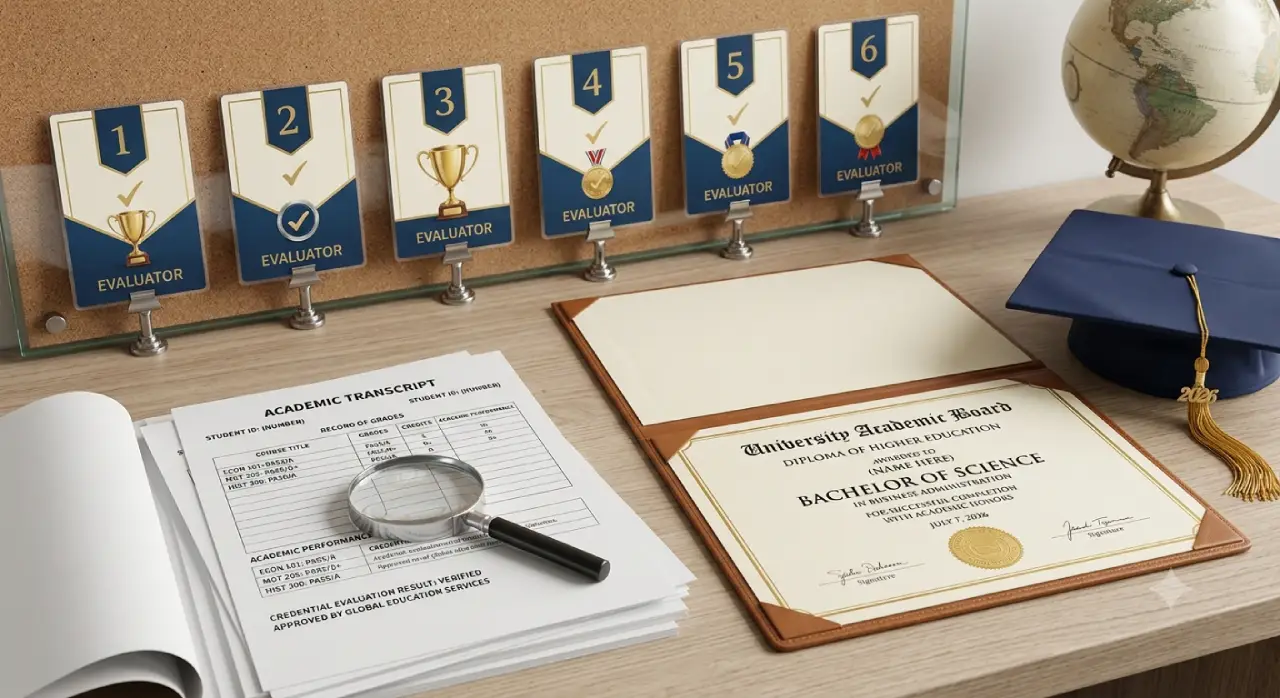
The agency issues a formal report stating the U.S. equivalent degree, along with institutional details and the evaluator’s supporting credentials.
Step 5: Report Delivery
Reports are sent to you directly, or to the specific institution or agency you designate — universities, employers, or USCIS.
A mistake I see constantly: applicants submit incomplete transcripts (missing a semester, or a program-transfer record) and the agency has to pause the evaluation to request the missing document. That single gap can add a week or more to your timeline. Before you submit anything, request a complete academic transcript from your registrar — not just your final diploma.
How to Interpret Your Evaluation Report
Once your report arrives, it should include four core sections:
- Equivalent Degree or Credential — the U.S. degree level your foreign education corresponds to (e.g., “equivalent to a Bachelor of Science”)
- Institution Details — dates of attendance and a profile of the institution you attended
- Program Information — entrance criteria, institutional accreditation status, and typical program length
- Evaluator’s Qualifications — the credentials and references used to reach the determination
Read this carefully before submitting it anywhere. If the equivalency looks lower than expected — say, a four-year engineering degree evaluated as an associate’s equivalent — contact the agency immediately. Most accredited evaluators allow clarification requests or re-review if you can provide additional institutional documentation. Don’t submit a report you think is wrong and hope it gets accepted anyway; a flawed report attached to a USCIS petition is far harder to fix after the fact than before submission.
Common Mistakes That Delay or Derail an Evaluation
I’ve seen the same handful of errors trip up applicants over and over — most of them are avoidable if you know to watch for them.
- Choosing an unaccredited agency to save $20. This is the single costliest mistake on this list. An unrecognized report gets rejected, and you end up paying for a second, correct evaluation while your deadline keeps moving closer.
- Requesting the wrong evaluation type. Applicants frequently order a document-by-document report when their target institution or licensing board actually requires course-by-course. Always confirm which type the receiving institution needs before you pay.
- Submitting transcripts instead of official transcripts. A photocopy or a student-printed transcript often isn’t accepted — most agencies require documents sent directly from the issuing institution, or notarized copies at minimum.
- Skipping certified translation. If your documents aren’t in English, the evaluation can’t proceed until a certified translation is attached. Build that extra step into your timeline rather than discovering it mid-process.
- Assuming all evaluators handle your country the same way. Grading scales and degree structures vary enormously — a “First Class Honours” degree from one country’s system doesn’t equate the same way as another’s. Confirm the agency has specific experience with your country before committing.
- Waiting until the deadline is close. Even a 1–2 day turnaround agency can hit delays if documents are incomplete. Start the process at least three to four weeks before you actually need the report in hand.
Avoiding these six mistakes alone will save most applicants more time than switching between agencies ever will.
Where You’ll Actually Use This Report
- Academic Admissions — Proves your foreign credentials meet a university or graduate program’s entry requirements
- Employment — HR departments use it to confirm you meet a role’s minimum education requirement
- Professional Licensing — Nursing, engineering, and teaching boards typically require a credential evaluation before issuing licensure
- Immigration — Employment-based visa petitions (H-1B, O-1, L-1) and green card categories like EB-1 and EB-2 NIW require it as supporting evidence, often alongside an expert opinion letter
Frequently Asked Questions
What is the difference between a document-by-document and course-by-course evaluation?
A document-by-document evaluation confirms your overall degree equivalency — useful for most visas and general employment. A course-by-course evaluation breaks down every individual class, credit hour, and grade, which graduate schools and licensing boards typically require.
How long does an educational credential evaluation take?
It ranges from 1–2 business days at faster agencies like EEE of America to 2–3 weeks at higher-volume nonprofits. Rush service is available at most agencies for an added fee.
How much does a credential evaluation cost?
Basic document-by-document evaluations start around $55–$100. Course-by-course, work experience, or specialized visa evaluations typically run $105–$300+.
Is NACES accreditation required?
It’s not legally required everywhere, but it’s the de facto standard USCIS officers, universities, and licensing boards look for. An evaluation from a non-accredited agency carries real risk of rejection.
Can I use a credential evaluation for an H-1B visa?
Yes — H-1B petitions frequently require an education evaluation for H-1B visa applications when the beneficiary’s degree is foreign, particularly if work experience is being used to supplement an incomplete degree.
What’s the difference between a credential evaluation and an expert opinion letter?
A credential evaluation states degree equivalency. An expert opinion letter, required for EB-1, EB-2 NIW, and O-1 petitions, is a more detailed analysis written by a subject-matter expert assessing your specific qualifications and contributions to your field — agencies like AAE Evaluations and EEE of America both offer this as a separate service.
Can my credential evaluation be rejected by USCIS?
Yes, most commonly when the issuing agency isn’t NACES/AICE accredited, or when the report has inconsistencies with submitted transcripts. Using an accredited evaluator and double-checking your report before submission largely eliminates this risk.
Do I need separate evaluations for different visa types?
Not always — a single degree evaluation can often support multiple petition types, but expert opinion letters are typically petition-specific and need to be tailored to the visa category you’re filing under.
Which evaluator is fastest?
EEE of America currently offers the fastest standard turnaround in this comparison, at 1–2 business days for most evaluation types.
Choosing the Right Evaluator for Your Situation
There’s no single “best” evaluator — there’s a best evaluator for what you’re actually trying to accomplish.
If you need a fast, affordable report for a general employment or academic use case, EEE of America delivers that combination better than anyone on this list — most clients have a completed evaluation in hand within two business days, at some of the lowest pricing in the industry. If you’re deep into an EB-1 or EB-2 NIW petition and need an expert opinion letter alongside your evaluation, AAE Evaluations is a legitimate specialist worth comparing against.
Whichever agency you choose, don’t skip the accreditation check, and don’t submit incomplete transcripts hoping the agency will sort it out — that single step is what separates a two-day turnaround from a two-week delay.
Ready to get your evaluation moving? Get started with EEE of America and most applicants receive their report within 1–2 business days — trusted by international students and immigration petitioners across the country.